
We read your photo as:
How do you find the factor 'n' to determine the molecular formula from the empirical formula, using an example like CH2 and a molecular mass of 70?
Chemistry
ScanSolve AI Answer
Answer
You're asking about Step 2 in Problem 1, part b, which determines the factor 'n' to find the molecular formula.
Here's a detailed explanation:
- Empirical Formula: This is the simplest whole-number ratio of atoms in a compound. For example, if a compound has 2 carbons and 4 hydrogens, its empirical formula is .
- Molecular Formula: This is the actual number of atoms of each element in a molecule of the compound. For the example above, if the actual molecule has 4 carbons and 8 hydrogens, its molecular formula is . Notice that is .
The molecular formula is always a whole-number multiple of the empirical formula. This whole number is what we call 'n'.
To find 'n', we use the masses:
In :
- We found the empirical formula in part (a) to be .
- We calculated the empirical formula mass of : .
- The problem statement gives the molecular mass as .
So, to find 'n':
This means the actual molecule is 5 times larger than the empirical formula unit. Therefore, the molecular formula is , which simplifies to .
Was this helpful?
Still stuck on this one?
Ask a follow-up, and the answer starts from this question.
Got a different question?Ask your own question
More Chemistry Questions
QThe empirical formula of a compound is CH2O. Which of the following could be its relative molecular…QA hydrocarbon has 86% carbon and 14% hydrogen and a molecular mass of 70. Determine its empirical…QA hydrocarbon has an empirical formula of CH2. Its density at r.t.p. is 0.001167 g/cm3. [1] a)…QMolecular formula not empirical formulaQDetermine the empirical and molecular formulas of a compound with C: 35%, H: 6.6%, Br: 58.4%. Also…
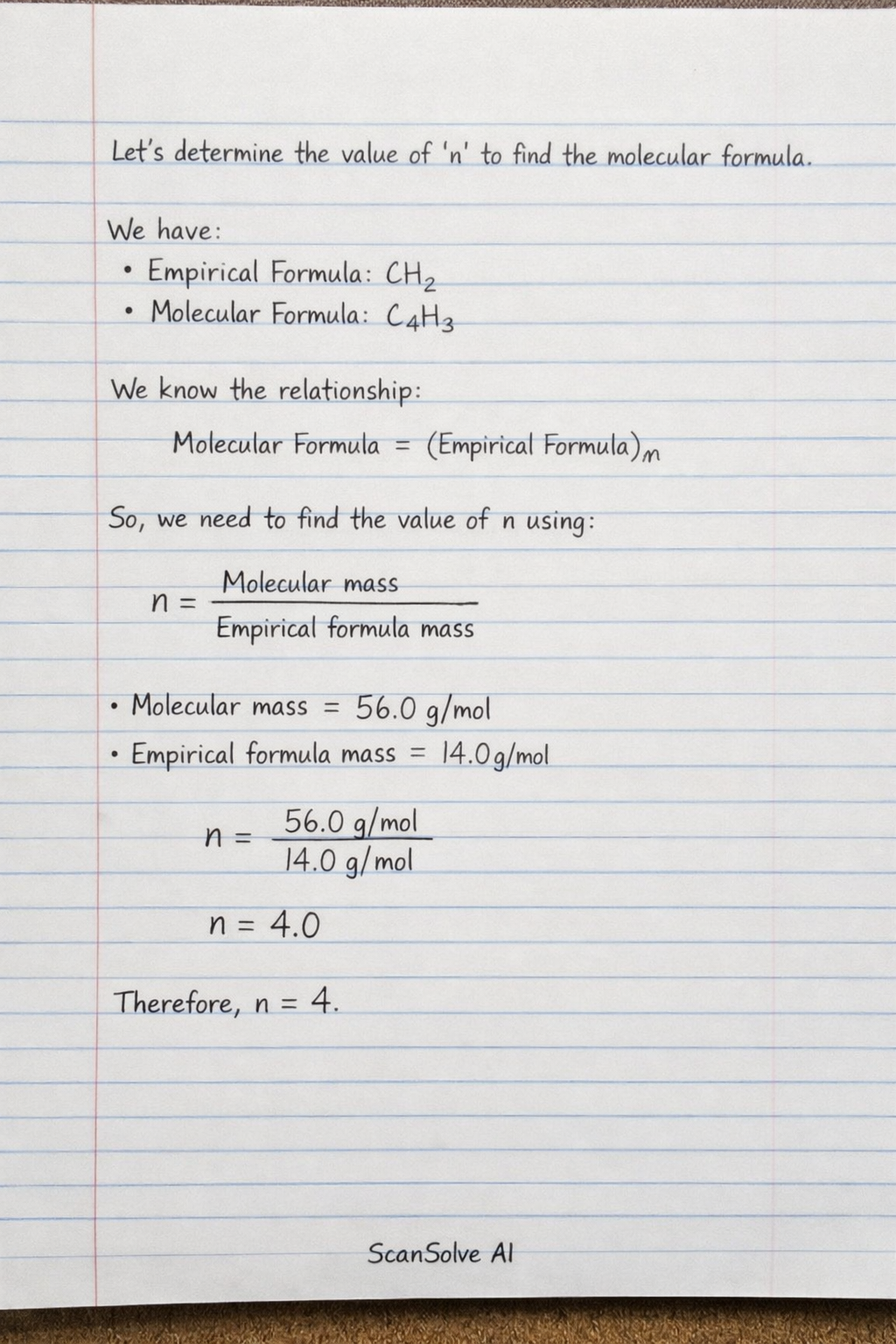
Handwritten Step-by-Step Solution
Get this as a handwritten image on WhatsApp — like a tutor wrote it for you.
Try on WhatsApp