
We read your photo as:
Determine the empirical and molecular formulas of a compound with C: 35%, H: 6.6%, Br: 58.4%. Also, how to test for Br?
ScanSolve AI Answer
This answer stops before the end.
It was cut off when it was first written. Ask ScanSolve this question again for the full working.
Step-by-step solution
6 stepsPart i· 3 steps
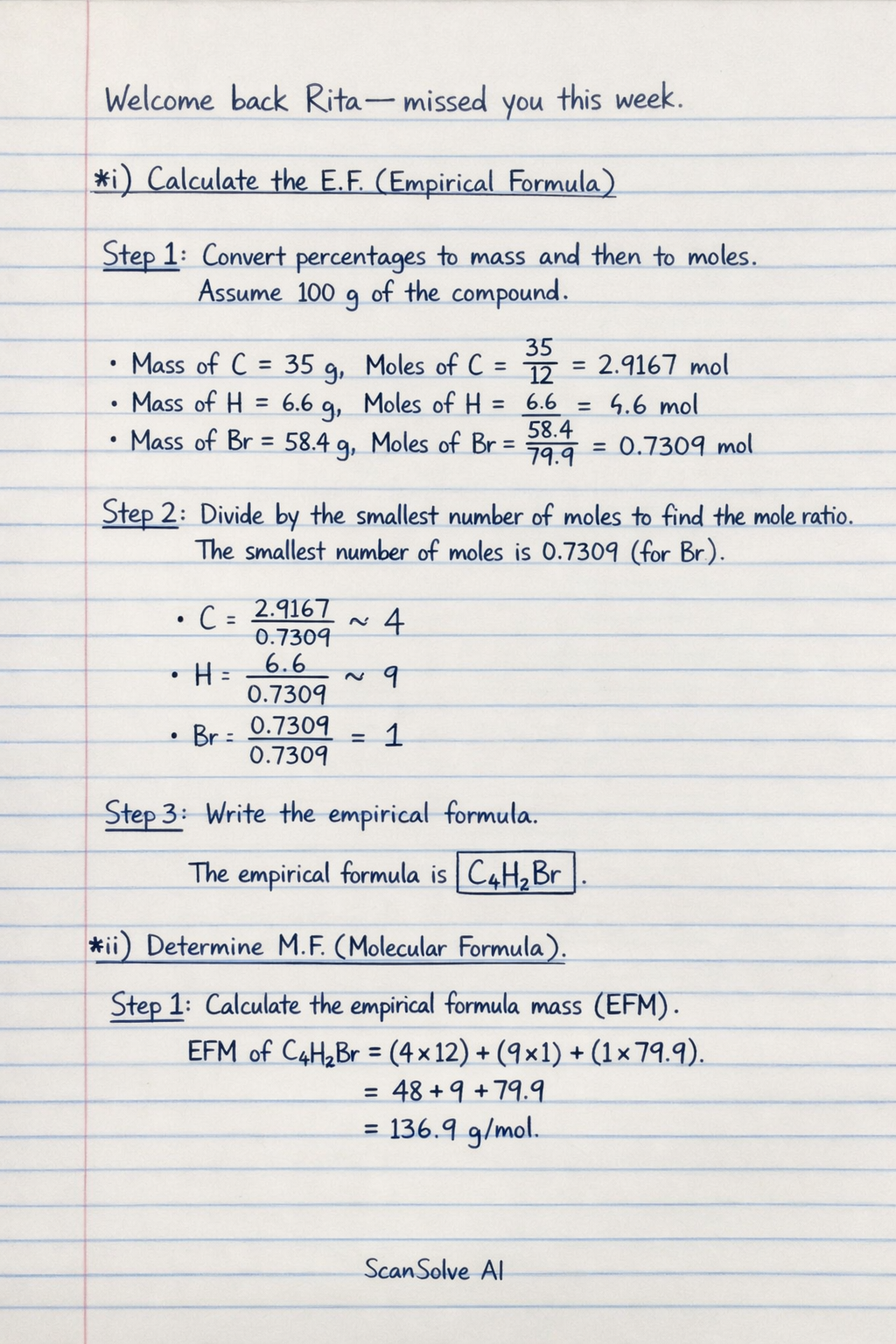
Calculate the E.F (Empirical Formula)
Convert percentages to mass and then to moles.
Assume 100 g of the compound.
- Mass of C = 35 g, Moles of C = mol
- Mass of H = 6.6 g, Moles of H = mol
- Mass of Br = 58.4 g, Moles of Br = mol
Divide by the smallest number of moles to find the mole ratio.
The smallest number of moles is 0.7309 (for Br).
- C:
- H:
- Br:
Write the empirical formula.
The empirical formula is .
Part ii· 3 steps
Determine M.F (Molecular Formula)
Calculate the empirical formula mass (EFM).
EFM of g/mol.
Determine the ratio () of molecular mass to empirical formula mass.
Given molecular mass = 136.9 g/mol.
Calculate the molecular formula.
Molecular Formula = .
Part iii
How can you test for the presence of Bromine in the compound?
The presence of bromine can be tested using the Lassaigne's test (sodium fusion test) followed by the silver nitrate test. First, the organic compound is heated with sodium metal to convert covalent bromine into ionic bromide. The resulting solution is then acidified with dilute nitric acid and treated with silver nitrate solution. The formation of a pale yellow precipitate of silver bromide (), which is sparingly soluble in dilute ammonia but soluble in concentrated ammonia, confirms the presence of bromine.
Part iv
Which spectroscopic method will be used to identify the position of hydrogen in Y?
Nuclear Magnetic Resonance (NMR) spectroscopy, specifically H NMR, is used to identify the position and chemical environment of hydrogen atoms (protons) in an organic compound.
Part v
If Y is a solid, how will you determine its purity?
The purity of a solid compound is determined by measuring its melting point. A pure solid will have a sharp, characteristic melting point over a narrow temperature range. Impurities will cause the melting point to be lowered and the melting range to broaden.
Part vi
Draw the geometric isomers of the compound CH(Br)=CH(Br)
The compound is 1,2-dibromoethene. It exhibits geometric isomerism (cis-trans isomerism) because each carbon atom of the double bond is attached to two different groups (H and Br).
- cis-1,2-dibromoethene:
\begin{array}{cc}
H & H \\
  \backslash & / \\
\text{Still stuck on this one?
Ask a follow-up, and the answer starts from this question.
More Chemistry Questions
Handwritten Step-by-Step Solution
Get this as a handwritten image on WhatsApp — like a tutor wrote it for you.
Try on WhatsApp