
We read your photo as:
How do you prepare a 250 cm³ of 0.1 M Na₂CO₃(aq) standard solution and use it for titration?
Chemistry
ScanSolve AI Answer
Step-by-step solution
4 stepsHere are the steps to prepare the standard solution and use it for titration:
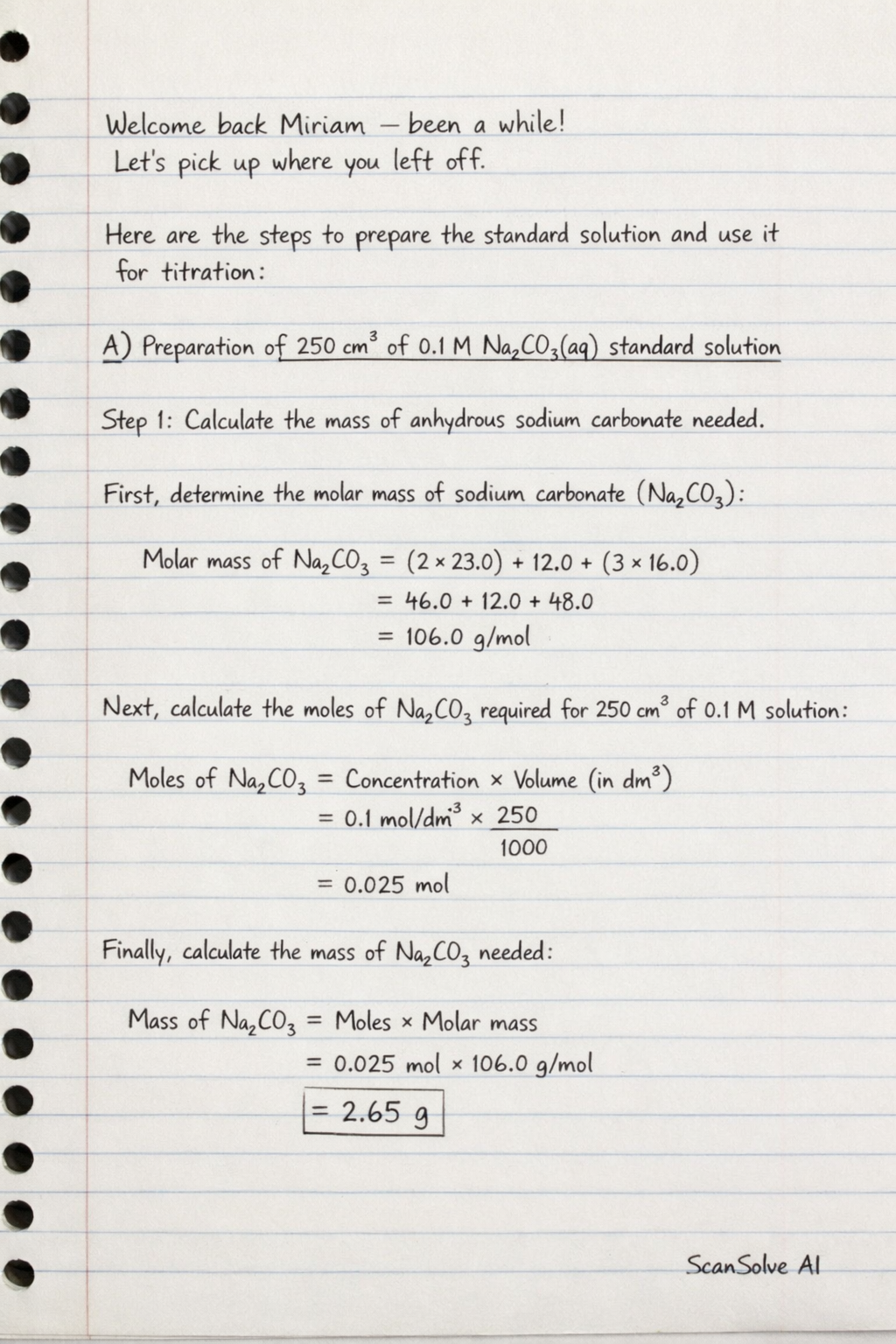
A) Preparation of 250 cm³ of 0.1 M Na₂CO₃(aq) standard solution
Calculate the mass of anhydrous sodium carbonate needed.
First, determine the molar mass of sodium carbonate ().
Next, calculate the moles of required for 250 cm³ of 0.1 M solution.
Finally, calculate the mass of needed.
Procedure for preparing the standard solution.
- Accurately weigh out 2.65 g of anhydrous sodium carbonate using a weighing boat and an electronic balance.
- Transfer the weighed sodium carbonate into a beaker and dissolve it in a small amount (e.g., 50 cm³) of distilled water, stirring with a glass rod.
- Carefully transfer the solution from the beaker into a 250 cm³ volumetric flask using a funnel.
- Rinse the beaker and the funnel several times with small portions of distilled water, adding all washings to the volumetric flask to ensure complete transfer of the solute.
- Add distilled water to the volumetric flask until the bottom of the meniscus is exactly on the 250 cm³ mark at eye level.
- Stopper the volumetric flask and invert it several times to ensure the solution is thoroughly mixed and homogeneous.
B) Using the standard solution to determine the concentration of dilute sulphuric acid
Titration procedure.
- Rinse a burette with dilute sulphuric acid and then fill it with the acid, ensuring no air bubbles are trapped. Record the initial burette reading.
- Using a pipette, transfer exactly 25.0 cm³ of the prepared 0.1 M standard solution into a clean conical flask.
- Add 2-3 drops of phenolphthalein indicator to the sodium carbonate solution in the conical flask. The solution will turn pink.
- Place the conical flask on a white tile under the burette. Slowly add the dilute sulphuric acid from the burette into the conical flask, swirling the flask constantly.
- Continue adding the acid drop by drop until the pink color just disappears, indicating the endpoint of the titration.
- Record the final burette reading and calculate the volume of acid used (titre).
- Repeat the titration several times to obtain at least two concordant titres (volumes that are within of each other). Calculate the average of these concordant titres.
Calculation of sulphuric acid concentration.
- Write the balanced chemical equation for the reaction: From the equation, the mole ratio of is 1:1.
- Calculate the moles of used in the titration:
- Using the 1:1 mole ratio from the balanced equation, the moles of reacted are equal to the moles of .
- Calculate the concentration of dilute sulphuric acid:
Was this helpful?
Still stuck on this one?
Ask a follow-up, and the answer starts from this question.
Got a different question?Ask your own question
More Chemistry Questions
QOutline 3 key steps to prepare a standard solution of sodium carbonate, state a precaution, identify…QWhat is a standard solution? What mass of sodium carbonate (Na2CO3) is needed to prepare 500 cm3 of…QDefine a standard solution. (i) How would you prepare 500 cm³ of 0.2 mol/dm³ sodium carbonate…QWhat apparatus is needed to prepare 250 cm³ of 0.1 mol dm⁻³ sodium trioxocarbonate(IV) solution, and…QA student prepares a solution by taking 5.0 cm³ of 0.1 M NaOH and diluting it with distilled water…
Handwritten Step-by-Step Solution
Get this as a handwritten image on WhatsApp — like a tutor wrote it for you.
Try on WhatsApp