
We read your photo as:
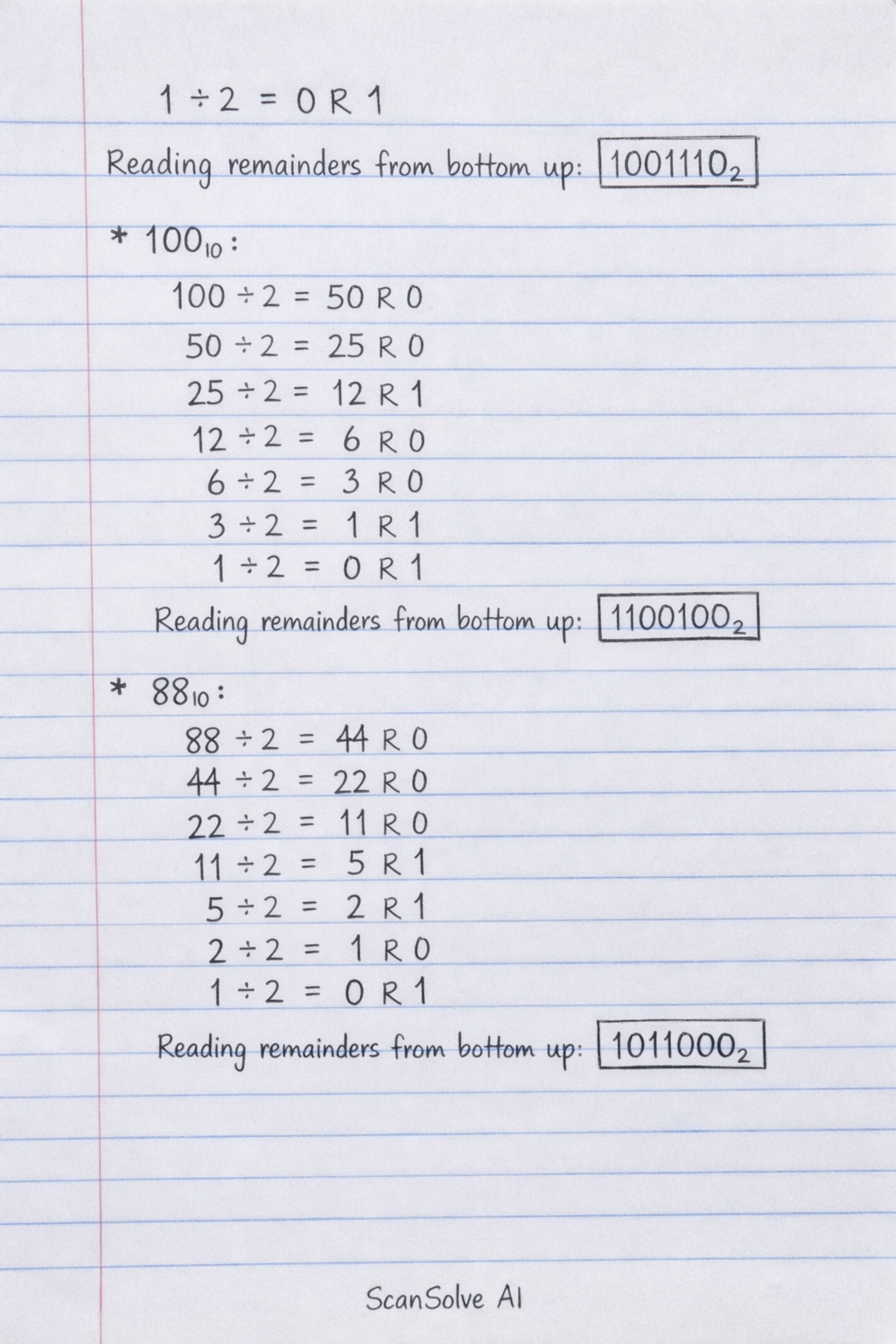
What is a binary number system? Convert the following numbers i. decimal numbers into binary numbers 50, 78, 100, 88 ii. binary numbers into decimal numbers 1101101 10001 101 010 1000001 iv. 8826
ScanSolve AI Answer
This answer stops before the end.
It was cut off when it was first written. Ask ScanSolve this question again for the full working.
Here are the solutions to the questions:
Question 1:
-
1a) What is a binary number system? A binary number system is a base-2 numeral system that uses only two symbols: 0 and 1. It is the fundamental language of computers and digital electronics, where 0 represents an "off" state and 1 represents an "on" state.
-
1b) Convert the following numbers:
-
i. Decimal to Binary:
- : Reading remainders from bottom up:
- : Reading remainders from bottom up:
- : Reading remainders from bottom up:
- : Reading remainders from bottom up:
-
ii. Binary to Decimal:
- :
- :
- :
- :
-
-
1c) Represent the following decimal numbers into Binary Coded Decimal (BCD):
- i. : Each decimal digit is converted to its 4-bit binary equivalent. Result:
- ii. : Result:
- iii. : Result:
- iv. : Result:
Question 2:
-
2a) Differentiate between a Bit and a Byte and state five (5) basic types of logic gate and support your answer with truth table of each logic gate
-
Bit vs. Byte: A bit (binary digit) is the smallest unit of data in a computer, representing either a 0 or a 1. A byte is a unit of digital information that typically consists of 8 bits, and it is the smallest addressable unit of memory in most computer architectures.
-
Five Basic Logic Gates and their Truth Tables:
- AND Gate:
A B Y 0 0 0 0 1 0 1 0 0 1 1 1 - OR Gate:
A B Y 0 0 0 0 1 1 1 0 1 1 1 1 - NOT Gate (Inverter):
A Y 0 1 1 0 - NAND Gate:
A B Y 0 0 1 0 1 1 1 0 1 1 1 0 - NOR Gate:
A B Y 0 0 1 0 1 0 1 0 0 1 1 0
- AND Gate:
-
-
2b) Explain what is meant by a digital logic level? A digital logic level refers to the specific voltage range used to represent a binary 0 (low logic level) or a binary 1 (high logic level) in a digital circuit. These defined voltage ranges ensure reliable distinction between the two states, preventing misinterpretation of signals.
-
2c) Determine the output of A and B in terms of NOT, NAND, NOR, AND and OR gate operations, given that A = 0, 1, 0, 0, 1, 1 and B = 0, 0, 1, 1, 1,
-
Assumption: The sequence for B is incomplete. Assuming B has 6 values and the last value is 1, so B = [0, 0, 1, 1, 1, 1].
-
Given: and
-
NOT A:
-
NOT B:
-
A AND B:
-
A OR B:
-
A NAND B:
-
A NOR B:
-
Question 3:
-
3a) State the following i. Distributive Law ii. Absorptive Law iii. Associative Law
- i. Distributive Law:
- ii. Absorptive Law:
- iii. Associative Law:
-
3b) Design a digital counter to sequence through the following numbers using JK flip flop 0, 2, 4, 3, 6, 7, 0
-
The sequence is . This requires 3 JK flip-flops ().
-
Step 1: State Table (Present State, Next State, JK Inputs)
000 010 0X 1X X0 010 100 1X X1 X0 100 011 X1 01 1X 011 110 1X X0 X1 110 111 X0 X0 1X 111 000 X1 X1 X1 001 (unused) XXY XX XX XX 101 (unused) XXY XX XX XX -
Step 2: K-Maps and Simplified Boolean Expressions for JK Inputs Using K-maps for each and input (considering unused states as don't cares 'X'):
-
Step 3: Circuit Diagram (Conceptual Description) The counter circuit consists of three JK flip-flops () with outputs .
- is connected to .
- is connected to an OR gate with inputs and .
- is connected to an AND gate with inputs and .
- is connected to an OR gate with inputs and .
- is connected to an OR gate with inputs and .
- is connected to an AND gate with inputs and . All flip-flops share a common clock input.
-
-
3c) Briefly explain what is meant by flip flop A flip-flop is a fundamental building block of digital electronic circuits, capable of storing a single bit of binary data (0 or 1). It is a sequential logic circuit that has two stable states and can be used to store state information, making it a basic memory element.
Question 4:
-
4a) What is Karnaugh map and state six (6) properties of Karnaugh map
-
Karnaugh Map (K-map): A Karnaugh map is a graphical method used to simplify Boolean algebra expressions. It arranges the truth table values in a grid such that adjacent cells differ by only one bit, allowing for visual identification and grouping of terms to minimize the expression.
-
Six Properties of Karnaugh Map:
- Adjacency: Cells that are physically adjacent (horizontally or vertically) differ by only one bit. This also applies to cells on opposite edges (wrap-around).
- Grouping: Groups of 1s (or 0s) must be rectangular or square, and their size must be a power of 2 (1, 2, 4, 8, etc.).
- Largest Groups: Always aim to form the largest possible groups of 1s to achieve maximum simplification.
- Minimum Groups: Use the minimum number of groups necessary to cover all the 1s in the map.
- Overlapping: Groups can overlap, meaning a 1 can be part of multiple groups, which can help in forming larger groups.
- Don't Cares: "Don't care" conditions (X) can be included in groups to make them larger, but they do not need to be covered if they don't help in simplification.
-
-
4b) Place "HIGH" logic in the Karnaugh Map where each product term = "1" for the following expressions
- i.
The 1s (HIGH logic) are placed in the cells corresponding to the minterms:
- :
- :
- : The K-map with 1s: | | 0 | 1 | |------------------|----|----| | 00 | 1 | 1 | | 01 | 0 | 1 | | 11 | 1 | 1 | | 10 |
- i.
The 1s (HIGH logic) are placed in the cells corresponding to the minterms:
Still stuck on this one?
Ask a follow-up, and the answer starts from this question.
More Computer Science Questions
Handwritten Step-by-Step Solution
Get this as a handwritten image on WhatsApp — like a tutor wrote it for you.
Try on WhatsApp