
We read your photo as:
A) Convert the following: i) Decimal 45 to binary. ii) Binary 101101 to decimal. b) Define the following terms: i) Bit ii) Byte iii) Character set
ScanSolve AI Answer
Answers
2 partsHere are the solutions to question 18:
a) Convert the following:
i) Decimal 45 to binary.
To convert decimal 45 to binary, we repeatedly divide by 2 and record the remainders:
Reading the remainders from bottom to top gives the binary equivalent.
The binary representation of decimal 45 is .
ii) Binary 101101 to decimal.
To convert binary 101101 to decimal, we multiply each digit by the corresponding power of 2:
The decimal representation of binary 101101 is .
b) Define the following terms:
i) Bit
A bit is the smallest unit of data in a computer, represented by a binary value of either 0 or 1.
ii) Byte
A byte is a unit of digital information that most commonly consists of eight bits. It is often the smallest addressable unit of memory in computer architectures.
iii) Character set
A character set is a defined list of characters (like letters, numbers, and symbols) that a computer can recognize and process, along with their corresponding numerical codes.
c) Explain three advantages of using binary system in computers.
- Simplicity and Reliability: The binary system uses only two states (0 and 1), which can be easily represented by electrical signals (on/off, high/low voltage). This makes electronic circuits simpler to design and more reliable in operation.
- Noise Immunity: The distinct difference between the two states (0 and 1) makes the system highly resistant to electrical noise and interference, ensuring data integrity.
- Logical Operations: Binary numbers are perfectly suited for implementing Boolean logic (AND, OR, NOT gates), which forms the fundamental basis of all digital computation and decision-making processes within a computer.
d) Differentiate between ASCII and Unicode.
- ASCII (American Standard Code for Information Interchange): An older character encoding standard that uses 7 bits to represent 128 characters, primarily English letters, numbers, and basic symbols. It is limited in its ability to represent characters from other languages.
- Unicode: A modern and comprehensive character encoding standard that aims to represent every character from every language in the world. It uses a variable number of bits (typically 8, 16, or 32 bits per character) to support a vast range of characters, including emojis and symbols.
Try one yourself
A new problem that tests the same skill.
Still stuck on this one?
Ask a follow-up, and the answer starts from this question.
More Computer Science Questions
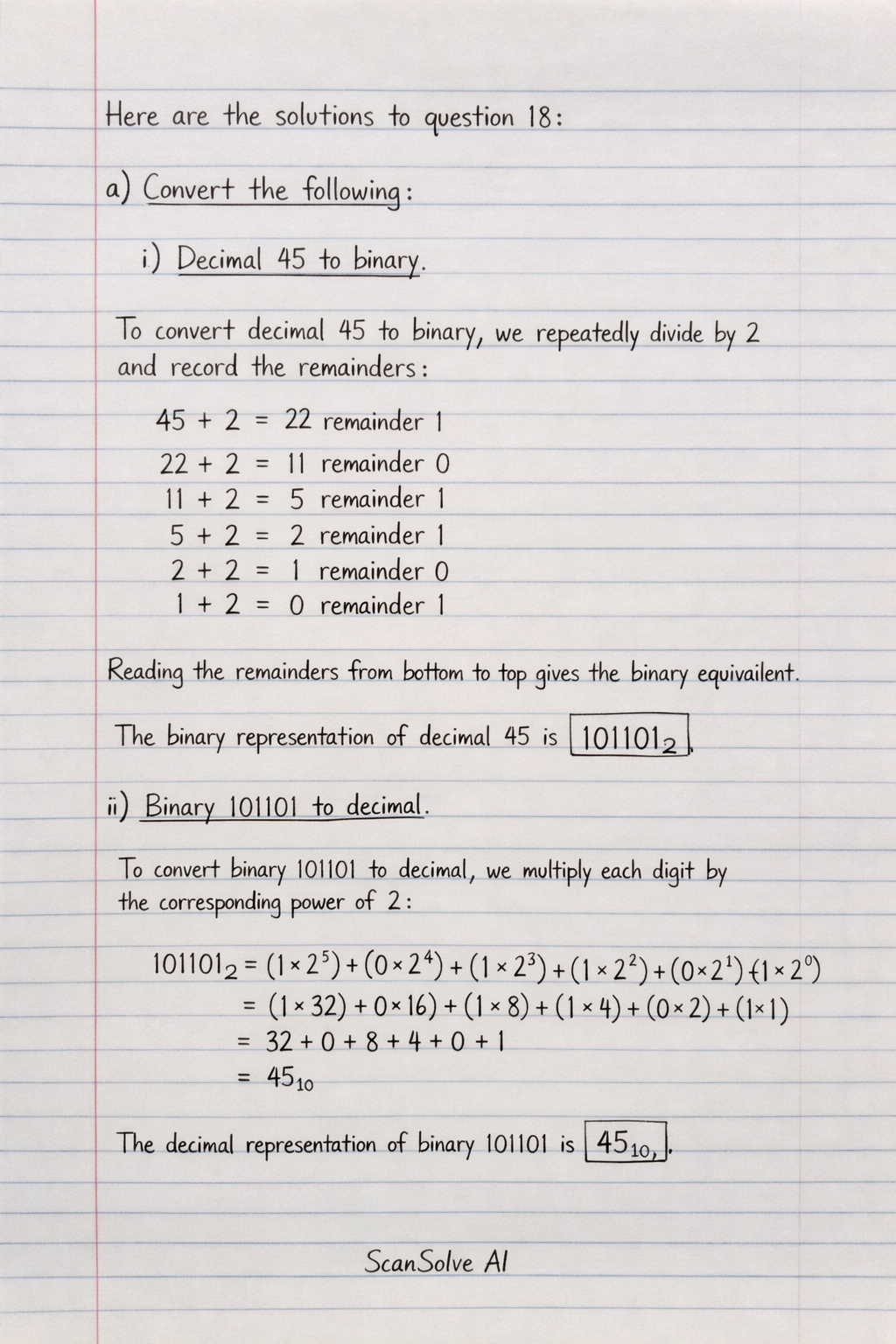
Handwritten Step-by-Step Solution
Get this as a handwritten image on WhatsApp — like a tutor wrote it for you.
Try on WhatsApp