
We read your photo as:
Convert decimal integers to binary, octal, and hexadecimal.
ScanSolve AI Answer
Answers
3 partsStep-by-step solution
15 stepsHere are the solutions to your questions.
QUESTION ONE
Part a· 6 steps
Convert into binary
To convert a decimal integer to binary, we repeatedly divide the decimal number by 2 and record the remainders. We then read the remainders from bottom to top.
Divide 57 by 2.
R 1
Divide 28 by 2.
R 0
Divide 14 by 2.
R 0
Divide 7 by 2.
R 1
Divide 3 by 2.
R 1
Divide 1 by 2.
R 1
Reading the remainders from bottom to top gives the binary equivalent.
Part b
Convert into octal
To convert a decimal integer to octal, we repeatedly divide the decimal number by 8 and record the remainders. We then read the remainders from bottom to top.
Divide 4937 by 8.
R 1
Divide 617 by 8.
R 1
Divide 77 by 8.
R 5
Divide 9 by 8.
R 1
Divide 1 by 8.
R 1
Reading the remainders from bottom to top gives the octal equivalent.
Part c
Convert into hexadecimal
To convert a decimal integer to hexadecimal, we repeatedly divide the decimal number by 16 and record the remainders. Remainders 10-15 are represented by letters A-F. We then read the remainders from bottom to top.
Divide 53241 by 16.
R 9
Divide 3327 by 16.
R 15 (which is F in hexadecimal)
Divide 207 by 16.
R 15 (which is F in hexadecimal)
Divide 12 by 16.
R 12 (which is C in hexadecimal)
Reading the remainders from bottom to top gives the hexadecimal equivalent.
Part d
Convert into binary
This conversion involves two parts: the integer part and the fractional part.
- Integer Part ( to binary): Repeatedly divide the integer part by 2 and record the remainders. R 1 R 1 R $
Still stuck on this one?
Ask a follow-up, and the answer starts from this question.
More Mathematics Questions
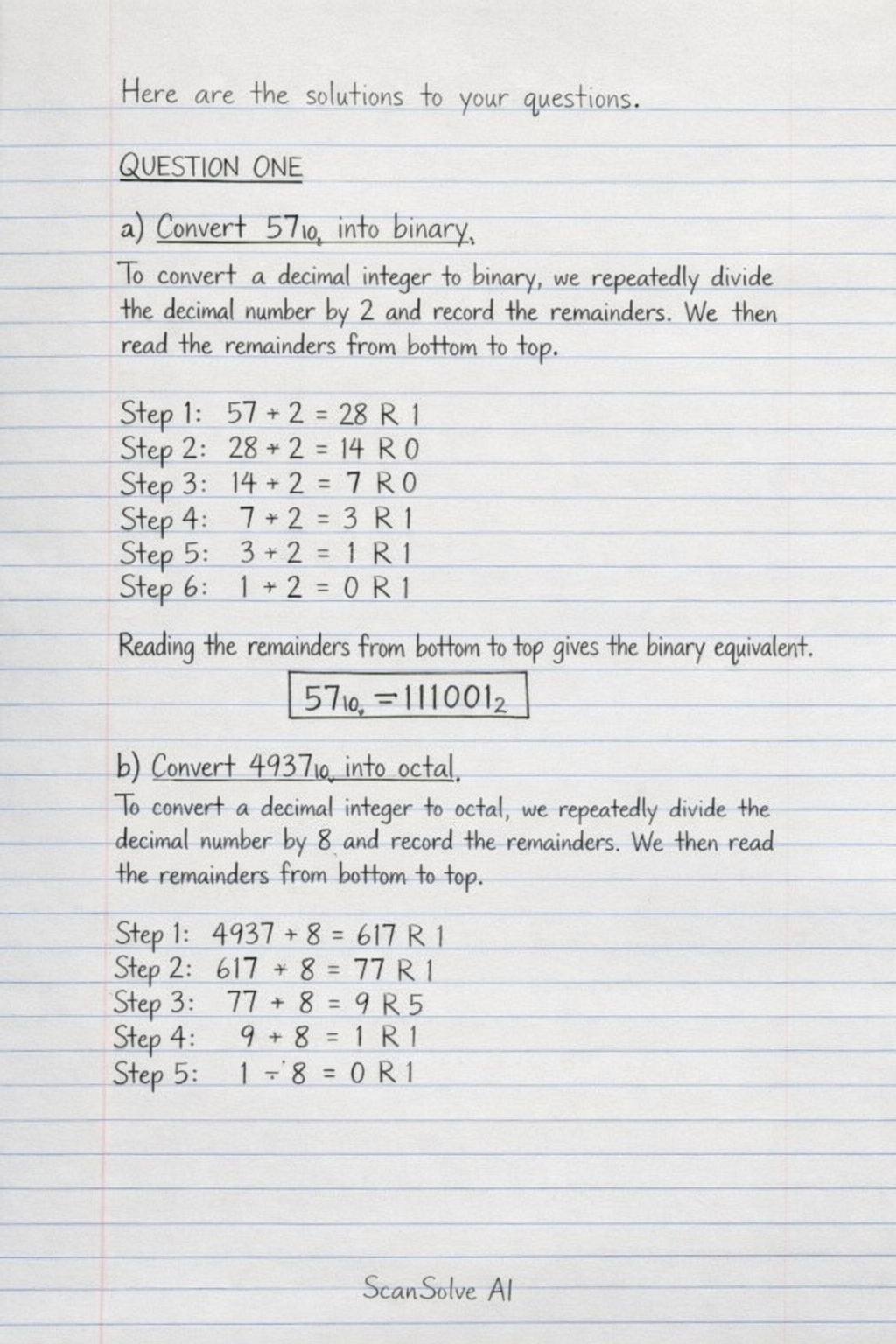
Handwritten Step-by-Step Solution
Get this as a handwritten image on WhatsApp — like a tutor wrote it for you.
Try on WhatsApp