
We read your photo as:
Compare and contrast the following data transmission modes: Parallel vs. Serial, Synchronous vs. Asynchronous, and Half Duplex vs. Full Duplex.
ScanSolve AI Answer
You're asking about the questions from the previous image, specifically 3.i, 3.ii, and 4.i. Here are the answers again:
3.i) Give the differences between the following pairs of transmission modes
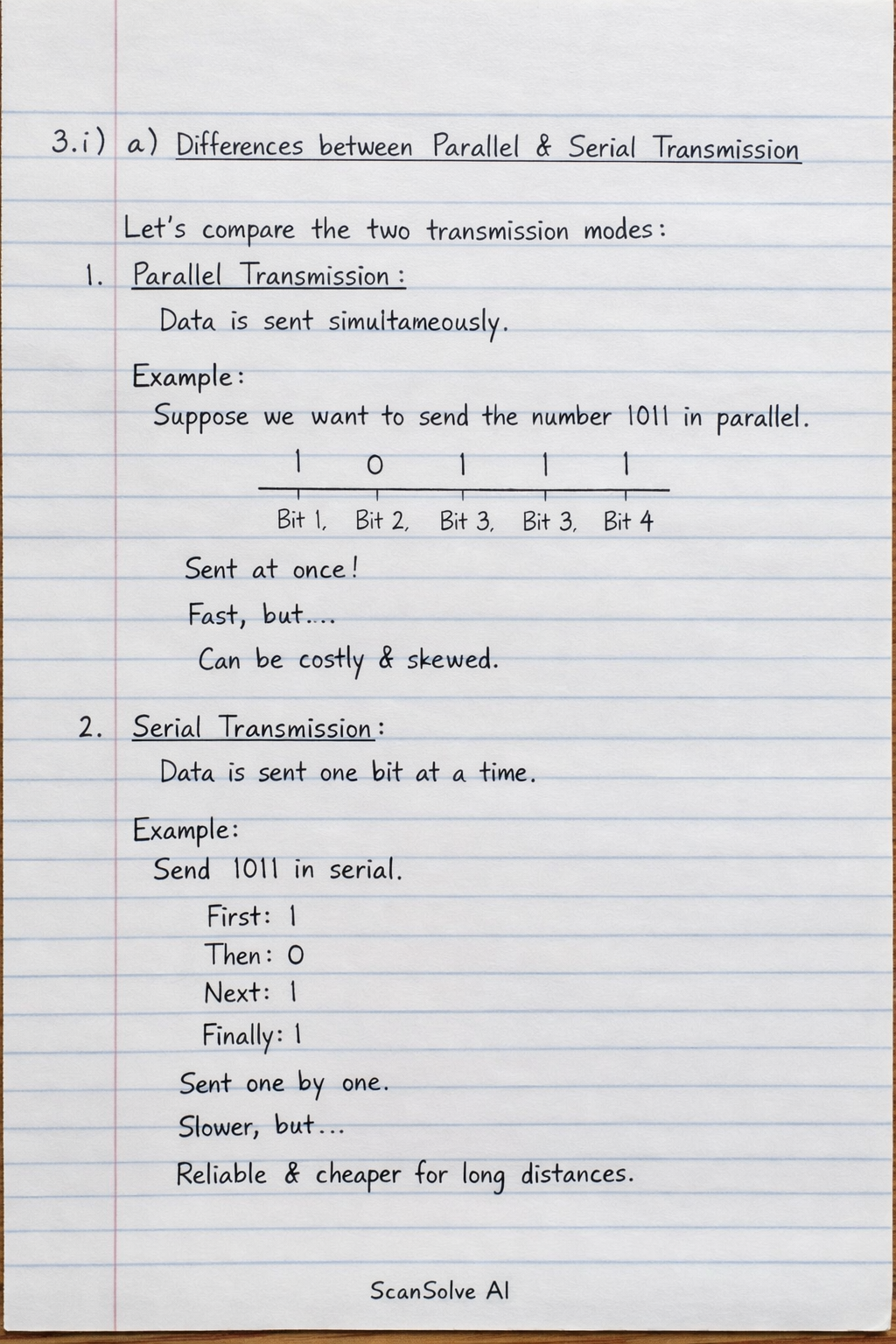
a) Parallel and serial transmission
- Parallel Transmission: Multiple bits of data are sent simultaneously over multiple channels (wires) at the same time. It is faster for short distances but more expensive and prone to skew.
- Serial Transmission: Bits of data are sent one after another over a single channel. It is slower than parallel for the same clock rate but more reliable and cost-effective for long distances.
b) Synchronous and asynchronous transmission
- Synchronous Transmission: Data is transmitted in blocks (frames) at a constant rate, synchronized by a shared clock signal between the sender and receiver. It is efficient for large data transfers but requires precise timing.
- Asynchronous Transmission: Data is transmitted character by character, with start and stop bits framing each character to indicate its beginning and end. It does not require a shared clock and is simpler to implement for small, irregular data transfers.
c) Half duplex and full duplex
- Half Duplex: Data can be transmitted in both directions, but only one direction at a time. Devices must take turns sending and receiving.
- Full Duplex: Data can be transmitted simultaneously in both directions at the same time. This allows for continuous two-way communication.
3.ii.a) Is the internet WAN or LAN? Explain. Name one common protocol used in LAN.
The internet is a WAN (Wide Area Network). It spans a vast geographical area, connecting multiple smaller networks (LANs and other WANs) across cities, countries, and continents.
One common protocol used in LAN is Ethernet.
3.ii.b) What is the difference between a network identifier and a host address?
- A network identifier (or network address) is the portion of an IP address that identifies the specific network to which a device is connected. All devices on the same network share the same network identifier.
- A host address is the portion of an IP address that uniquely identifies a specific device (host) within that particular network.
3.ii.c) What are the components of the complete internet address of a computer?
The complete internet address of a computer typically consists of:
- IP Address: A unique numerical label assigned to each device connected to a computer network that uses the Internet Protocol for communication.
- Port Number: A number that identifies a specific process or application running on a computer, allowing multiple applications to share the same IP address.
3.ii.d) Name three common ways that malware can gain access into a computer system. How can one get rid of malware?
Three common ways malware can gain access:
- Phishing/Social Engineering: Tricking users into opening malicious attachments or clicking on infected links in emails or messages.
- Exploiting Software Vulnerabilities: Taking advantage of unpatched security flaws in operating systems, web browsers, or other applications.
- Malicious Downloads/Drive-by Downloads: Downloading infected software from untrusted sources or unknowingly downloading malware when visiting compromised websites.
To get rid of malware, one can:
- Run a full scan with up-to-date antivirus/anti-malware software.
- Disconnect from the internet to prevent further spread or data exfiltration.
- Remove detected threats and quarantine suspicious files.
- Update the operating system and all software to patch vulnerabilities.
- Perform a system restore to a point before the infection, if available.
- In severe cases, a complete reinstallation of the operating system may be necessary.
4.i) Why are databases very important today?
Databases are crucial today because they provide an organized and efficient way to store, manage, and retrieve vast amounts of information. They enable businesses to make data-driven decisions, support complex applications, facilitate data sharing, and ensure data integrity and security, which are essential for almost every industry and modern digital service.
Still stuck on this one?
Ask a follow-up, and the answer starts from this question.
More Computer Science Questions
Handwritten Step-by-Step Solution
Get this as a handwritten image on WhatsApp — like a tutor wrote it for you.
Try on WhatsApp