
We read your photo as:
Explain two job scheduling techniques and the difference between simplex and full-duplex communication, serial and parallel transmission, and synchronous and asynchronous transmission.
Computer Science
ScanSolve AI Answer
Here are the solutions to the remaining questions:
QUESTION 4
(i)
d) Here are two job scheduling techniques:
- First-Come, First-Served (FCFS): Processes are executed in the order they arrive in the ready queue. This is a non-pre-emptive scheduling technique.
- Round Robin (RR): Each process is given a small, fixed unit of CPU time (time quantum). If the process does not complete within this time, it is pre-empted and moved to the end of the ready queue. This is a pre-emptive scheduling technique.
(ii)
a)
- Simplex: Data transmission occurs in only one direction. Example: Radio broadcast (the radio station transmits, the receiver only listens).
- Full Duplex: Data transmission occurs in both directions simultaneously. Example: Telephone conversation (both parties can speak and hear at the same time).
b)
- Serial Transmission: Bits are sent one after another over a single communication channel. It is generally slower but effective for long distances.
- Parallel Transmission: Multiple bits are sent simultaneously over multiple communication channels. It is generally faster but typically used for shorter distances due to synchronization challenges.
c)
- Synchronous Transmission: Data is sent in blocks (frames) with a shared clock signal between the sender and receiver, ensuring precise timing and synchronization.
- Asynchronous Transmission: Data is sent character by character, with start and stop bits added to each character to indicate its beginning and end, allowing for irregular data transfer without a shared clock.
(iii)
a) Prototyping is an iterative software development approach where a preliminary working model (prototype) of a system is built quickly, tested, and refined based on user feedback to clarify requirements and design.
b) Two reasons for
Was this helpful?
Still stuck on this one?
Ask a follow-up, and the answer starts from this question.
Got a different question?Ask your own question
More Computer Science Questions
QExplain file extensions and provide examples. Differentiate between simplex and full duplex, and…QCompare and contrast the following data transmission modes: Parallel vs. Serial, Synchronous vs…QDifferentiate between half-duplex and full-duplex transmission modes. List and explain 3 things to…QWhat are the main purposes of industrial computing, input devices, system software, and the E12…QQuelles sont les définitions et les applications de la communication et de la transmission de…
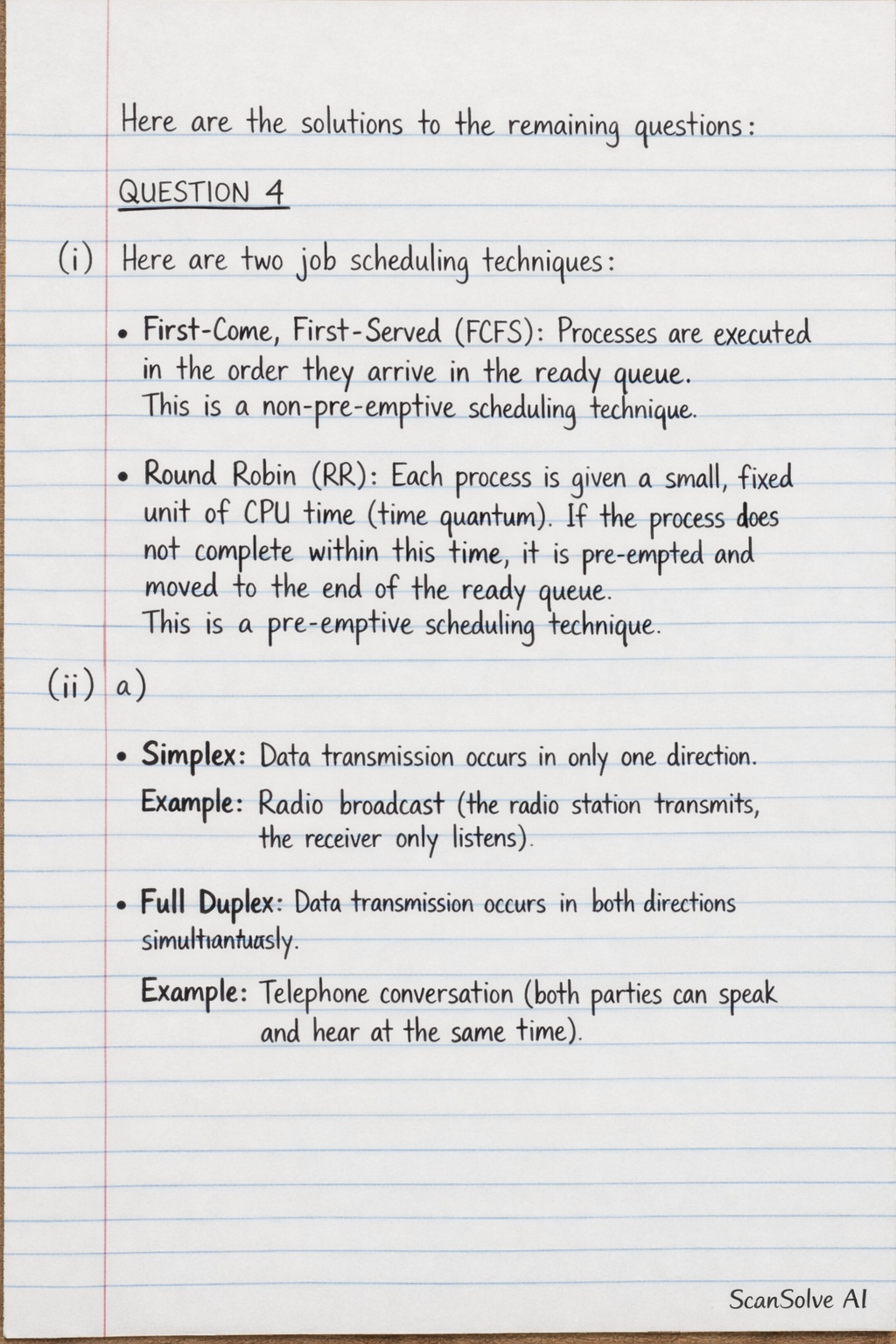
Handwritten Step-by-Step Solution
Get this as a handwritten image on WhatsApp — like a tutor wrote it for you.
Try on WhatsApp