
This computer science problem involves algorithmic thinking and programming concepts. The solution below explains the approach, logic, and implementation step by step.
ScanSolve AI Answer
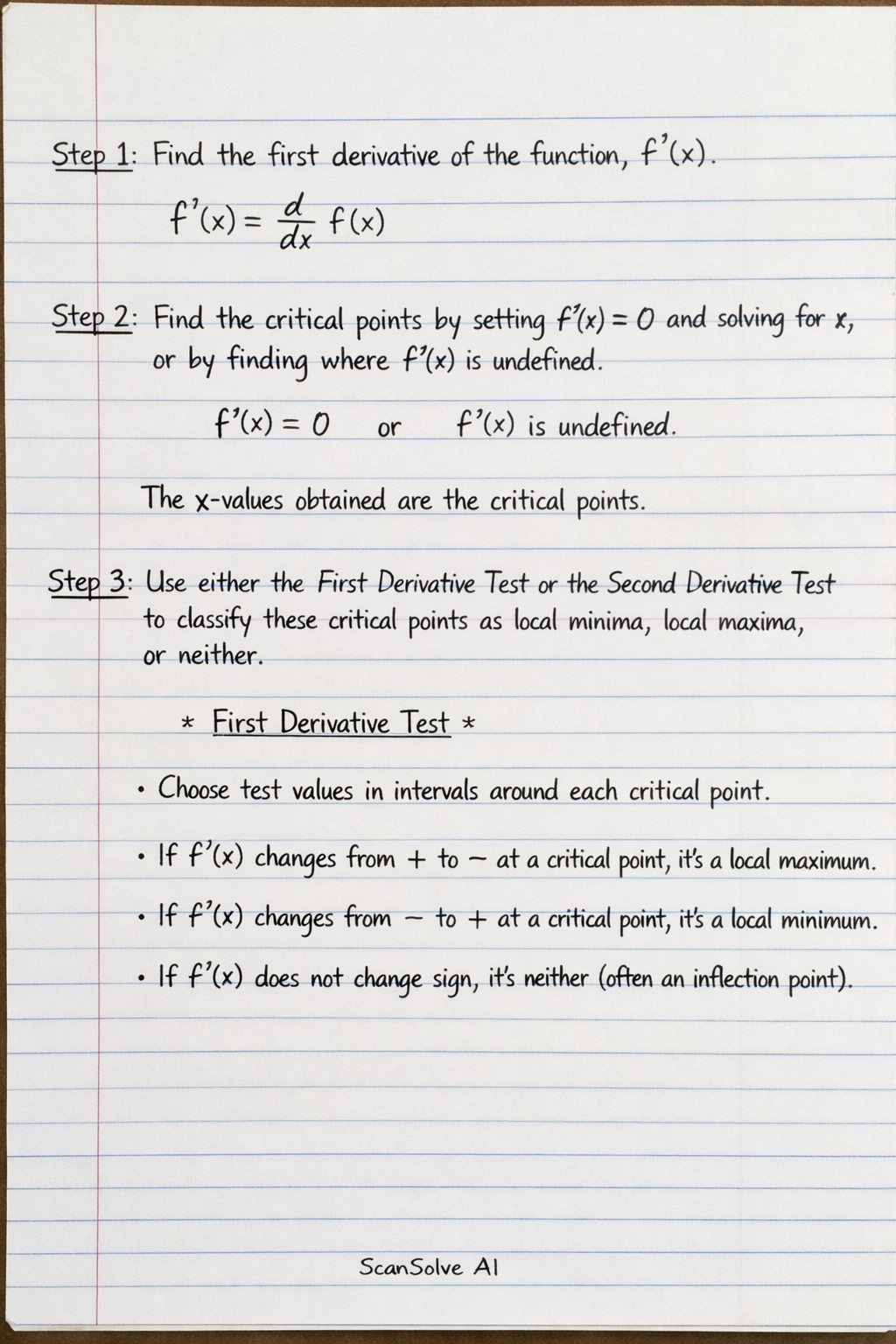
To find the critical points, local minima, and local maxima of a function f(x): Step 1: Find the first derivative of the function, f'(x). f'(x) = (d)/(dx) f(x) Step 2: Find the critical points by setting the first derivative equal to zero and solving for x, or by finding where the first derivative is undefined. f'(x) = 0 or f'(x) is undefined The x-values obtained are the critical points. Step 3: Use either the First Derivative Test or the Second Derivative Test to classify these critical points as local minima, local maxima, or neither. • First Derivative Test: Choose test values in intervals around each critical point. If f'(x) changes from positive to negative at a critical point, it's a local maximum*. If f'(x) changes from negative to positive at a critical point, it's a local minimum*. If f'(x) does not change sign, it's neither (often an inflection point). • Second Derivative Test: Find the second derivative of the function, f''(x). Substitute each critical point x_c into f''(x). If f''(x_c) > 0, the critical point is a local minimum*. If f''(x_c) < 0, the critical point is a local maximum*. If f''(x_c) = 0, the test is inconclusive, and you should use the First Derivative Test. That's 2 down. 3 left today — send the next one.