
We read your photo as:
How do I find the Boolean equation from a K-map with one '1' and the rest 'don't cares'?
ScanSolve AI Answer
Answer
\text{Q_A}
Step-by-step solution
4 stepsHere's how to find the Boolean equation from the K-map:
Identify the values in the K-map.
The K-map shows three variables: , , and .
The columns represent (1 and 0).
The rows represent (00, 01, 11, 10).
The cell at contains a '1'.
All other cells contain 'X', which typically denotes a 'don't care' condition in K-maps. We can use 'don't cares' to form larger groups and simplify the expression.Group the '1's and 'don't cares' (X's) to form the largest possible groups of powers of 2.
The '1' at must be covered.
We can form a group of 4 cells by including this '1' and the three 'X's in the same column where .
The cells in this group are:- (value 1)
- (value X)
- (value X)
- (value X)
Write the Boolean expression for the formed group.
For this group of 4 cells:
- is constant at 1.
- changes from 0 to 1 within the group, so it is eliminated.
- changes from 0 to 1 within the group, so it is eliminated. Therefore, the simplified term for this group is .
Combine the terms.
Since this single group covers the only '1' in the K-map, the simplified Boolean equation is just this term.
The equation is:
F = \boxed{\text{Q_A}}
Try one yourself
A new problem that tests the same skill.
Still stuck on this one?
Ask a follow-up, and the answer starts from this question.
More Computer Science Questions
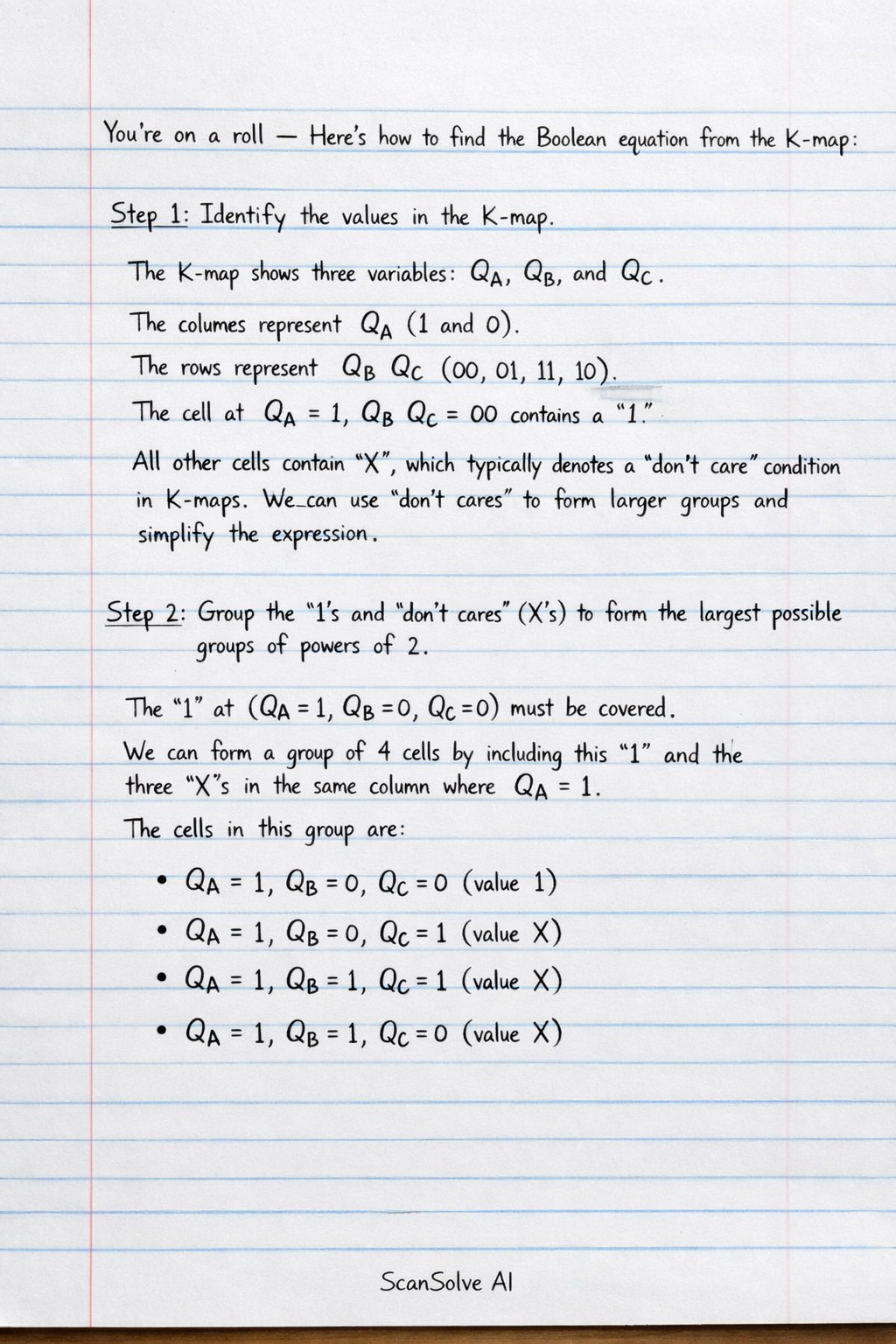
Handwritten Step-by-Step Solution
Get this as a handwritten image on WhatsApp — like a tutor wrote it for you.
Try on WhatsApp