

This computer science problem involves algorithmic thinking and programming concepts. The solution below explains the approach, logic, and implementation step by step.
ScanSolve AI Answer
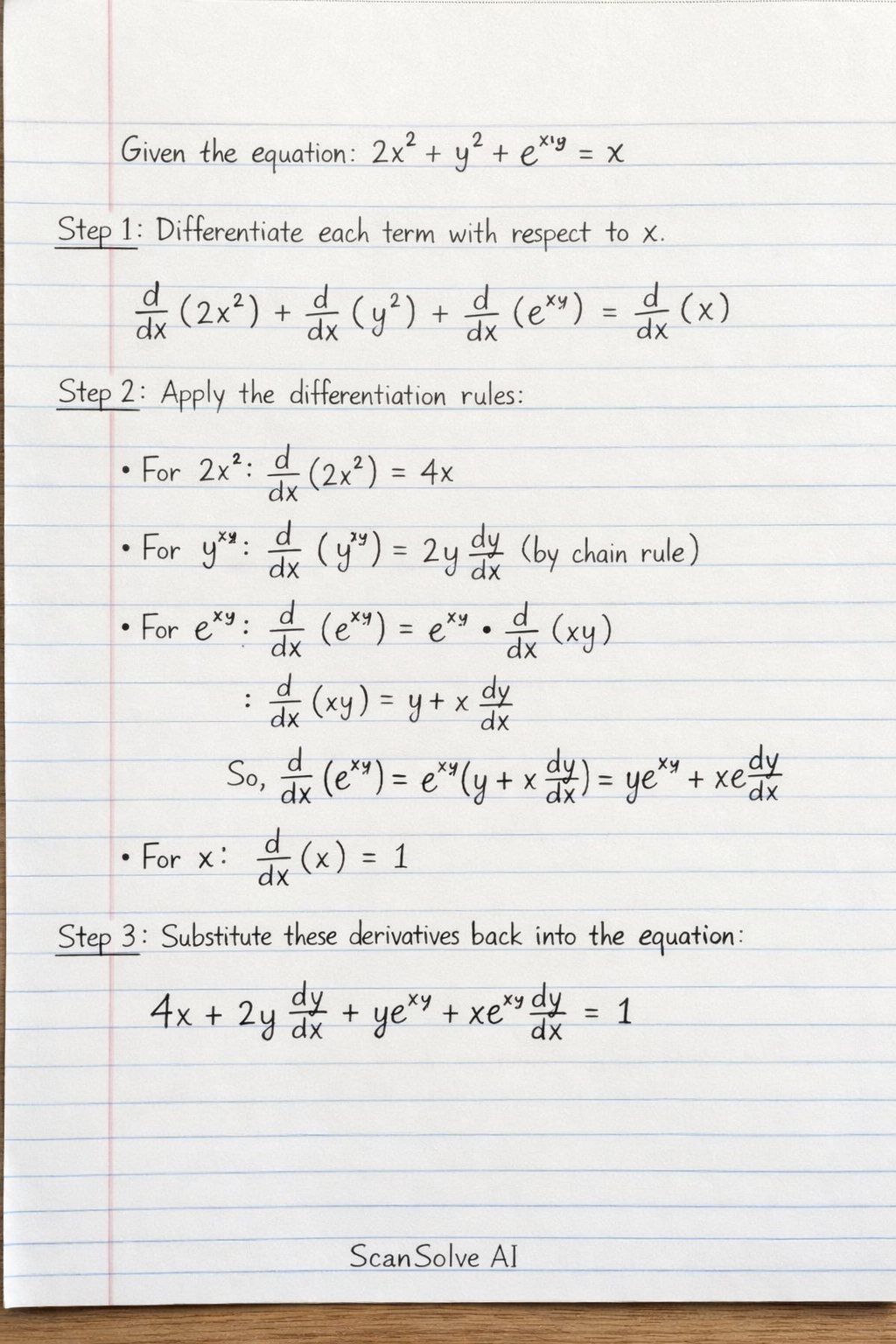
Morning andyjenniferebot — let's get this done. To find (dy)/(dx) using implicit differentiation, we differentiate every term in the equation with respect to x, remembering to apply the chain rule for terms involving y. Given the equation: 2x^2 + y^2 + e^xy = x Step 1: Differentiate each term with respect to x. (d)/(dx)(2x^2) + (d)/(dx)(y^2) + (d)/(dx)(e^xy) = (d)/(dx)(x) Step 2: Apply the differentiation rules. • For 2x^2: (d)/(dx)(2x^2) = 4x. • For y^2: Using the chain rule, (d)/(dx)(y^2) = 2y (dy)/(dx). • For e^xy: Using the chain rule and product rule for the exponent xy: (d)/(dx)(e^xy) = e^xy · (d)/(dx)(xy) (d)/(dx)(xy) = (1 · y) + (x · (dy)/(dx)) = y + x (dy)/(dx) So, (d)/(dx)(e^xy) = e^xy(y + x (dy)/(dx)) = y e^xy + x e^xy (dy)/(dx). • For x: (d)/(dx)(x) = 1. Step 3: Substitute these derivatives back into the equation. 4x + 2y (dy)/(dx) + y e^xy + x e^xy (dy)/(dx) = 1 Step 4: Group all terms containing (dy)/(dx) on one side of the equation and move all other terms to the other side. 2y (dy)/(dx) + x e^xy (dy)/(dx) = 1 - 4x - y e^xy Step 5: Factor out (dy)/(dx) from the terms on the left side. (dy)/(dx) (2y + x e^xy) = 1 - 4x - y e^xy Step 6: Solve for (dy)/(dx) by dividing both sides by (2y + x e^xy). (dy)/(dx) = 1 - 4x - y e^xy2y + x e^xy Send me the next one 📸