

This computer science problem involves algorithmic thinking and programming concepts. The solution below explains the approach, logic, and implementation step by step.
ScanSolve AI Answer
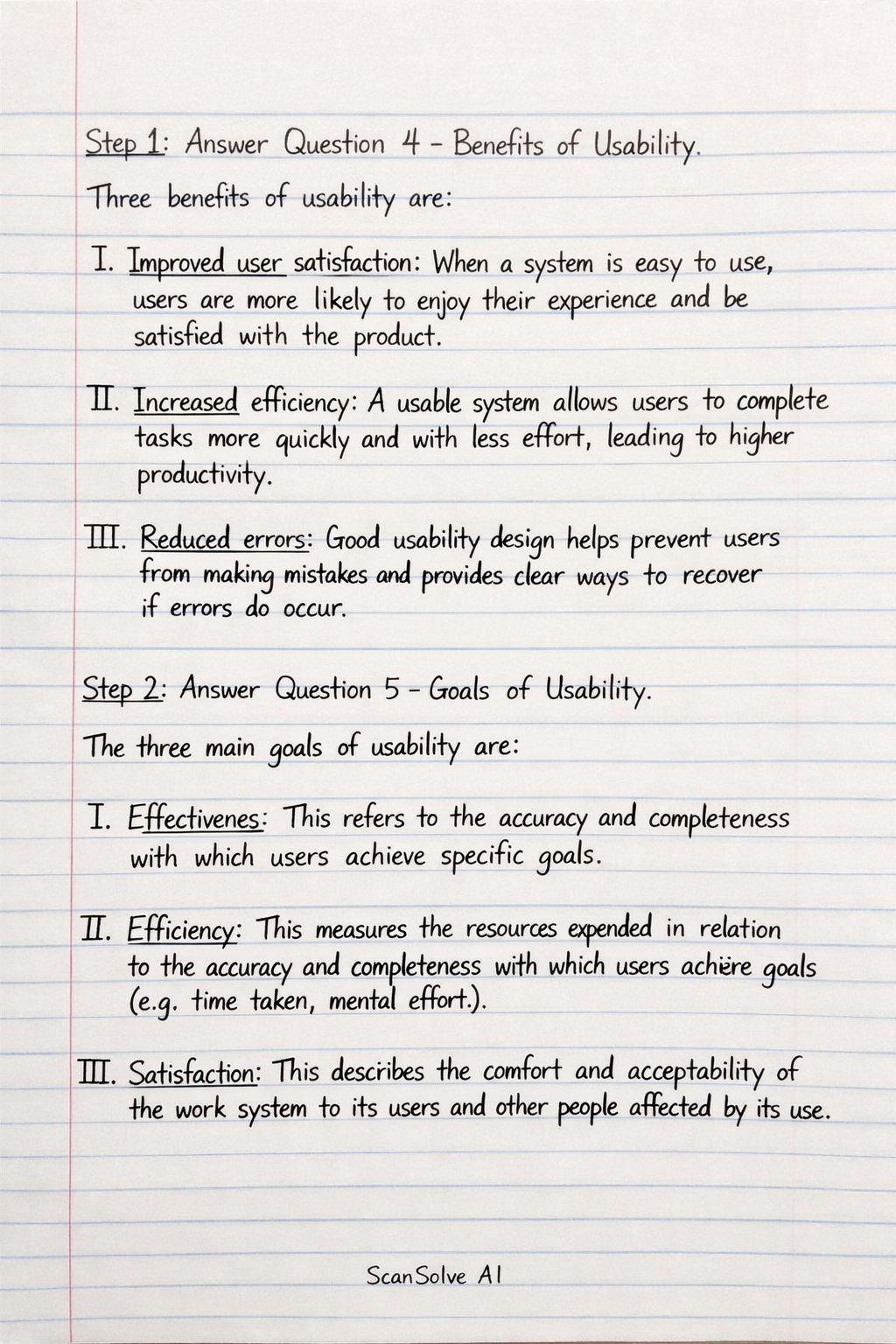
Step 1: Answer Question 4 - Benefits of Usability. Three benefits of usability are: I. Improved user satisfaction: When a system is easy to use, users are more likely to enjoy their experience and be satisfied with the product. II. Increased efficiency: A usable system allows users to complete tasks more quickly and with less effort, leading to higher productivity. III. Reduced errors: Good usability design helps prevent users from making mistakes and provides clear ways to recover if errors do occur. Step 2: Answer Question 5 - Goals of Usability. The three main goals of usability are: I. Effectiveness: This refers to the accuracy and completeness with which users achieve specific goals. II. Efficiency: This measures the resources expended in relation to the accuracy and completeness with which users achieve goals (e.g., time taken, mental effort). III. Satisfaction: This describes the comfort and acceptability of the work system to its users and other people affected by its use. Step 3: Answer Question 6 - Expert-based Usability Evaluation Methods. Three expert-based usability evaluation methods are: I. Heuristic Evaluation: In this method, usability experts evaluate an interface against a set of established usability principles (heuristics) to identify potential problems. II. Cognitive Walkthrough: Experts simulate a user's thought process step-by-step through a task to identify potential problems a new user might encounter, focusing on learnability. III. Expert Review/Critique: Usability specialists examine an interface and provide feedback based on their extensive knowledge of usability principles and experience with similar systems. Step 4: Answer Question 7 - User-based Usability Evaluation Methods. Three user-based usability evaluation methods are: I. Surveys/Questionnaires: Users are asked to provide feedback on their experience with a system through structured questions, often using rating scales or open-ended responses. II. Usability Testing: Actual users perform predefined tasks with the system while researchers observe their behavior, record their interactions, and note any difficulties or successes. III. Observation: Researchers directly watch users interact with a system in their natural environment or a controlled setting to understand their behavior, workflows, and challenges without direct intervention. Send me the next one 📸