
We read your photo as:
Derive the loaded voltage gain of the first CE amplifier stage and select the correct option.
ScanSolve AI Answer
Answer
Step-by-step solution
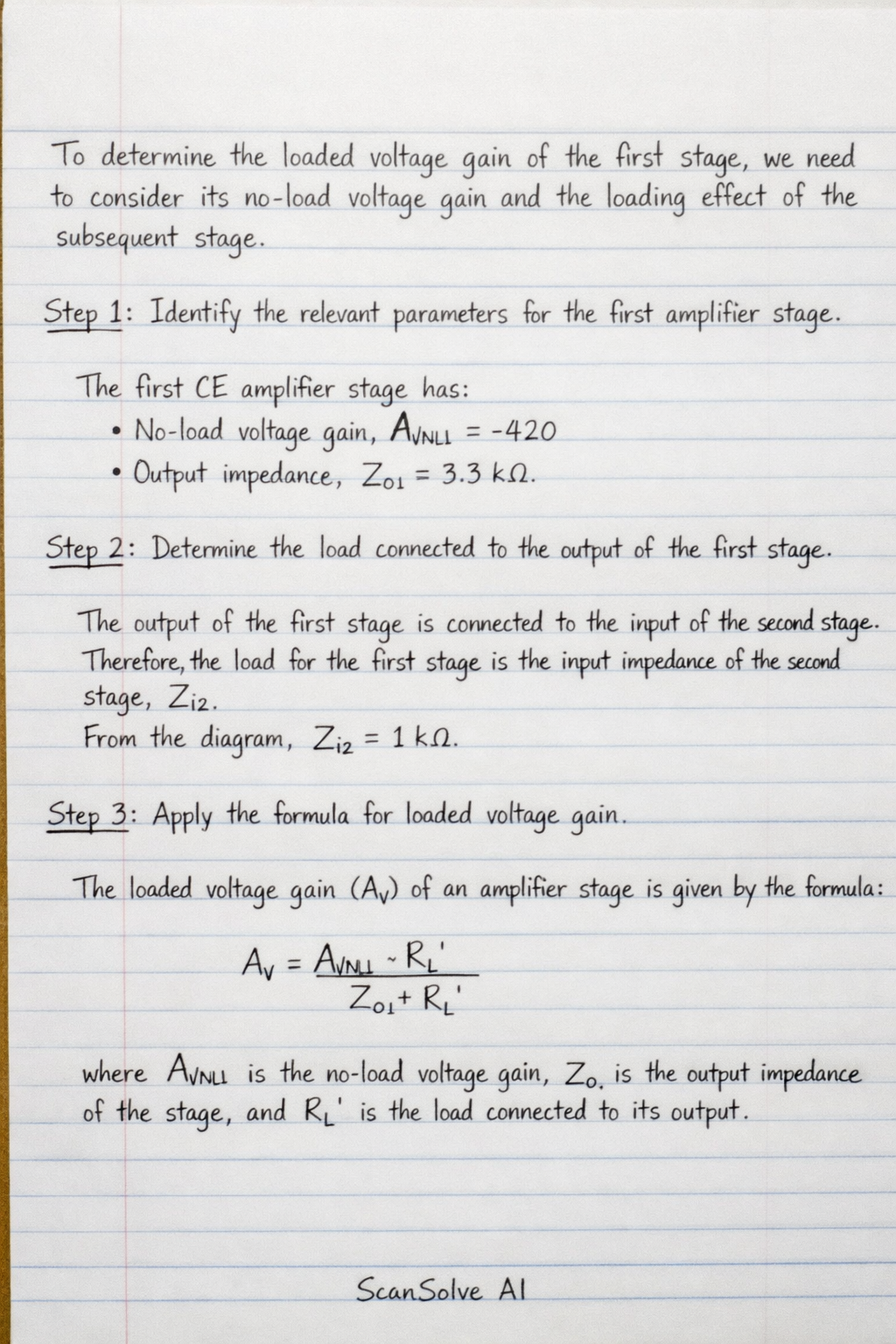
4 stepsTo determine the loaded voltage gain of the first stage, we need to consider its no-load voltage gain and the loading effect of the subsequent stage.
Identify the relevant parameters for the first amplifier stage.
The first CE amplifier stage has:
- No-load voltage gain,
- Output impedance,
Determine the load connected to the output of the first stage.
The output of the first stage is connected to the input of the second stage. Therefore, the load for the first stage is the input impedance of the second stage, .
From the diagram, .Apply the formula for loaded voltage gain.
The loaded voltage gain () of an amplifier stage is given by the formula:
where is the no-load voltage gain, is the output impedance of the stage, and is the load connected to its output.
For the first stage, substituting the values:
Compare with the given options.
Comparing our derived formula with the options, option C matches:
C)The final answer is .
Try one yourself
A new problem that tests the same skill.
Still stuck on this one?
Ask a follow-up, and the answer starts from this question.
More Computer Science Questions
Handwritten Step-by-Step Solution
Get this as a handwritten image on WhatsApp — like a tutor wrote it for you.
Try on WhatsApp