
We read your photo as:
Logically conceptualize and differentiate between E-learning, Virtual learning, and Mobile learning.
ScanSolve AI Answer
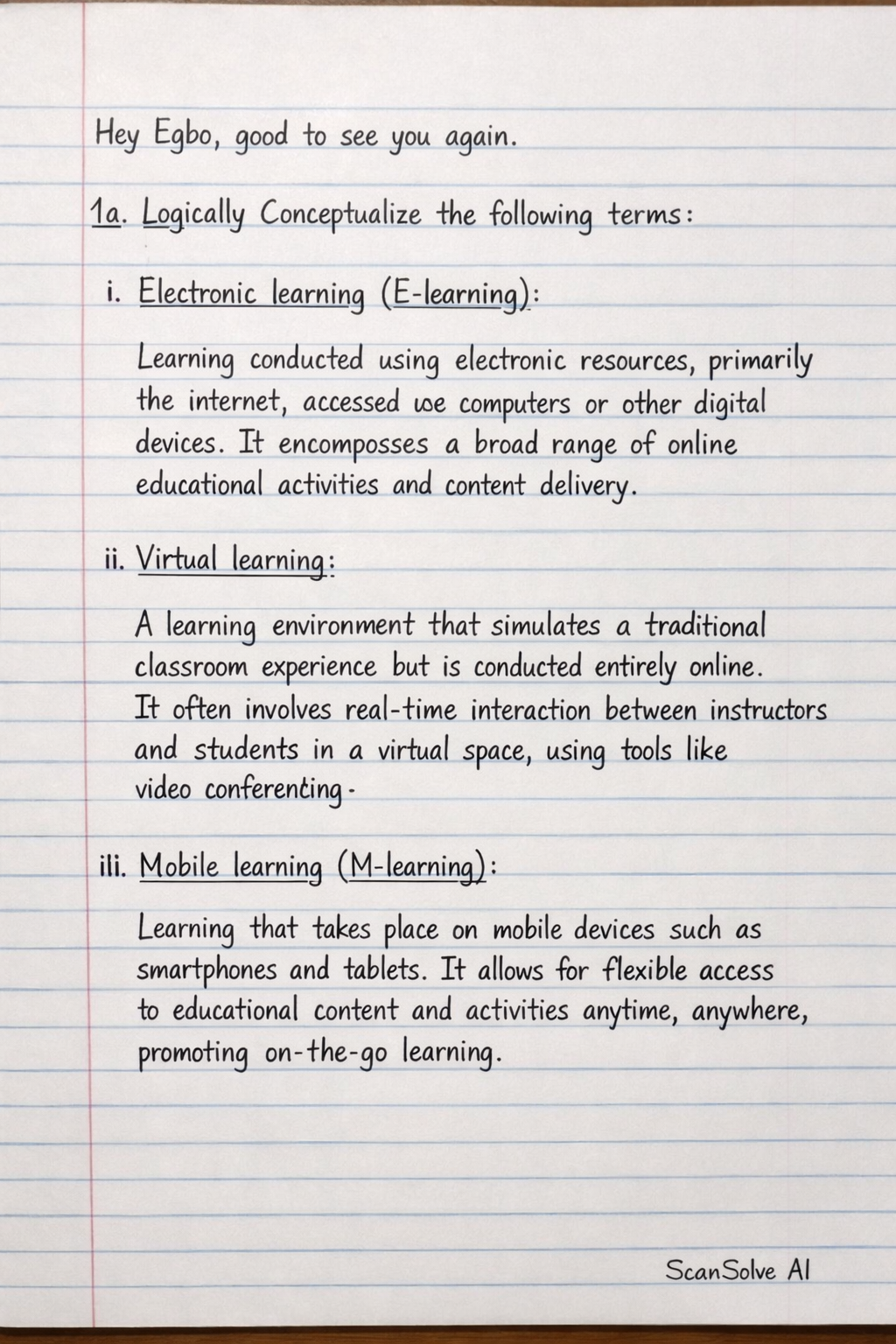
1a. Logically Conceptualize the following terms:
-
i. Electronic learning (E-learning): Learning conducted using electronic resources, primarily the internet, accessed via computers or other digital devices. It encompasses a broad range of online educational activities and content delivery.
-
ii. Virtual learning: A learning environment that simulates a traditional classroom experience but is conducted entirely online. It often involves real-time interaction between instructors and students in a virtual space, using tools like video conferencing.
-
iii. Mobile learning (M-learning): Learning that takes place on mobile devices such as smartphones and tablets. It allows for flexible access to educational content and activities anytime, anywhere, promoting on-the-go learning.
-
iv. E-learning platforms: Software applications or web-based technologies that provide a comprehensive environment for online learning. These platforms manage courses, deliver educational content, track student progress, and facilitate communication and collaboration.
1b. Differential between E-learning and Virtual Learning:
E-learning is a broad term referring to any learning facilitated by electronic means. Virtual learning is a specific type of e-learning that aims to replicate a traditional classroom experience online, often involving synchronous interaction and a structured virtual environment. Essentially, virtual learning is a subset of e-learning.
1c. Briefly explain any (5) five Mobile learning platforms:
- Google Classroom: A free web service by Google for schools that simplifies creating, distributing, and grading assignments, fostering communication between teachers and students.
- Moodle: A widely used free and open-source learning management system (LMS) that allows educators to create custom online courses and interactive learning environments.
- Canvas: A popular web-based LMS used by educational institutions to manage online learning, distribute course materials, facilitate discussions, and track student performance.
- Edmodo: A social learning platform designed to connect learners and educators, enabling teachers to share content, manage assignments, and communicate with students and parents.
- Blackboard Learn: A comprehensive LMS extensively used in higher education for course management, content delivery, assessment, and fostering student engagement in online settings.
2a. Discuss any one (1) ICT assessment tool in education, stating its features, (5) five advantages and (3) challenges.
- ICT Assessment Tool: Online Quizzes/Tests (e.g., using platforms like Google Forms, Kahoot!, Quizizz).
- Features: Online quizzes offer automated grading, instant feedback, support various question types (multiple choice, true/false, short answer), and can incorporate multimedia elements. They also provide data analytics on student performance.
- Advantages:
- Instant feedback to students, aiding immediate learning and self-correction.
- Automated grading saves significant teacher time and reduces potential bias.
- Accessibility allows students to take assessments from various locations and devices.
- Data analytics provide valuable insights into student understanding and areas needing improvement.
- Engaging formats (e.g., gamified quizzes) can increase student motivation and participation.
- Challenges:
- Technical issues such as internet connectivity problems or device malfunctions can disrupt assessments.
- Digital divide can exclude students who lack access to necessary technology or reliable internet.
- Academic dishonesty can be harder to prevent without robust proctoring mechanisms, raising integrity concerns.
3a. Define the Concept Information Communication Technology (ICT):
Information Communication Technology (ICT) refers to the diverse set of technological tools and resources used to create, store, manage, and exchange information. It encompasses a wide range of technologies, including computers, the internet, broadcasting technologies (radio and television), and telephony, all aimed at facilitating communication and information processing.
3b. Identify and discuss at least five relevance of ICT in education:
- Enhanced Access to Information: ICT provides students and teachers with unparalleled access to a vast array of educational resources, research materials, and diverse perspectives beyond traditional textbooks.
- Improved Teaching and Learning Methods: Interactive whiteboards, educational software, online simulations, and multimedia content make lessons more engaging, dynamic, and cater to various learning styles.
- Facilitates Collaboration and Communication: Online platforms and tools enable students to collaborate on projects, share ideas, and communicate effectively with peers and teachers, transcending geographical barriers.
- Personalized Learning Experiences: ICT allows for adaptive learning paths, where educational content and pace can be tailored to individual student needs, strengths, and weaknesses, promoting self-paced learning.
- Development of Digital Literacy Skills: Integrating ICT into education helps students acquire essential digital skills, critical for navigating the modern world, succeeding in the workforce, and participating in a digital society.
3c. Logically discuss five challenges of ICT in education:
- Lack of Adequate Infrastructure: Many educational institutions, particularly in developing regions, face challenges with unreliable internet access, insufficient numbers of computers, and a lack of necessary technical support.
- Teacher Training and Digital Literacy: A significant challenge is ensuring that educators possess the necessary skills and confidence to effectively integrate ICT into their teaching practices, often requiring extensive professional development.
- Cost of Implementation and Maintenance: The initial acquisition, ongoing updates, and maintenance of ICT equipment and software can be prohibitively expensive, posing a substantial financial burden on schools and educational systems.
- Digital Divide and Equity Issues: Disparities in access to technology and internet connectivity among students from different socioeconomic backgrounds can exacerbate existing inequalities, creating a "digital divide" in learning opportunities.
- Cybersecurity Risks and Data Privacy: The increased use of ICT in education raises critical concerns about protecting sensitive student data, preventing cyberattacks, and ensuring a safe and secure online learning environment.
Still stuck on this one?
Ask a follow-up, and the answer starts from this question.
More Computer Science Questions
Handwritten Step-by-Step Solution
Get this as a handwritten image on WhatsApp — like a tutor wrote it for you.
Try on WhatsApp