
We read your photo as:
Which of the following options best represents an oblique axis system, what tool is used for transferring measurements, and which scale produces the largest view?
ScanSolve AI Answer
Answer
Here are the answers to the questions:
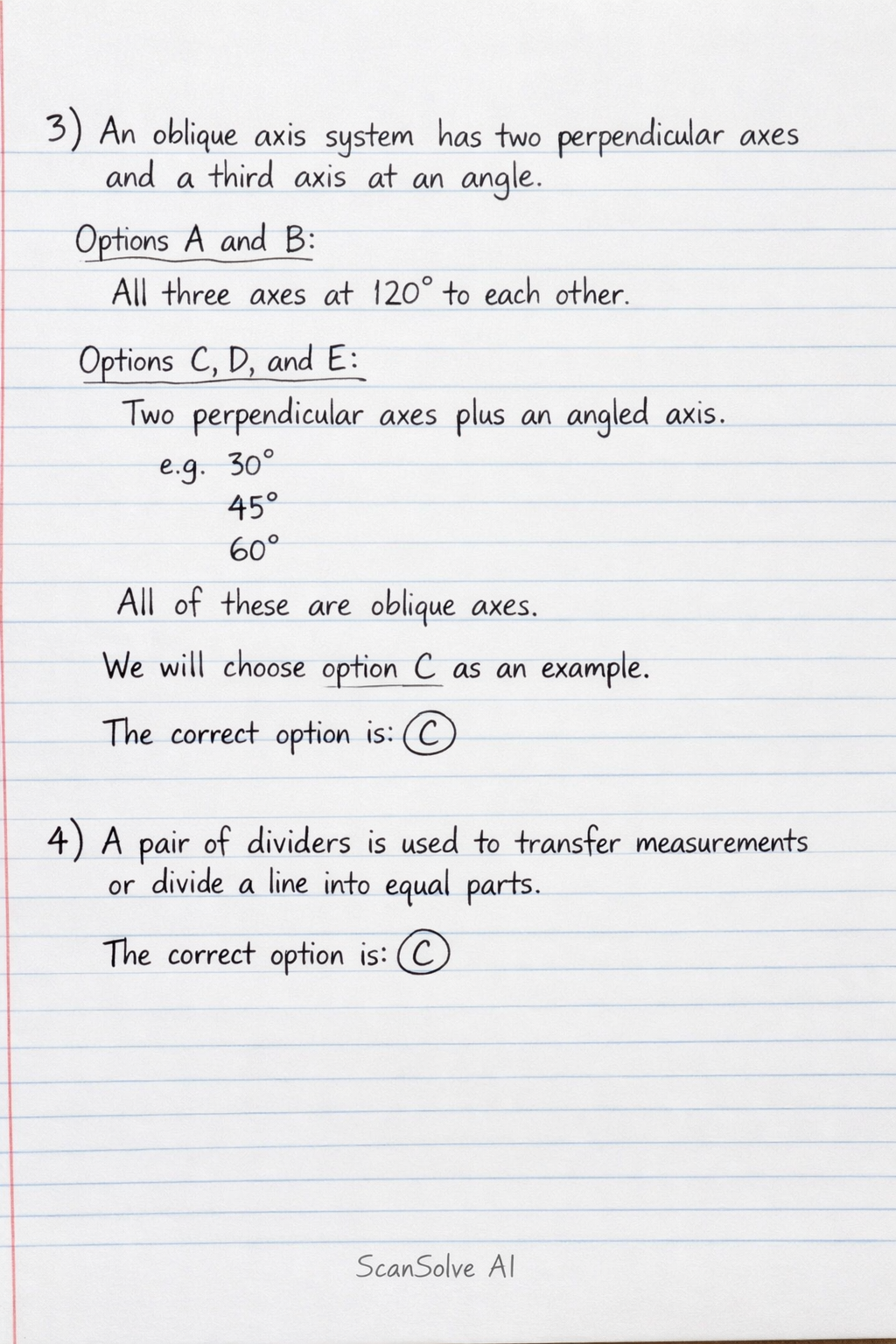
3) An oblique axis system in technical drawing typically features two axes that are perpendicular to each other (representing the front face of an object parallel to the projection plane), and a third axis that recedes at an angle (e.g., , , or ) to represent depth. Options A and B represent isometric axis systems, where all three axes are at to each other. Options C, D, and E all show two perpendicular axes and a third angled axis, which are characteristics of oblique axis systems. Given that this is a multiple-choice question, and C, D, and E are all valid representations of oblique axes, we will select C as a representative example.
The correct option is C.
4) A pair of dividers is a drawing instrument specifically designed for transferring measurements from a scale or between points on a drawing, and for dividing lines into equal segments.
The correct option is C.
5) To produce the largest view of an object, the scale ratio (drawing size : actual size) must be the largest. Let's convert the given ratios to decimal values:
- A.
- B.
- C.
- D.
- E. Comparing these values, 2.5 (from ) is the largest, meaning it will produce the largest view of the object. The correct option is D.
Try one yourself
A new problem that tests the same skill.
Still stuck on this one?
Ask a follow-up, and the answer starts from this question.
More Computer Science Questions
Handwritten Step-by-Step Solution
Get this as a handwritten image on WhatsApp — like a tutor wrote it for you.
Try on WhatsApp