

This computer science problem involves algorithmic thinking and programming concepts. The solution below explains the approach, logic, and implementation step by step.
ScanSolve AI Answer
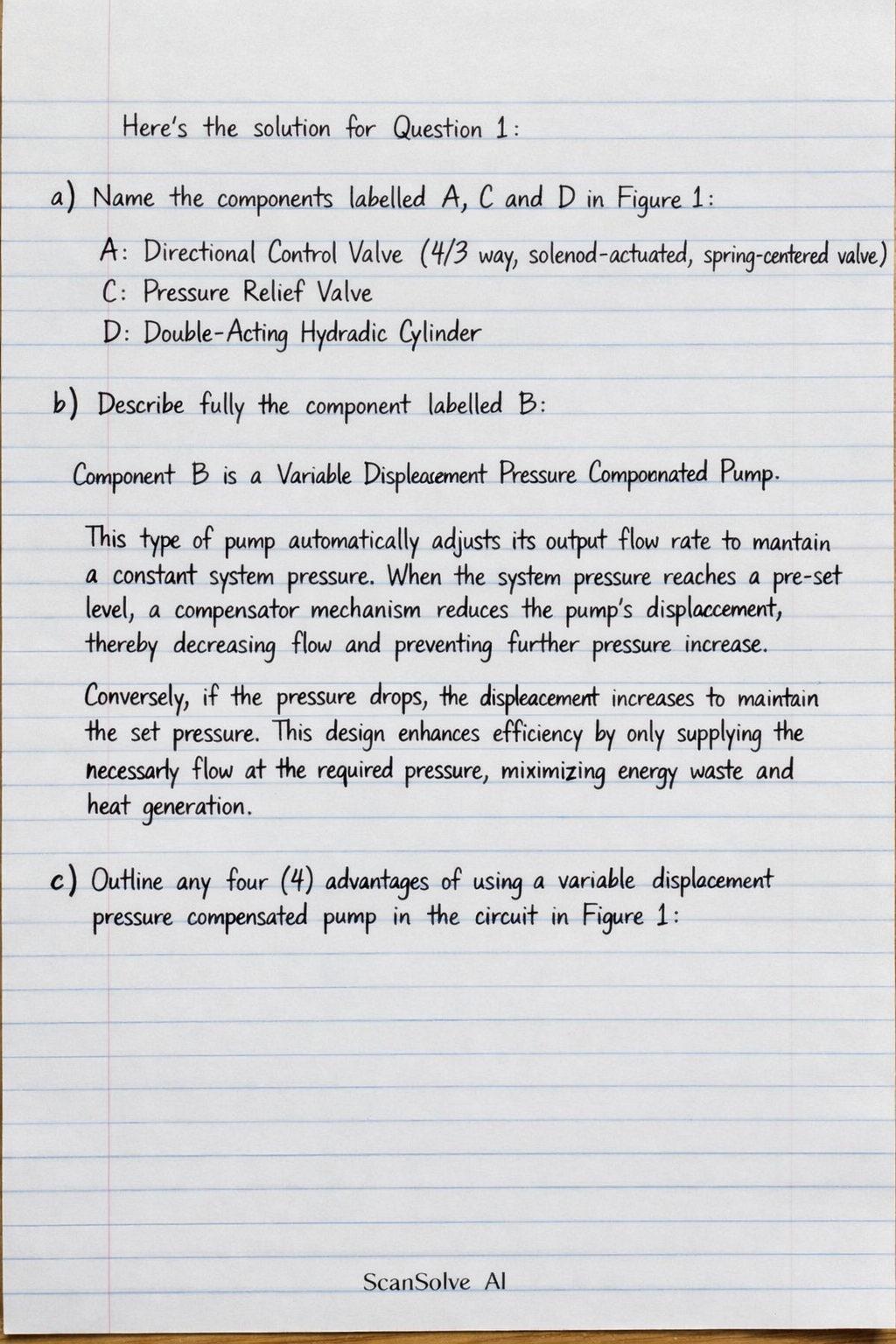
Here's the solution for Question 1: a) Name the components labelled A, C and D in Figure 1. A: Directional Control Valve* (specifically, a 4/3 way, solenoid-actuated, spring-centered valve) C: Pressure Relief Valve* D: Double-Acting Hydraulic Cylinder* b) Describe fully the component labelled B. Component B is a Variable Displacement Pressure Compensated Pump. This type of pump automatically adjusts its output flow rate to maintain a constant system pressure. When the system pressure reaches a pre-set level, a compensator mechanism reduces the pump's displacement, thereby decreasing flow and preventing further pressure increase. Conversely, if the pressure drops, the displacement increases to maintain the set pressure. This design enhances efficiency by only supplying the necessary flow at the required pressure, minimizing energy waste and heat generation. c) Outline any four (4) advantages of using a variable displacement pressure compensated pump in the circuit in Figure 1. 1. Energy Efficiency: The pump only delivers the fluid required to maintain the set pressure, reducing power consumption and avoiding unnecessary flow through a relief valve. 2. Reduced Heat Generation: Less energy is dissipated as heat, leading to cooler system operation and extending the life of hydraulic components and fluid. 3. Longer Component Life: Lower operating temperatures and reduced fluid shearing contribute to increased longevity for the pump, valves, and other system components. 4. Lower Noise Levels: The pump operates at a reduced flow rate when system demand is low, resulting in quieter overall system operation. d) Using indirect electrical control show the operation of the electric circuit during load lowering. To lower the load, the double-acting hydraulic cylinder (D) must retract. This requires the directional control valve (A) to shift to the position where pressure (P) is directed to the rod side of the cylinder (connected to valve port B) and the cap side (connected to valve port A) is connected to the tank (T). This is achieved by energizing the right-hand solenoid of valve A (let's call it SOL R). Step 1: The operator presses a "Lower Load" push-button switch, which is a normally open (NO) contact. Step 2: Pressing the push-button completes a control circuit, energizing a control relay coil (e.g., RL1). Step 3: When relay RL1 is energized, its associated normally open contact closes, completing a separate power circuit. Step 4: This closed contact supplies electrical power to the right-hand solenoid (SOL R) of the directional control valve (A). Step 5: Energizing SOL R shifts the spool of valve A to its right-hand position, directing hydraulic fluid from the pump (B) to port B of the valve (and thus to the rod side of cylinder D), while simultaneously connecting port A of the valve (and the cap side of cylinder D) to the hydraulic reservoir (E). Step 6: This hydraulic action causes the cylinder (D) to retract, thereby lowering the load. That's 2 down. 3 left today — send the next one.