
We read your photo as:
Figure 1 represents a circuit diagram. Use it to answer the questions that follow. (a) Name the parts labelled P, Q and R. (b) State Ohm's Law.
ScanSolve AI Answer
Step-by-step solution
4 stepsHere are the solutions to the questions:
7. Figure 1 represents a circuit diagram. Use it to answer the questions that follow.
(a) Name the parts labelled P, Q and R.
Identify the standard circuit symbols.
-
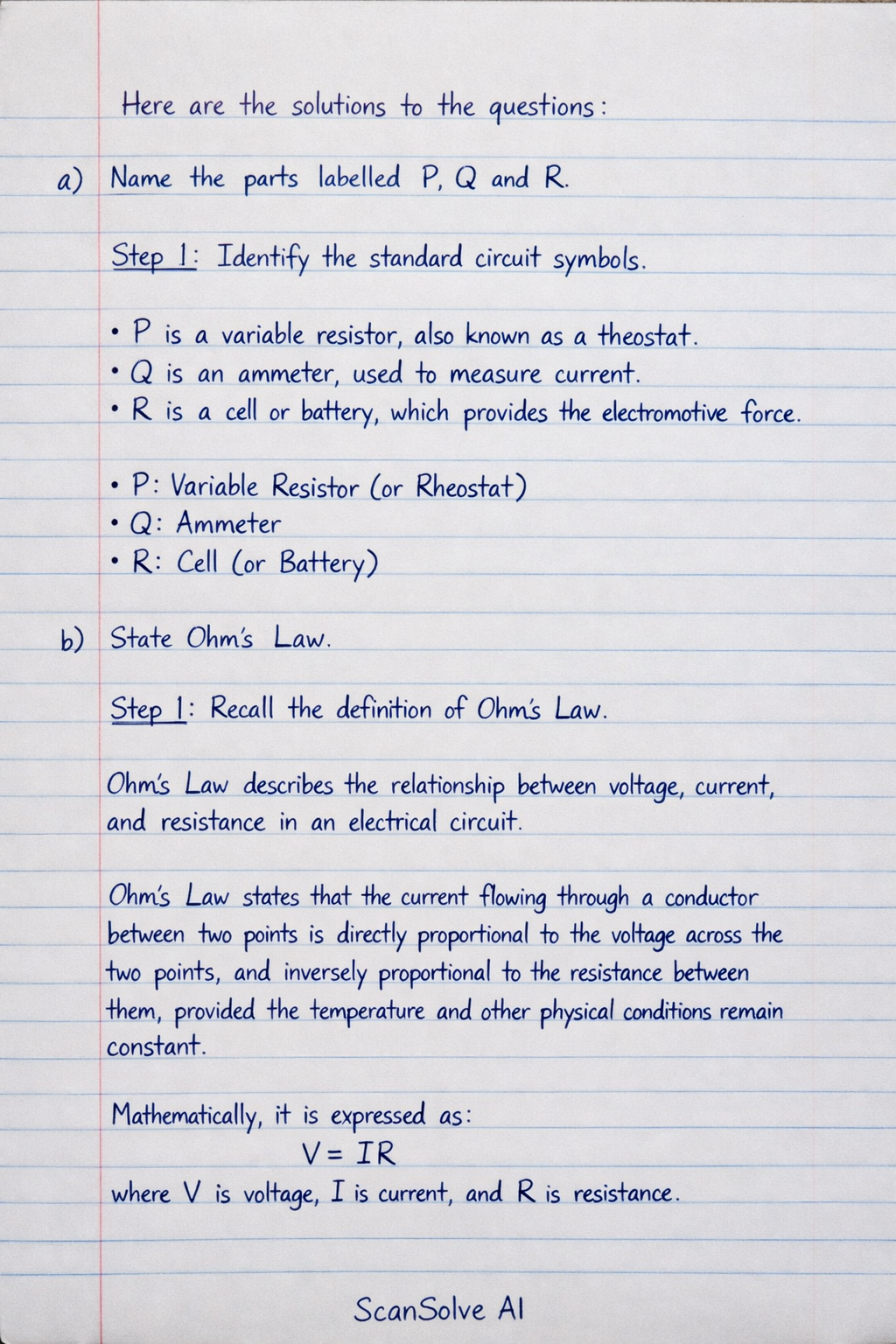
P is a variable resistor, also known as a rheostat.
-
Q is an ammeter, used to measure current.
-
R is a cell or battery, which provides the electromotive force.
-
P: Variable resistor (or Rheostat)
-
Q: Ammeter
-
R: Cell (or Battery)
(b) State Ohm's Law.
-
Recall the definition of Ohm's Law.
Ohm's Law describes the relationship between voltage, current, and resistance in an electrical circuit.
- Ohm's Law states that the current flowing through a conductor between two points is directly proportional to the voltage across the two points, and inversely proportional to the resistance between them, provided the temperature and other physical conditions remain constant.
- Mathematically, it is expressed as , where is voltage, is current, and is resistance.
8. (a) Name two excretory organs in plants and animals.
Identify excretory organs for plants and animals.
Excretory organs remove waste products from an organism.
- (i) plants:
- Stomata (for gaseous waste like oxygen and water vapor)
- Lenticels (for gaseous waste)
- Leaves (for storing waste that is shed during leaf fall)
- (ii) animals:
- Kidneys (for filtering blood and producing urine)
- Lungs (for expelling carbon dioxide and water vapor)
- Skin (for sweating out water, salts, and urea)
(b) Name two materials that can be attracted by a magnet.
- (i) plants:
Recall common ferromagnetic materials.
Ferromagnetic materials are strongly attracted to magnets.
- 1. Iron
- 2. Nickel
- 3. Cobalt
Still stuck on this one?
Ask a follow-up, and the answer starts from this question.
More Physics Questions
Handwritten Step-by-Step Solution
Get this as a handwritten image on WhatsApp — like a tutor wrote it for you.
Try on WhatsApp