
We read your photo as:
AIM: To verify Ohm's law in a series-parallel circuit. (a)-(m) are instructions for the experiment and data analysis.
ScanSolve AI Answer
Answer
The following parts of the question require experimental setup and data collection, which cannot be performed by an AI: (a), (b), (d), (e), (f), (g), (h), (i), (j), and (l).
Step-by-step solution
5 stepsHere are the answers to the conceptual parts:
k) What does the slope, , of the graph represent?
Identify the relationship between and .
The voltmeter measures the voltage across resistor , and the ammeter measures the current flowing through . According to Ohm's law, the voltage across a resistor is directly proportional to the current flowing through it, with the resistance being the constant of proportionality.
Determine what the slope represents.
When is plotted on the vertical axis (y-axis) and on the horizontal axis (x-axis), the equation is in the form , where is the slope.
Therefore, the slope of the versus graph represents the resistance of resistor .The slope represents the resistance of .
m) How does the result in 2(l) satisfy Ohm's law?
Understand the calculation in part (l).
Part (l) asks to evaluate the product of the slope and the current at a specific voltage . From part (k), we know that the slope represents the resistance . So, the product is equivalent to .
Relate the product to Ohm's law.
Ohm's law states that the voltage across a resistor is equal to the product of the current flowing through it and its resistance (). In this experiment, is the voltage across , and is the current through . Thus, Ohm's law for is .
Conclude how the result satisfies Ohm's law.
If the experiment is performed correctly, the product (which is ) calculated in part (l) should be equal to the corresponding voltage (which is ). This equality, , directly demonstrates and verifies Ohm's law for resistor .
Still stuck on this one?
Ask a follow-up, and the answer starts from this question.
More Physics Questions
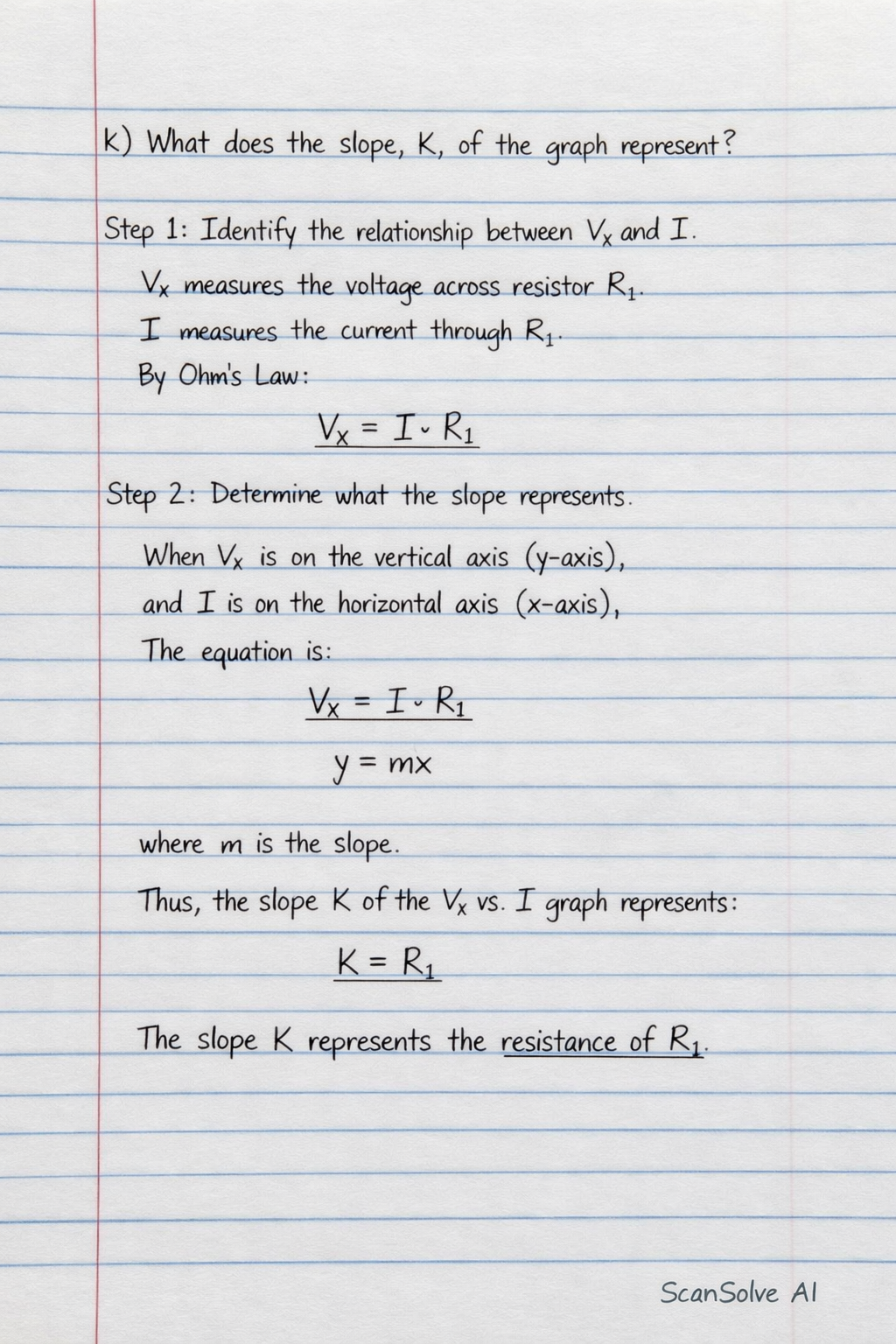
Handwritten Step-by-Step Solution
Get this as a handwritten image on WhatsApp — like a tutor wrote it for you.
Try on WhatsApp