
We read your photo as:
A.i. State Ohm's law. 10.a.ii. Name two types of electric circuits. 10.b. Calculate the maximum and minimum resistance using three resistors with values 5 Ω, 10 Ω, and 20 Ω.
ScanSolve AI Answer
Step-by-step solution
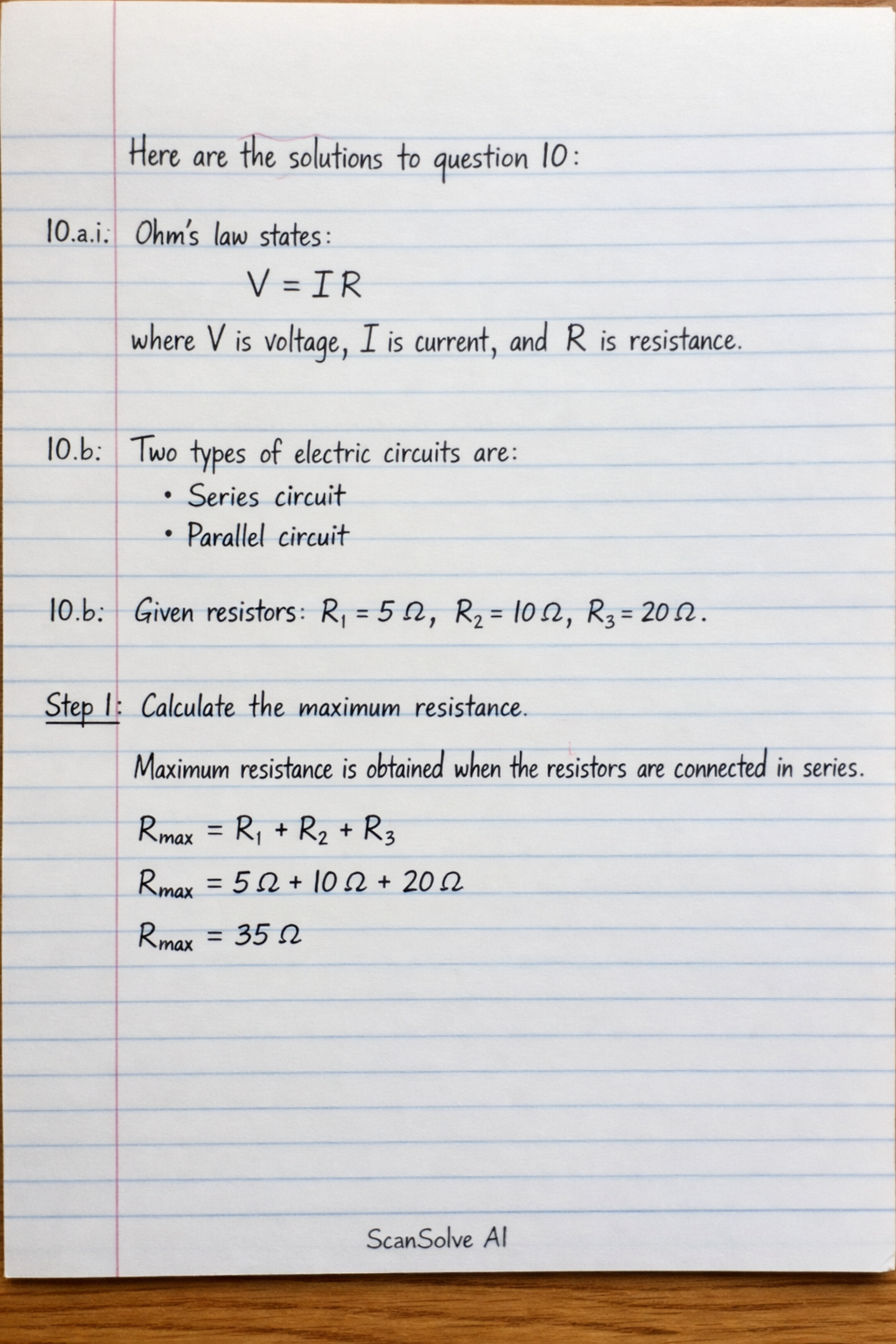
6 stepsHere are the solutions to question 10:
10.a.i:
Ohm's law states that the current flowing through a conductor between two points is directly proportional to the voltage across the two points, and inversely proportional to the resistance between them. Mathematically, it is expressed as , where is voltage, is current, and is resistance.
10.a.ii:
Two types of electric circuits are:
- Series circuit
- Parallel circuit
10.b:
Given resistors: , , .
Calculate the maximum resistance.
Maximum resistance is obtained when the resistors are connected in series.
Calculate the minimum resistance.
Minimum resistance is obtained when the resistors are connected in parallel.
The maximum resistance is and the minimum resistance is .
10.c.i:
When Switch K1 is closed (and K2 is open).Determine the total resistance.
With K1 closed and K2 open, the and resistors are in series.
Calculate the current using Ohm's Law.
The voltage source is .
The current passing through the circuit is .
10.c.ii:
When Switches K1 and K2 are both closed.Determine the total resistance.
With K1 closed and K2 closed, switch K2 short-circuits the resistor. This means current will flow through K2 and bypass the resistor, effectively removing it from the circuit. Only the resistor remains in the path of the current.
Calculate the current using Ohm's Law.
The voltage source is .
The current passing through the circuit is .
Still stuck on this one?
Ask a follow-up, and the answer starts from this question.
More Physics Questions
Handwritten Step-by-Step Solution
Get this as a handwritten image on WhatsApp — like a tutor wrote it for you.
Try on WhatsApp