
We read your photo as:
What are Shodan and Maltego, and how are they used in the reconnaissance phase of cybersecurity?
ScanSolve AI Answer
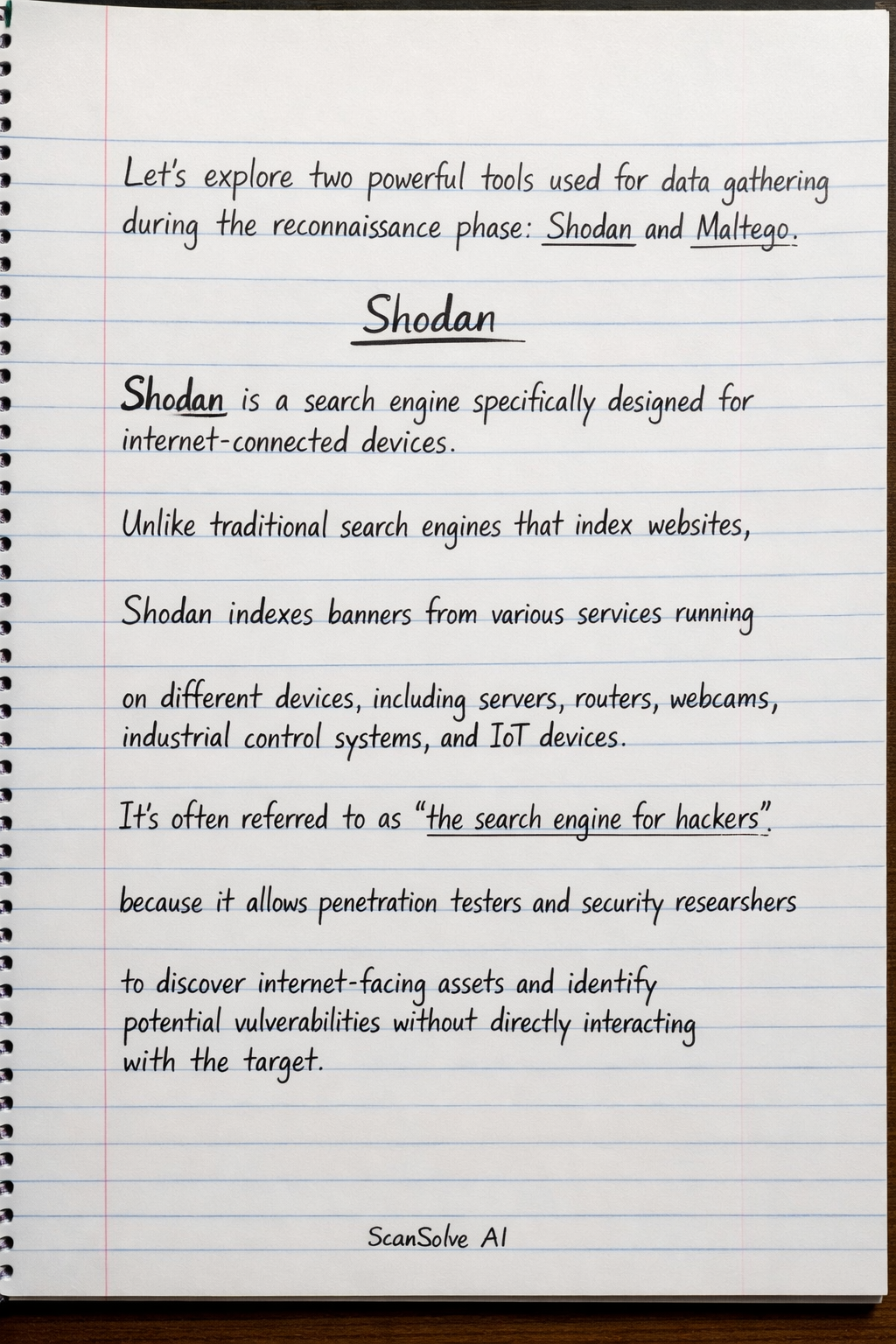
Let's explore two powerful tools used for data gathering during the reconnaissance phase: Shodan and Maltego.
Shodan
Shodan is a search engine specifically designed for internet-connected devices. Unlike traditional search engines that index websites, Shodan indexes banners from various services running on different devices, including servers, routers, webcams, industrial control systems, and IoT devices. It's often referred to as "the search engine for hackers" because it allows penetration testers and security researchers to discover internet-facing assets and identify potential vulnerabilities without directly interacting with the target.
- Purpose in Reconnaissance: Shodan's primary purpose is to discover an organization's internet-facing footprint. It helps identify devices, services, and open ports that might not be immediately obvious through standard web searches. This includes finding forgotten servers, misconfigured devices, or services running on non-standard ports.
- How it Works: Shodan continuously scans the internet, collecting banner information from services running on various IP addresses and ports. This banner information often reveals details like the software version, operating system, and specific configurations. Users can then query Shodan's database using filters based on keywords, IP ranges, ports, operating systems, or even specific vulnerabilities.
- Data Gathered: It provides data such as:
- Open ports and running services (e.g., HTTP, FTP, SSH, RDP).
- Software versions and server types (e.g., Apache, Nginx, IIS).
- Geographic location of devices.
- SSL certificate details.
- Vulnerability information associated with specific software versions.
- Metadata from various devices, including IoT devices and industrial control systems.
- Significance: For penetration testers, Shodan is invaluable for identifying potential entry points, understanding the target's external attack surface, and discovering devices that might be running outdated or vulnerable software. It helps in passive reconnaissance by providing a global view of exposed assets without directly probing the target network.
Maltego
Maltego is an open-source intelligence (OSINT) and graphical link analysis tool used for gathering and connecting information for investigative tasks. It specializes in visualizing relationships between various pieces of information, making complex data sets easier to understand. Maltego is particularly effective at mapping out networks, domains, individuals, and organizations.
- Purpose in Reconnaissance: Maltego's main purpose is to collect and visualize relationships between disparate pieces of information related to a target. It helps penetration testers build a comprehensive understanding of a target's infrastructure, personnel, and digital presence by showing how different entities are connected.
- How it Works: Maltego uses "transforms" to query various public data sources (like DNS records, Whois information, social media, search engines, and other OSINT sources). These transforms take an initial piece of information (an "entity," such as a domain name, email address, or person's name) and expand upon it by finding related entities. The results are then displayed graphically, showing the connections and relationships.
- Data Gathered: It can gather and link data such as:
- Domain names, subdomains, and associated IP addresses.
- DNS records (MX, NS, A records).
- Email addresses and associated individuals.
- Social media profiles and connections.
- Company information, including employees and locations.
- File metadata.
- Network infrastructure details.
- Significance: Maltego is crucial for understanding the broader context of a target. By visually mapping relationships, penetration testers can uncover hidden connections, identify key personnel, discover overlooked infrastructure, and gain insights into the target's organizational structure. This holistic view helps in formulating more targeted and effective attack strategies during later phases of the penetration test.
Still stuck on this one?
Ask a follow-up, and the answer starts from this question.
More Computer Science Questions
Handwritten Step-by-Step Solution
Get this as a handwritten image on WhatsApp — like a tutor wrote it for you.
Try on WhatsApp