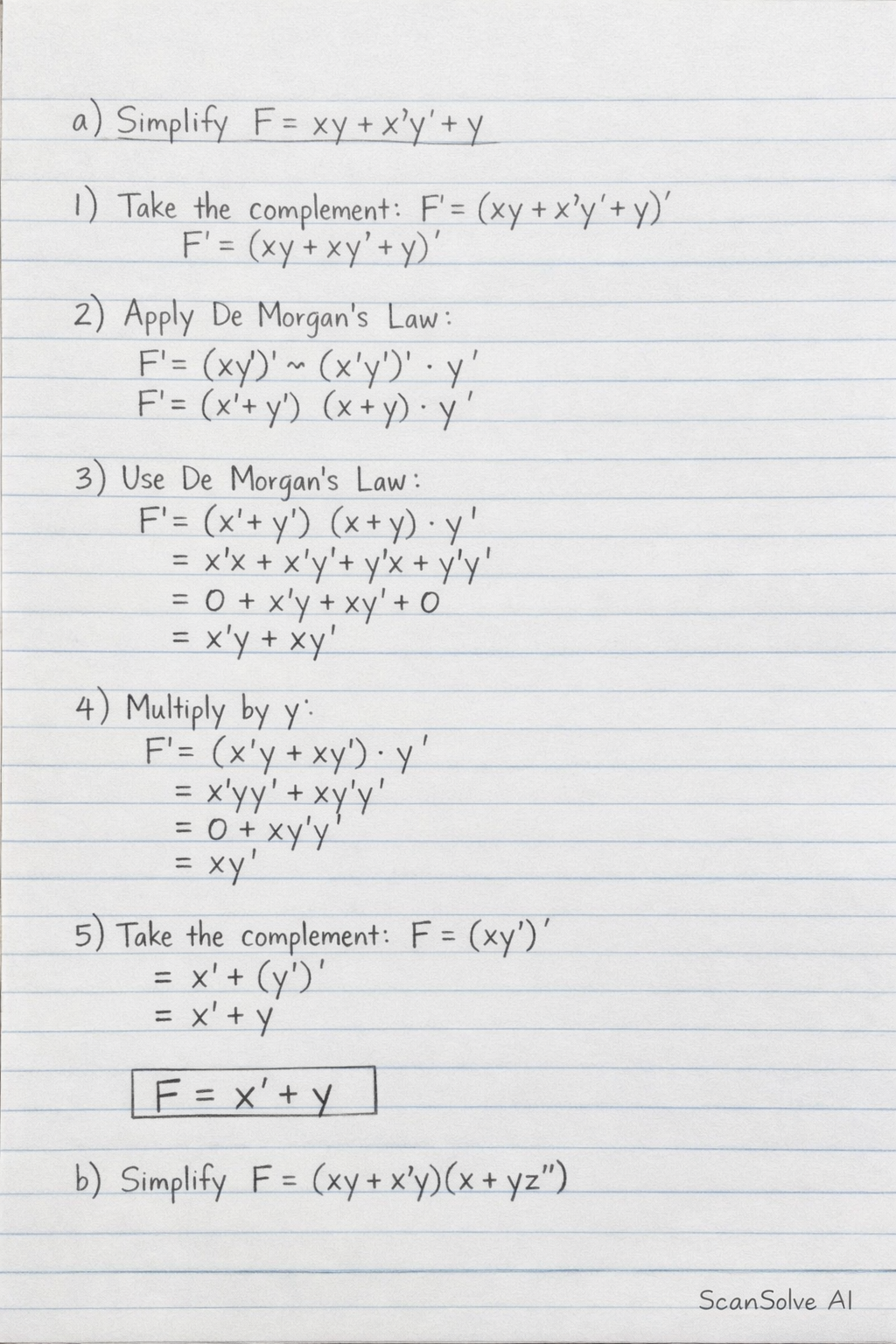
We read your photo as:

Simply the following using de morgans law: a) F = xy + x'y' + y b) F = (xy + x'y') (x+y'z')

Computer Science

ScanSolve AI Answer

Answers

2 parts
a

F=x′+yF = x' + y

b

F=xy+yz′F = xy + yz'

Step-by-step solution

11 steps

Here's how to simplify the given Boolean expressions using De Morgan's Law:

Part a· 5 steps

Simplify F=xy+x′y′+yF = xy + x'y' + y

  1. Take the complement of the function FF.

    F′=(xy+x′y′+y)′F' = (xy + x'y' + y)'
  2. Apply De Morgan's Law (A+B+C)′=A′B′C′(A+B+C)' = A'B'C'.

    F′=(xy)′⋅(x′y′)′⋅y′F' = (xy)' \cdot (x'y')' \cdot y'
  3. Apply De Morgan's Law again to (xy)′=x′+y′(xy)' = x'+y' and (x′y′)′=x′′+y′′=x+y(x'y')' = x''+y'' = x+y.

    F′=(x′+y′)⋅(x+y)⋅y′F' = (x'+y') \cdot (x+y) \cdot y'
  4. Expand the product (x′+y′)(x+y)(x'+y')(x+y) and then multiply by y′y'.

    (x′+y′)(x+y)=x′x+x′y+y′x+y′y=0+x′y+xy′+0=x′y+xy′(x'+y')(x+y) = x'x + x'y + y'x + y'y = 0 + x'y + xy' + 0 = x'y + xy'

    Now, multiply by y′y':

    F′=(x′y+xy′)⋅y′=x′yy′+xy′y′F' = (x'y + xy') \cdot y' = x'yy' + xy'y'

    Apply the Complement Law (yy′=0yy'=0) and Idempotent Law (y′y′=y′y'y'=y'):

    F′=x′(0)+x(y′)=0+xy′=xy′F' = x'(0) + x(y') = 0 + xy' = xy'
  5. Take the complement of F′F' to find FF using De Morgan's Law (AB)′=A′+B′(AB)' = A'+B'.

    F=(xy′)′=x′+(y′)′=x′+yF = (xy')' = x' + (y')' = x' + y

    The simplified expression is:

    F=x′+y\boxed{F = x' + y}

Part b

F=xy+yz′F = xy + yz'

Simplify F=(xy+x′y)(x+yz′)F = (xy + x'y)(x+yz')

  1. Simplify the initial expression using Distributive and Complement Laws.

    (xy+x′y)=y(x+x′)=y(1)=y(xy + x'y) = y(x+x') = y(1) = y

    The expression becomes:

    F=y(x+yz′)F = y(x+yz')

    Distribute yy and apply the Idempotent Law (yy=yyy=y):

    F=yx+y(yz′)=xy+yyz′=xy+yz′F = yx + y(yz') = xy + yy z' = xy + yz'
  2. Take the complement of FF and apply De Morgan's Law (A+B)′=A′B′(A+B)' = A'B'.

    F′=(xy+yz′)′=(xy)′⋅(yz′)′F' = (xy + yz')' = (xy)' \cdot (yz')'
  3. Apply De Morgan's Law again to (xy)′=x′+y′(xy)' = x'+y' and (yz′)′=y′+(z′)′=y′+z(yz')' = y'+(z')' = y'+z.

    F′=(x′+y′)(y′+z)F' = (x'+y')(y'+z)
  4. Expand and simplify F′F'.

    F′=x′y′+x′z+y′y′+y′zF' = x'y' + x'z + y'y' + y'z

    Apply Idempotent Law (y′y′=y′y'y'=y') and Absorption Law (A+AB=AA+AB=A):

    F′=x′y′+x′z+y′+y′zF' = x'y' + x'z + y' + y'z F′=y′(x′+1)+x′z+y′z=y′(1)+x′z+y′z=y′+x′z+y′zF' = y'(x'+1) + x'z + y'z = y'(1) + x'z + y'z = y' + x'z + y'z F′=y′(1+z)+x′z=y′(1)+x′z=y′+x′zF' = y'(1+z) + x'z = y'(1) + x'z = y' + x'z
  5. Take the complement of F′F' to find FF using De Morgan's Law (A+B)′=A′B′(A+B)' = A'B'.

    F=(y′+x′z)′=(y′)′⋅(x′z)′F = (y' + x'z)' = (y')' \cdot (x'z)'
  6. Apply De Morgan's Law again to (x′z)′=(x′)′+z′=x+z′(x'z)' = (x')' + z' = x+z'.

    F=y⋅(x+z′)F = y \cdot (x+z')

    Distribute yy:

    F=yx+yz′=xy+yz′F = yx + yz' = xy + yz'

    The simplified expression is:

    F=xy+yz′\boxed{F = xy + yz'}
Was this helpful?

Try one yourself

A new problem that tests the same skill.

Still stuck on this one?

Ask a follow-up, and the answer starts from this question.

Got a different question?Ask your own question
Handwritten step-by-step solution preview

Handwritten Step-by-Step Solution

Get this as a handwritten image on WhatsApp — like a tutor wrote it for you.

Try on WhatsApp