
We read your photo as:
If x + 2xy + 3y2 = 1, prove that (x + 3y)3 d2y/dx2 + 2 + 0
ScanSolve AI Answer
Step-by-step solution
9 stepsHere are the solutions to the questions from your image:
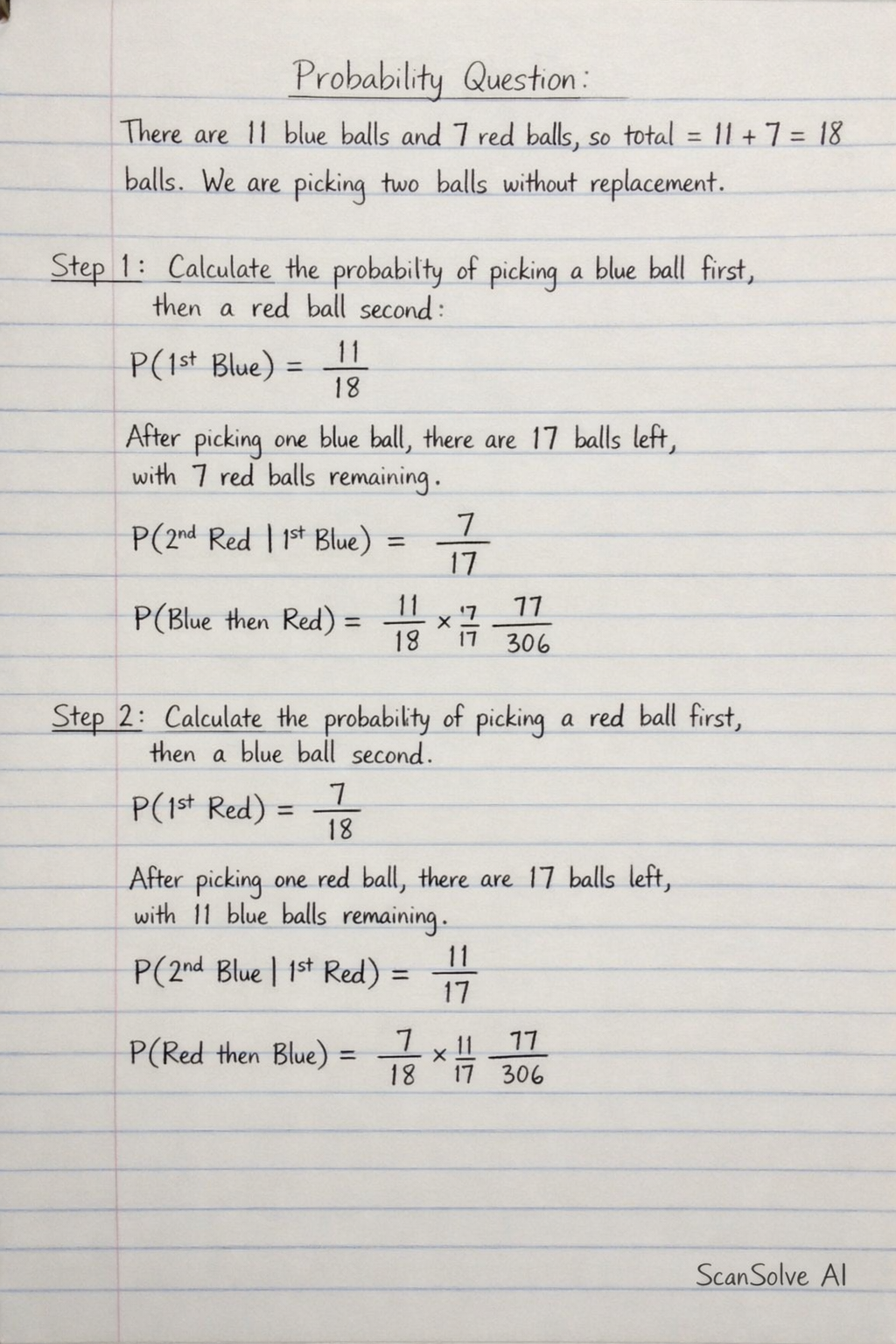
Probability Question:
There are 11 blue balls and 7 red balls, making a total of balls. We are picking two balls without replacement.
Calculate the probability of picking a blue ball first, then a red ball second.
After picking one blue ball, there are 17 balls left, with 7 red balls remaining.
Calculate the probability of picking a red ball first, then a blue ball second.
After picking one red ball, there are 17 balls left, with 11 blue balls remaining.
Add the probabilities of these two mutually exclusive events to find the total probability of picking balls of different colours.
Simplify the fraction.
The probability that both balls are of different colours is .
Implicit Differentiation Proof:
Given the equation .
We need to prove that .Differentiate the given equation implicitly with respect to .
Using the product rule for and the chain rule for :
Solve for .
Differentiate again with respect to using the quotient rule.
Let and .
Then and .
The quotient rule is .Substitute into the numerator.
Numerator:
From the original equation, we know that .
So, the numerator simplifies to .Substitute the simplified numerator back into the expression for and rearrange.
Multiply both sides by :
Add 2 to both sides:
This proves the statement.
Trigonometry Question:
The question asks to "find the value of " given . This question is incomplete as there is no additional information or equation provided to determine a specific value for or the expression. Without more context, the expression cannot be simplified to a numerical value.
Still stuck on this one?
Ask a follow-up, and the answer starts from this question.
More Mathematics Questions
Handwritten Step-by-Step Solution
Get this as a handwritten image on WhatsApp — like a tutor wrote it for you.
Try on WhatsApp