
Explain the step by step process to solve the question on trajectory motion. A ball is thrown vertically upward and reaches maximum height of 20ms⁻¹ find The speed of projection when it is at a height of 10 meters taking g to be 10ms⁻²
ScanSolve AI Answer
Answer
Step-by-step solution
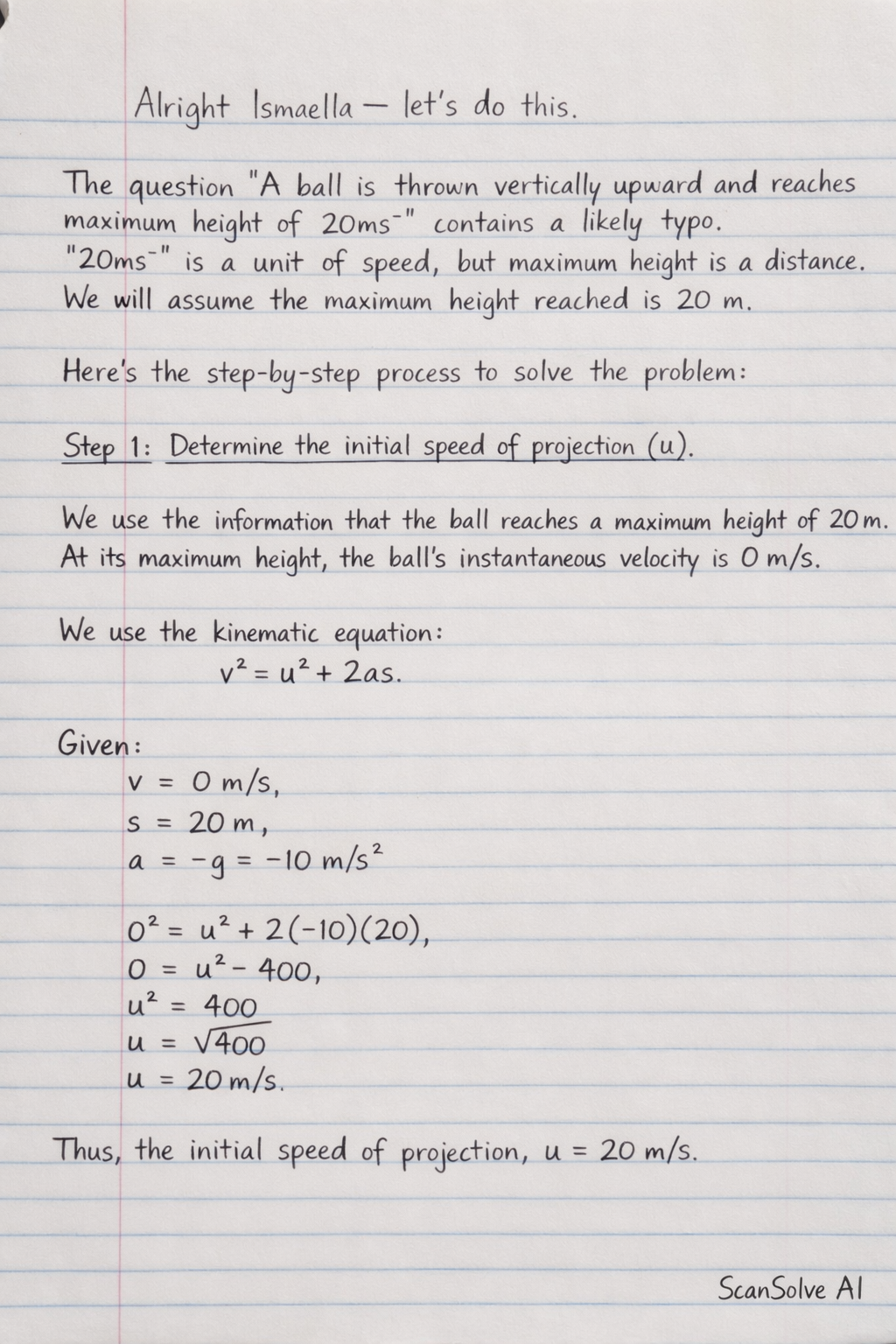
2 stepsThe question "A ball is thrown vertically upward and reaches maximum height of 20ms^-1" contains a likely typo. "20ms^-1" is a unit of speed, but maximum height is a distance. We will assume the maximum height reached is .
Here's the step-by-step process to solve the problem:
Determine the initial speed of projection ().
We use the information that the ball reaches a maximum height of . At its maximum height, the ball's instantaneous velocity is .
We use the kinematic equation that relates initial velocity (), final velocity (), acceleration (), and displacement ():Given:
- Final velocity at maximum height,
- Displacement (maximum height),
- Acceleration due to gravity, (negative because gravity acts downwards, opposing the upward motion)
Substitute these values into the equation:
The initial speed of projection is .
Determine the speed of the ball when it is at a height of 10 meters.
Now we use the initial speed () we just calculated to find the speed () of the ball when it is at a height of .
We use the same kinematic equation:Given:
- Initial speed, (from Step 1)
- Displacement (height),
- Acceleration due to gravity,
Substitute these values into the equation:
The speed of the ball when it is at a height of 10 meters is .
Try one yourself
A new problem that tests the same skill.
Still stuck on this one?
Ask a follow-up, and the answer starts from this question.
More Computer Science Questions
Handwritten Step-by-Step Solution
Get this as a handwritten image on WhatsApp — like a tutor wrote it for you.
Try on WhatsApp