
We read your photo as:
A particle is projected at an angle of 30° to the Horizontal with a speed of 250m/s. Calculate the time of flight, speed of the particle at its maximum height. (g = 10m/s)
ScanSolve AI Answer
Answers
2 partsStep-by-step solution
6 stepsGiven:
Initial speed,
Angle of projection,
Acceleration due to gravity,
Part a· 3 steps
Time of flight
The formula for the time of flight () for a projectile is given by
Substitute the given values into the formula
We know that .
Calculate the time of flight
The time of flight is 25 s.
Part b
Speed of the particle at its maximum height
At the maximum height, the vertical component of the velocity is zero.
The horizontal component of the velocity remains constant throughout the projectile motion (neglecting air resistance).
The horizontal component of the initial velocity () is given by:Substitute the given values into the formula
We know that .
Calculate the speed at maximum height
The speed of the particle at its maximum height is approximately 216.5 m/s.
Try one yourself
A new problem that tests the same skill.
Still stuck on this one?
Ask a follow-up, and the answer starts from this question.
More Physics Questions
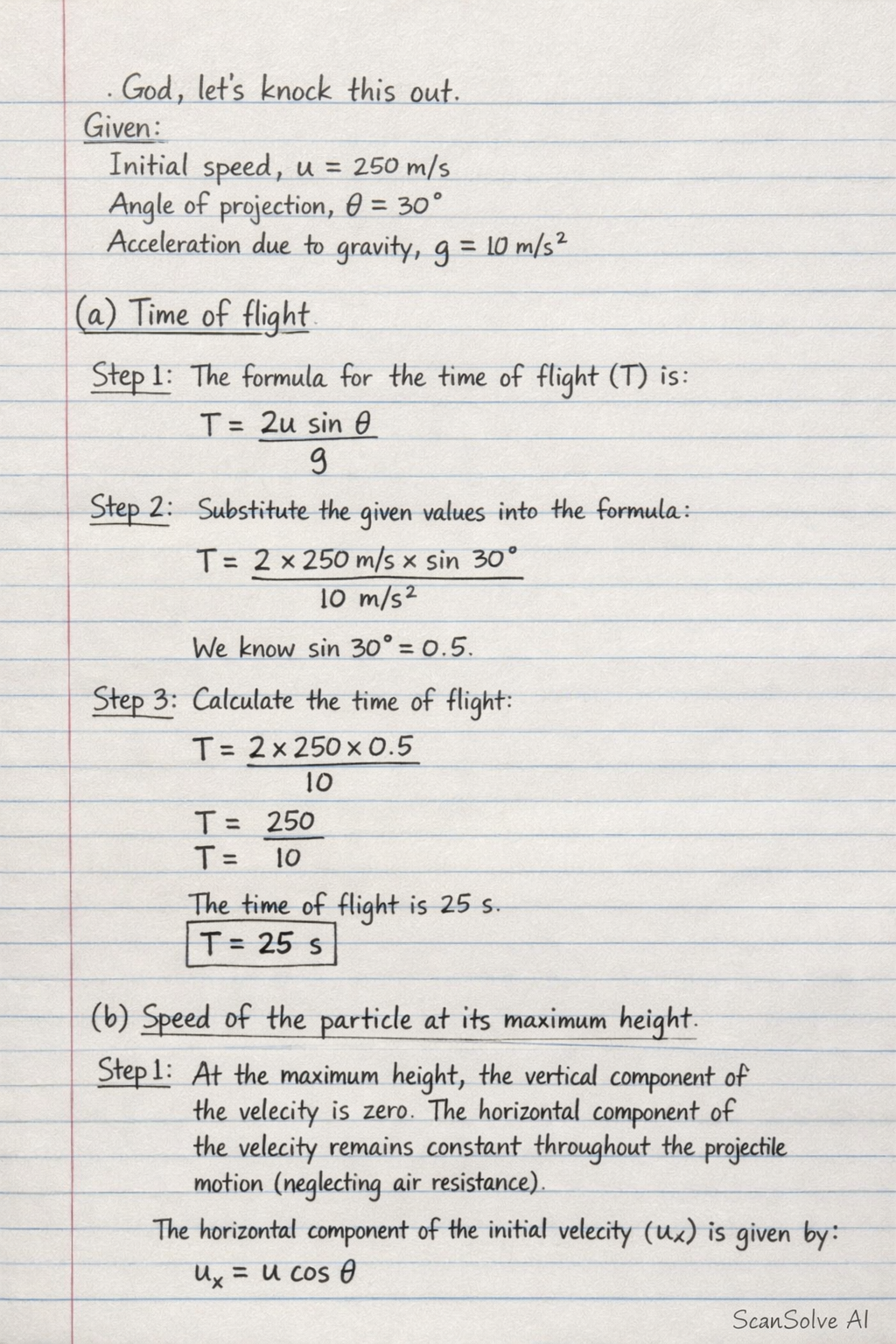
Handwritten Step-by-Step Solution
Get this as a handwritten image on WhatsApp — like a tutor wrote it for you.
Try on WhatsApp