
We read your photo as:
A particle is projected with an initial speed of 50 m/s at an angle heta. If the time to reach maximum height is 3s, show that sin heta = 3/5 and find the maximum height and horizontal distance.
ScanSolve AI Answer
Answers
4 partsStep-by-step solution
9 stepsHere's the solution for question 2:
Given:
Initial speed, m/s
Angle of projection =
Time to reach maximum height, s
We will assume the acceleration due to gravity, m/s, as this value is consistent with the given information in part (i).
Part i· 2 steps
Show that .
Use the vertical component of velocity at maximum height.
At maximum height, the vertical component of velocity () is 0.
The initial vertical velocity is .
Using the kinematic equation :Substitute the given values and solve for .
This matches the required value.
Part ii
Find the maximum height attained by the particle.
Calculate the initial vertical velocity.
Use the kinematic equation for vertical displacement to find the maximum height ().
Part iii
The horizontal distance OA covered by the particle.
Calculate the total time of flight ().
Since the particle lands at the same horizontal level as it was projected, the total time of flight is twice the time to reach maximum height.
Calculate the initial horizontal velocity ().
First, find from . Using the identity :
Calculate the horizontal distance (Range ).
Part iv
The direction of motion of the particle 4 seconds after projection.
Calculate the horizontal and vertical components of velocity at s.
The horizontal velocity () remains constant:
The vertical velocity () at s:
The negative sign indicates the particle is moving downwards.
Determine the direction of motion.
The direction of motion is given by the angle that the velocity vector makes with the horizontal.
Try one yourself
A new problem that tests the same skill.
Still stuck on this one?
Ask a follow-up, and the answer starts from this question.
More Physics Questions
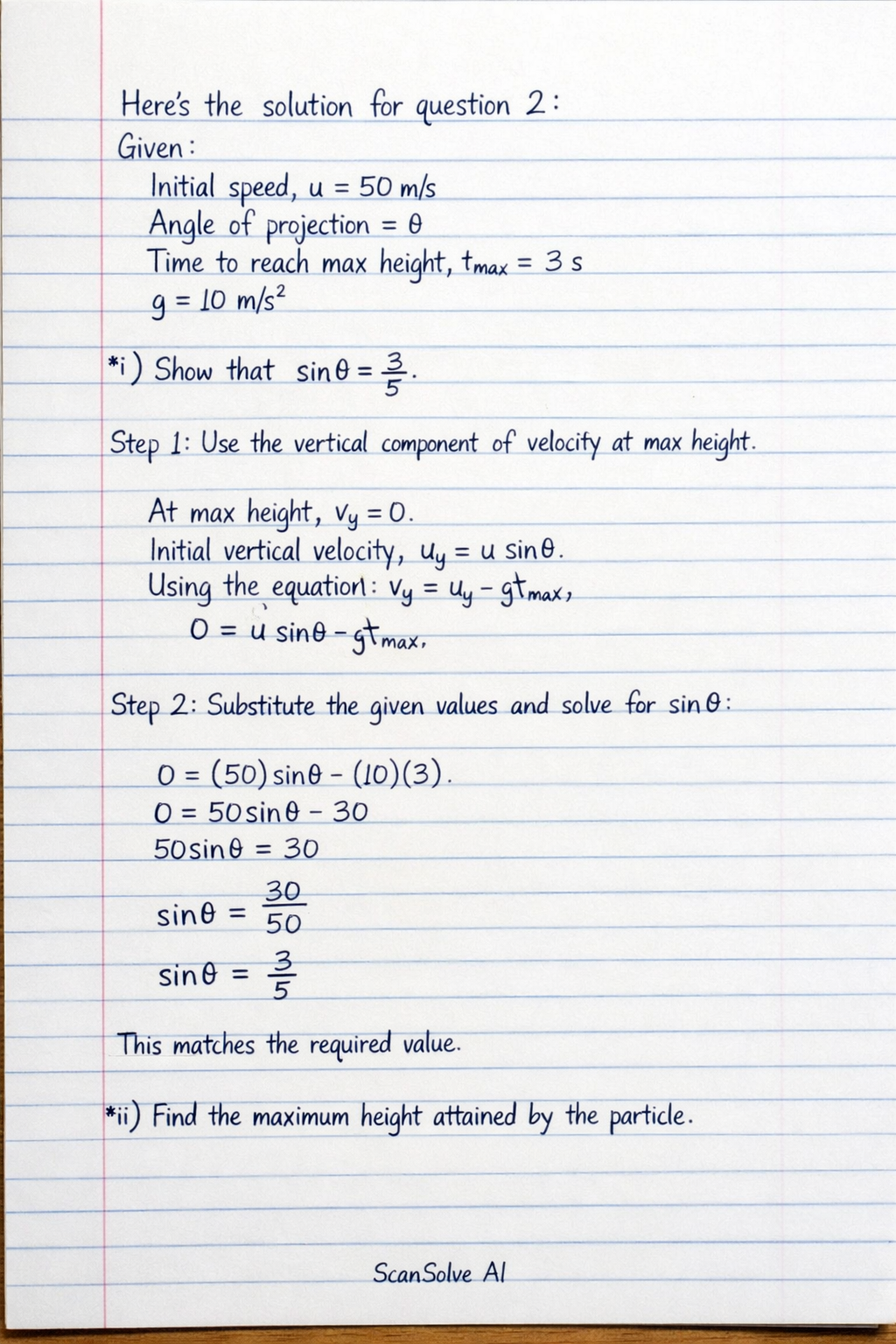
Handwritten Step-by-Step Solution
Get this as a handwritten image on WhatsApp — like a tutor wrote it for you.
Try on WhatsApp