
We read your photo as:
Explain the three primary models of cloud services (IaaS, PaaS, SaaS) and provide examples.
ScanSolve AI Answer
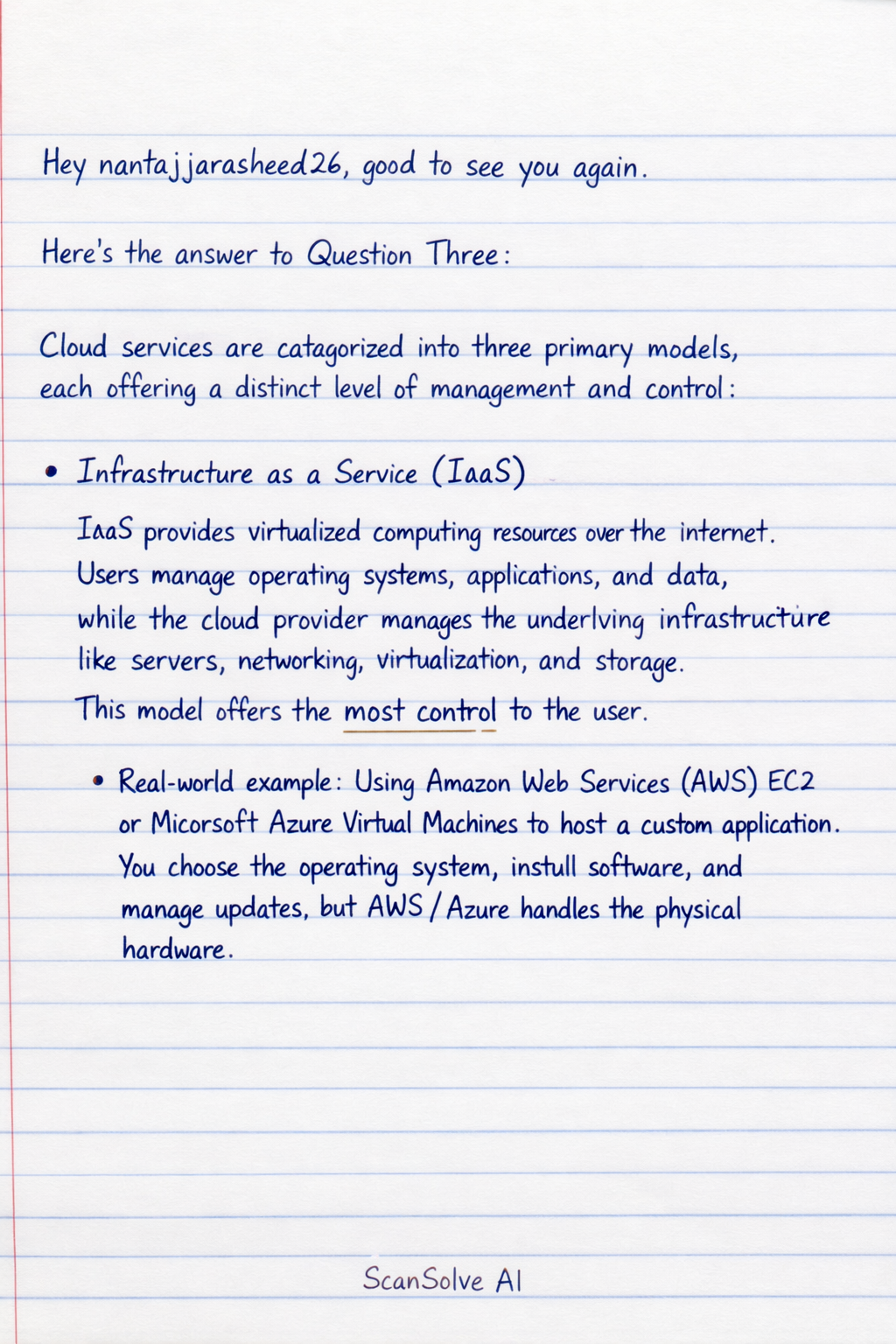
Here's the answer to Question Three:
Cloud services are categorized into three primary models, each offering a distinct level of management and control:
-
Infrastructure as a Service (IaaS) IaaS provides virtualized computing resources over the internet. Users manage operating systems, applications, and data, while the cloud provider manages the underlying infrastructure like servers, networking, virtualization, and storage. This model offers the most control to the user.
- Real-world example: Using Amazon Web Services (AWS) EC2 or Microsoft Azure Virtual Machines to host a custom application. You choose the operating system, install software, and manage updates, but AWS/Azure handles the physical hardware.
-
Platform as a Service (PaaS) PaaS provides a complete development and deployment environment in the cloud, with resources that enable users to deliver everything from simple cloud-based apps to sophisticated, cloud-enabled enterprise applications. The cloud provider manages the operating system, runtime, middleware, and underlying infrastructure, while the user manages their applications and data. This model offers moderate control.
- Real-world example: Developing and deploying a web application using Google App Engine or Heroku. You focus on writing your application code, and the platform handles the servers, databases, and scaling.
-
Software as a Service (SaaS) SaaS delivers software applications over the internet, on-demand, typically on a subscription basis. The cloud provider manages all aspects of the application, including the software, runtime, operating system, and infrastructure. Users simply access and use the application through a web browser or client interface. This model offers the least control to the user.
- Real-world example: Using Gmail, Salesforce, or Microsoft 365. You use the software directly without needing to install, manage, or update anything; the provider handles all the underlying infrastructure and application maintenance.
The key difference lies in the shared responsibility model:
- IaaS: The user is responsible for the most layers (applications, data, runtime, OS), while the provider handles the foundational infrastructure.
- PaaS: The user is responsible for applications and data, with the provider managing the platform and infrastructure.
- SaaS: The user is only responsible for their data and usage, with the provider managing everything else.
Still stuck on this one?
Ask a follow-up, and the answer starts from this question.
More Computer Science Questions
Handwritten Step-by-Step Solution
Get this as a handwritten image on WhatsApp — like a tutor wrote it for you.
Try on WhatsApp