
This computer science problem involves algorithmic thinking and programming concepts. The solution below explains the approach, logic, and implementation step by step.
ScanSolve AI Answer
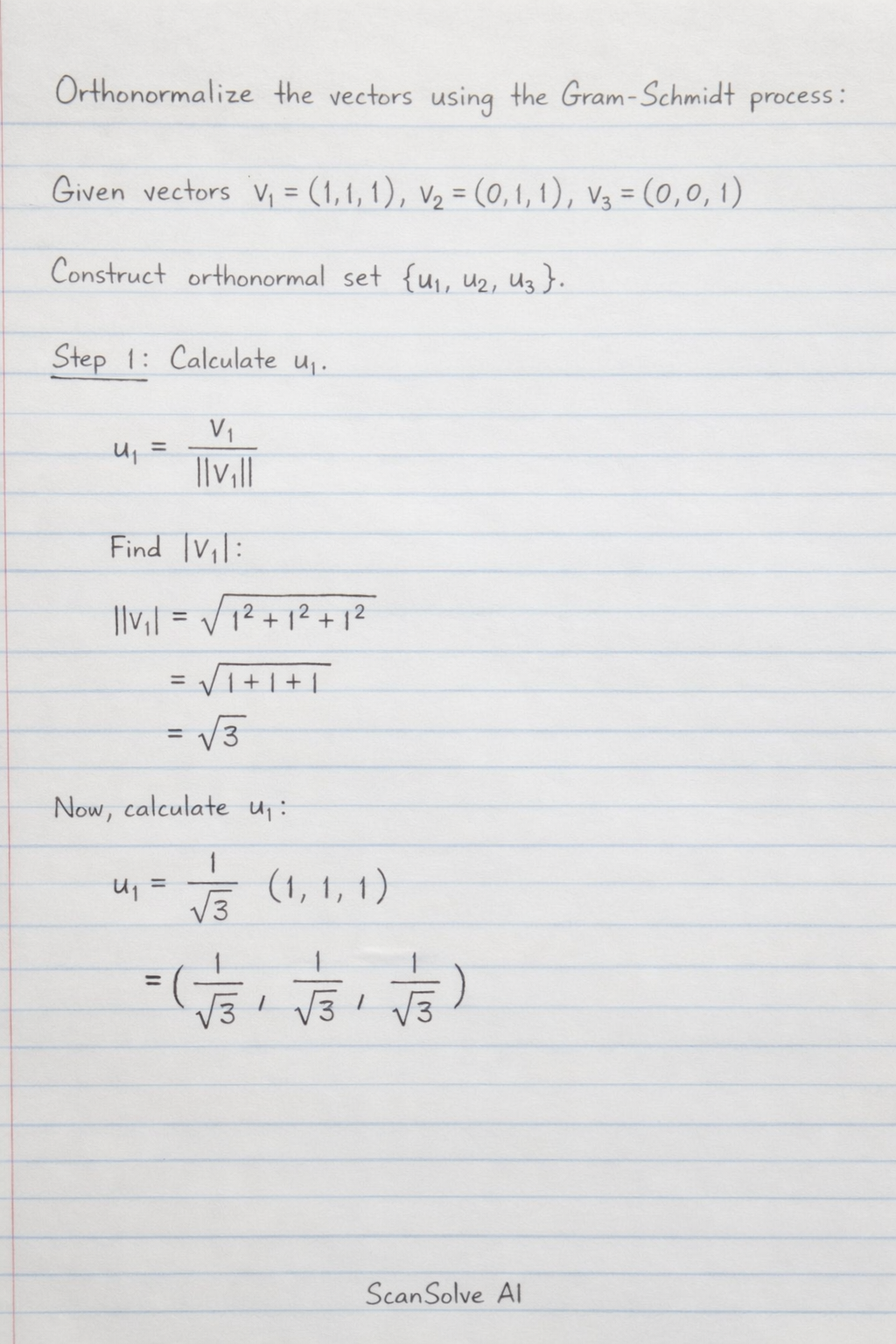
Here's how to orthonormalize the given set of linearly independent vectors using the Gram-Schmidt process: Let the given vectors be v_1 = (1, 1, 1), v_2 = (0, 1, 1), and v_3 = (0, 0, 1). We will construct an orthonormal set \u_1, u_2, u_3\. Step 1: Calculate u_1. The first orthonormal vector u_1 is obtained by normalizing v_1. u_1 = (v_1)/(\|v_1\|) First, find the norm of v_1: \|v_1\| = sqrt(1^2 + 1^2 + 1^2) = sqrt(1 + 1 + 1) = sqrt(3) Now, calculate u_1: u_1 = (1)/(sqrt(3))(1, 1, 1) = ((1)/(sqrt(3)), (1)/(sqrt(3)), (1)/(sqrt(3))) Step 2: Calculate u_2. To find u_2, we first find an orthogonal vector w_2 by subtracting the projection of v_2 onto u_1 from v_2. w_2 = v_2 - (v_2 · u_1) u_1 First, calculate the dot product v_2 · u_1: v_2 · u_1 = (0, 1, 1) · ((1)/(sqrt(3)), (1)/(sqrt(3)), (1)/(sqrt(3))) = 0 · (1)/(sqrt(3)) + 1 · (1)/(sqrt(3)) + 1 · (1)/(sqrt(3)) = (2)/(sqrt(3)) Now, calculate w_2: w_2 = (0, 1, 1) - (2)/(sqrt(3)) ((1)/(sqrt(3)), (1)/(sqrt(3)), (1)/(sqrt(3))) w_2 = (0, 1, 1) - ((2)/(3), (2)/(3), (2)/(3)) w_2 = (0 - (2)/(3), 1 - (2)/(3), 1 - (2)/(3)) = (-(2)/(3), (1)/(3), (1)/(3)) Next, normalize w_2 to get u_2: \|w_2\| = sqrt((-(2)/(3))^2 + ((1)/(3))^2 + ((1)/(3))^2) = sqrt((4)/(9) + (1)/(9) + (1)/(9)) = sqrt((6)/(9)) = sqrt((2)/(3)) u_2 = (w_2)/(\|w_2\|) = (1)/(sqrt(2)3) (-(2)/(3), (1)/(3), (1)/(3)) = sqrt(3)sqrt(2) (-(2)/(3), (1)/(3), (1)/(3)) u_2 = (-2sqrt(3)3sqrt(2), sqrt(3)3sqrt(2), sqrt(3)3sqrt(2)) = (-(2)/(sqrt(6)), (1)/(sqrt(6)), (1)/(sqrt(6))) Step 3: Calculate u_3. To find u_3, we first find an orthogonal vector w_3 by subtracting the projections of v_3 onto u_1 and u_2 from v_3. w_3 = v_3 - (v_3 · u_1) u_1 - (v_3 · u_2) u_2 First, calculate the dot product v_3 · u_1: v_3 · u_1 = (0, 0, 1) · ((1)/(sqrt(3)), (1)/(sqrt(3)), (1)/(sqrt(3))) = 0 · (1)/(sqrt(3)) + 0 · (1)/(sqrt(3)) + 1 · (1)/(sqrt(3)) = (1)/(sqrt(3)) Next, calculate the dot product v_3 · u_2: v_3 · u_2 = (0, 0, 1) · (-(2)/(sqrt(6)), (1)/(sqrt(6)), (1)/(sqrt(6))) = 0 · (-(2)/(sqrt(6))) + 0 · (1)/(sqrt(6)) + 1 · (1)/(sqrt(6)) = (1)/(sqrt(6)) Now, calculate w_3: w_3 = (0, 0, 1) - (1)/(sqrt(3)) ((1)/(sqrt(3)), (1)/(sqrt(3)), (1)/(sqrt(3))) - (1)/(sqrt(6)) (-(2)/(sqrt(6)), (1)/(sqrt(6)), (1)/(sqrt(6))) w_3 = (0, 0, 1) - ((1)/(3), (1)/(3), (1)/(3)) - (-(2)/(6), (1)/(6), (1)/(6)) w_3 = (0, 0, 1) - ((1)/(3), (1)/(3), (1)/(3)) - (-(1)/(3), (1)/(6), (1)/(6)) w_3 = (0 - (1)/(3) - (-(1)/(3)), 0 - (1)/(3) - (1)/(6), 1 - (1)/(3) - (1)/(6)) w_3 = (0, -(2)/(6) - (1)/(6), (6)/(6) - (2)/(6) - (1)/(6)) w_3 = (0, -(3)/(6), (3)/(6)) = (0, -(1)/(2), (1)/(2)) Finally, normalize w_3 to get u_3: \|w_3\| = sqrt(0^2 + (-(1)/(2))^2 + ((1)/(2))^2) = sqrt(0 + (1)/(4) + (1)/(4)) = sqrt((2)/(4)) = sqrt((1)/(2)) u_3 = (w_3)/(\|w_3\|) = (1)/(sqrt(1)2) (0, -(1)/(2), (1)/(2)) = sqrt(2) (0, -(1)/(2), (1)/(2)) u_3 = (0, -sqrt(2)2, sqrt(2)2) = (0, -(1)/(sqrt(2)), (1)/(sqrt(2))) The orthonormal set of vectors is: \((1)/(sqrt(3)), (1)/(sqrt(3)), (1)/(sqrt(3))), (-(2)/(sqrt(6)), (1)/(sqrt(6)), (1)/(sqrt(6))), (0, -(1)/(sqrt(2)), (1)/(sqrt(2)))\ Last free one today — make it count tomorrow, or type /upgrade for unlimited.