
We read your photo as:
Compute y(t) = x(t) * h(t) given x(t) = u(t−3) − u(t−5) and h(t) = e⁻³tu(t).
Computer Science
ScanSolve AI Answer
Step-by-step solution
2 stepsa) Compute .
Define the convolution integral.
The convolution is given by:
Given signals are and .
This means for and 0 otherwise.
Also, , which is for (i.e., ) and 0 otherwise.Set up the integral
Was this helpful?
Still stuck on this one?
Ask a follow-up, and the answer starts from this question.
Got a different question?Ask your own question
More Computer Science Questions
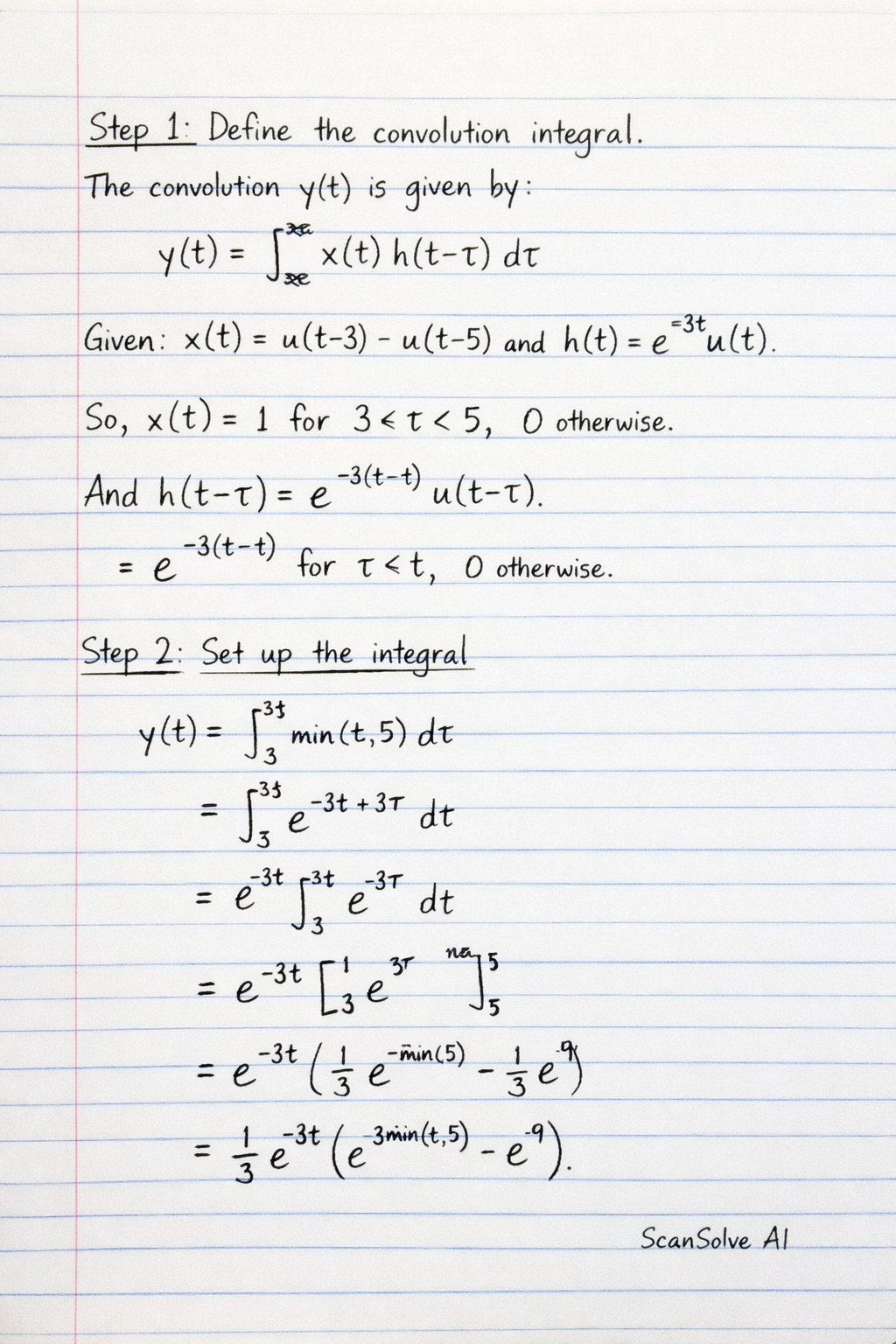
Handwritten Step-by-Step Solution
Get this as a handwritten image on WhatsApp — like a tutor wrote it for you.
Try on WhatsApp