
We read your photo as:
Solve the following set of inequality: 2x + 4 >= 18
ScanSolve AI Answer
Step-by-step solution
2 steps- a) Biology is the scientific study of life. It explores the structure, function, growth, evolution, distribution, and classification of all living organisms.
b) Mathematics is applied in various fields, including:
i. Engineering
ii. Physics
iii. Computer Science
iv. Economics
v. Medicine
- a)
i. Algebra: The study of mathematical symbols and the rules for manipulating these symbols. It involves solving equations and understanding relationships between quantities.
- Examples: Solving for . Using variables like . ii. Geometry: The study of shapes, sizes, positions, and properties of space. It deals with points, lines, angles, surfaces, and solids.
- Examples: Calculating the area of a triangle. Determining the volume of a cylinder. iii. Statistics: The science of collecting, analyzing, interpreting, presenting, and organizing data. It helps in making informed decisions based on numerical information.
- Examples: Calculating the average score of a class. Predicting election outcomes based on survey data.
b) Yes, learning mathematics is important in our daily life for the following reasons:
i. It develops critical thinking and problem-solving skills.
ii. It is essential for managing personal finances and budgeting.
iii. It helps in understanding and interpreting data from news and reports.
iv. It is fundamental for technological literacy and understanding how modern devices work.
- a) i. To represent on a number line: Convert to a decimal: . The inequality is . On a number line, draw a closed circle at 2.6 and shade the line to the right.
\begin{tikzpicture}
\draw[<->] (-0.5,0) -- (5.5,0);
\foreach \x in {0,1,2,3,4,5}
  \draw (\x,0.1) -- (\x,-0.1) node[below] {\x};
\filldraw[black] (2.6,0) circle (2pt);
\draw[line width=1.5pt, ->] (2.6,0) -- (5.5,0);
\end{tikzpicture}
ii. To represent on a number line:
Convert to a decimal: .
The inequality is .
On a number line, draw a closed circle at 2.5 and an open circle at 4. Shade the line segment between these two points.
\begin{tikzpicture}
\draw[<->] (-0.5,0) -- (5.5,0);
\foreach \x in {0,1,2,3,4,5}
  \draw (\x,0.1) -- (\x,-0.1) node[below] {\x};
\filldraw[black] (2.5,0) circle (2pt);
\draw[white, line width=3pt] (4,0) circle (2pt); % To make it look like an open circle
\draw[black] (4,0) circle (2pt);
\draw[line width=1.5pt] (2.5,0) -- (4,0);
\end{tikzpicture}
b) Five rational numbers equivalent to are:
i.
ii.
iii.
iv.
v.
- a) Calculate Mr. Greyson's monthly savings. Total Salary = Tsh 450,000 Amount spent on food (first part) = Tsh Remaining salary = Tsh Amount spent on food (second part) = Tsh Remaining salary after second food expense = Tsh Amount spent on miscellaneous = Tsh Remaining salary after miscellaneous = Tsh His monthly savings = 90,000 Tsh. His monthly savings is .
b) The answer in part (a) is Tsh 90,000. This is a rational number because it can be expressed as a fraction of two integers, for example, .
- a) i. 23.126666... in recurring notation is . ii. 12.6231 in long form (expanded form) is .
b) The numbers such as and other similar numbers are called irrational numbers.
- a) Solve the inequality .
Subtract 4 from both sides of the inequality.
Divide both sides by 2.
The solution to the inequality is .
Still stuck on this one?
Ask a follow-up, and the answer starts from this question.
More Mathematics Questions
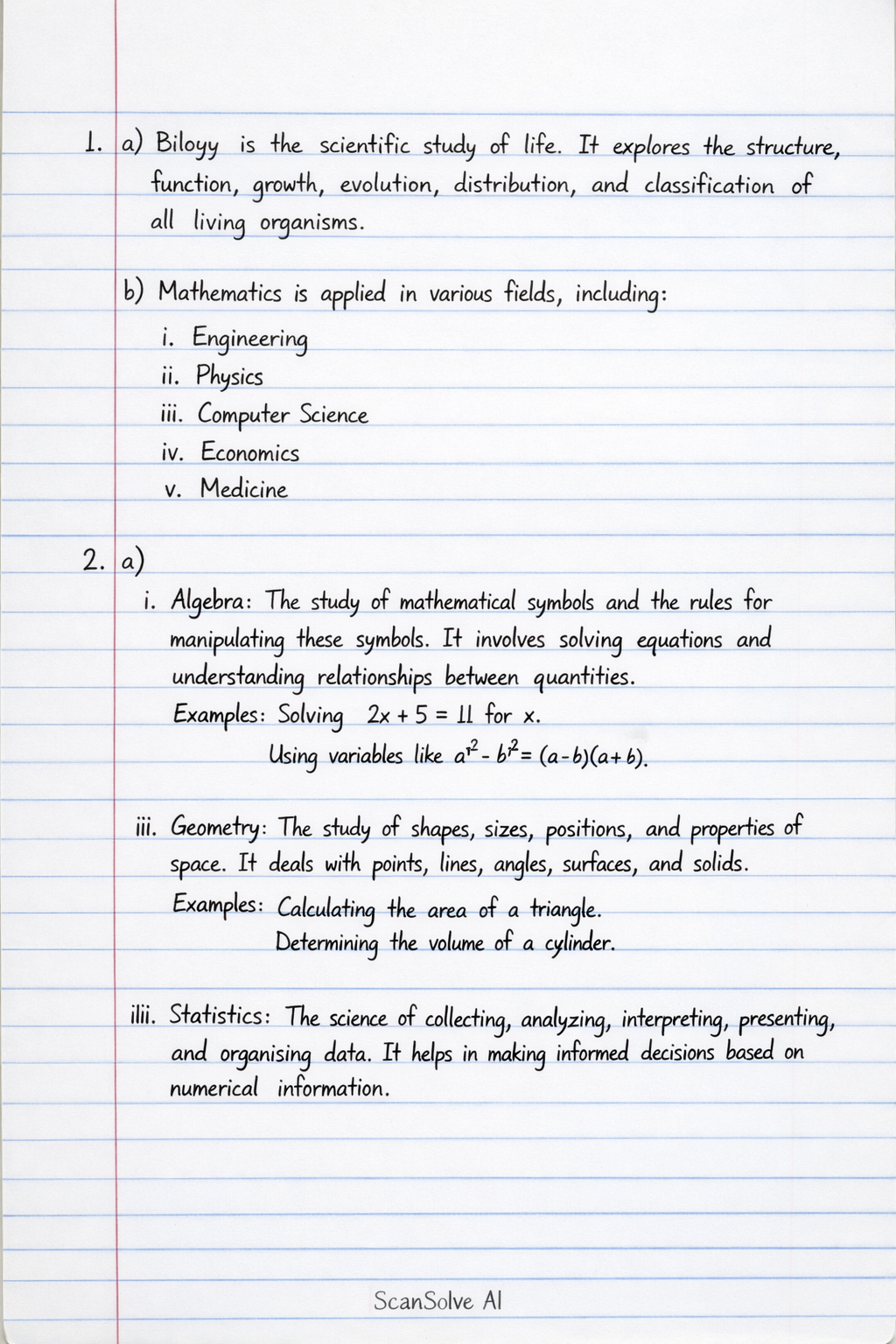
Handwritten Step-by-Step Solution
Get this as a handwritten image on WhatsApp — like a tutor wrote it for you.
Try on WhatsApp