
We read your photo as:
What is the commercial unit for measurement of electrical energy consumption? An electric heater rated 1000 W is used in a home for 5 hours each day. If the electricity company sells it at the cost of 50 frs, how much will it cost to run the heater for 30 days?
ScanSolve AI Answer
Step-by-step solution
11 steps1.a) What is the commercial unit for measurement of electrical energy consumption?
The commercial unit for measurement of electrical energy consumption is the kilowatt-hour ().
1.b) An electric heater rated 1000 W is used in a home for 5 hours each day. If the electricity company sells 1 kWh at the cost of 50 frs, how much will it cost to run the heater for 30 days?
Convert power from watts to kilowatts.
Calculate the energy consumed per day.
Calculate the total energy consumed over 30 days.
Calculate the total cost.
The total cost to run the heater for 30 days is .
1.c) The heater above is connected on 220 V mains. Determine the fuse value that would be good for the heater?
Calculate the current drawn by the heater.
The power formula is .
Determine a suitable fuse value.
A fuse should have a rating slightly higher than the normal operating current to prevent it from blowing unnecessarily, but low enough to protect the circuit in case of a fault. Standard fuse values are typically 1 A, 2 A, 3 A, 5 A, 10 A, 13 A. A 5 A fuse would be the most appropriate standard fuse value for a current of 4.55 A.
The fuse value that would be good for the heater is .
2.a) Copy the diagram and show all the forces acting on the bucket.
(Diagram cannot be copied here, but the forces are described below.)
The forces acting on the bucket are:- Weight of the sand (and bucket, though bucket weight is neglected in part d) acting vertically downwards.
- Tension in the string acting vertically upwards.
2.b) Calculate the weight of the sand in the bucket.
Identify the given mass and acceleration due to gravity.
Calculate the weight.
The weight of the sand in the bucket is .
2.c) Give one difference between the weight and mass of the sand.
- Mass is a measure of the amount of matter in an object and is constant regardless of location.
- Weight is the force of gravity acting on an object and varies depending on the gravitational field strength of the location.
2.d) If the system is in equilibrium, calculate the support provided by the string (neglect the weight of the bucket).
Apply the condition for equilibrium.
In equilibrium, the net force acting on the bucket is zero. This means the upward force equals the downward force.
Identify the forces.
The upward force is the support provided by the string (tension).
The downward force is the weight of the sand.Calculate the support.
The support provided by the string is .
3.a) Copy the diagram and show on it the direction of current and the magnetic flux pattern on the cardboard.
(Diagram cannot be copied here, but the directions and pattern are described.)- Direction of current: Assuming the battery symbol shows the longer line as positive and shorter as negative, the conventional current flows from the positive terminal of the battery, through the wire, and back to the negative terminal. This would typically be clockwise or counter-clockwise depending on the orientation of the battery in the diagram.
- Magnetic flux pattern: The magnetic field lines around a straight current-carrying wire are concentric circles centered on the wire. The direction of these circles can be determined by the Right-Hand Grip Rule. If the thumb points in the direction of the current, the curled fingers indicate the direction of the magnetic field lines.
3.b) Name one rule that can be used to determine the direction of the magnetic field around the wire.
The rule that can be used is the Right-Hand Grip Rule (also known as Maxwell's Corkscrew Rule).3.c) State one thing that can be done to increase the strength of the magnetic field.
One thing that can be done to increase the strength of the magnetic field is to increase the current flowing through the wire.4.a) Arrange the above radiations in order of increasing frequency.
The order of electromagnetic radiations in increasing frequency is:- Infra-red (IR)
- Visible light
- Ultra violet (UV)
The order is .
4.b) Name a detector each for infra-red and ultra violet radiations.
- Infra-red detector: Thermopile (or IR camera, skin, special photographic film).
- Ultra violet detector: UV sensor (or photographic film, fluorescent materials).
4.c) Give two properties that are common to all electromagnetic (em) waves.
Two properties common to all electromagnetic waves are:- They all travel at the speed of light () in a vacuum.
- They are all transverse waves.
- They do not require a medium for propagation.
- They can all be reflected, refracted, diffracted, and polarized.
Still stuck on this one?
Ask a follow-up, and the answer starts from this question.
More Physics Questions
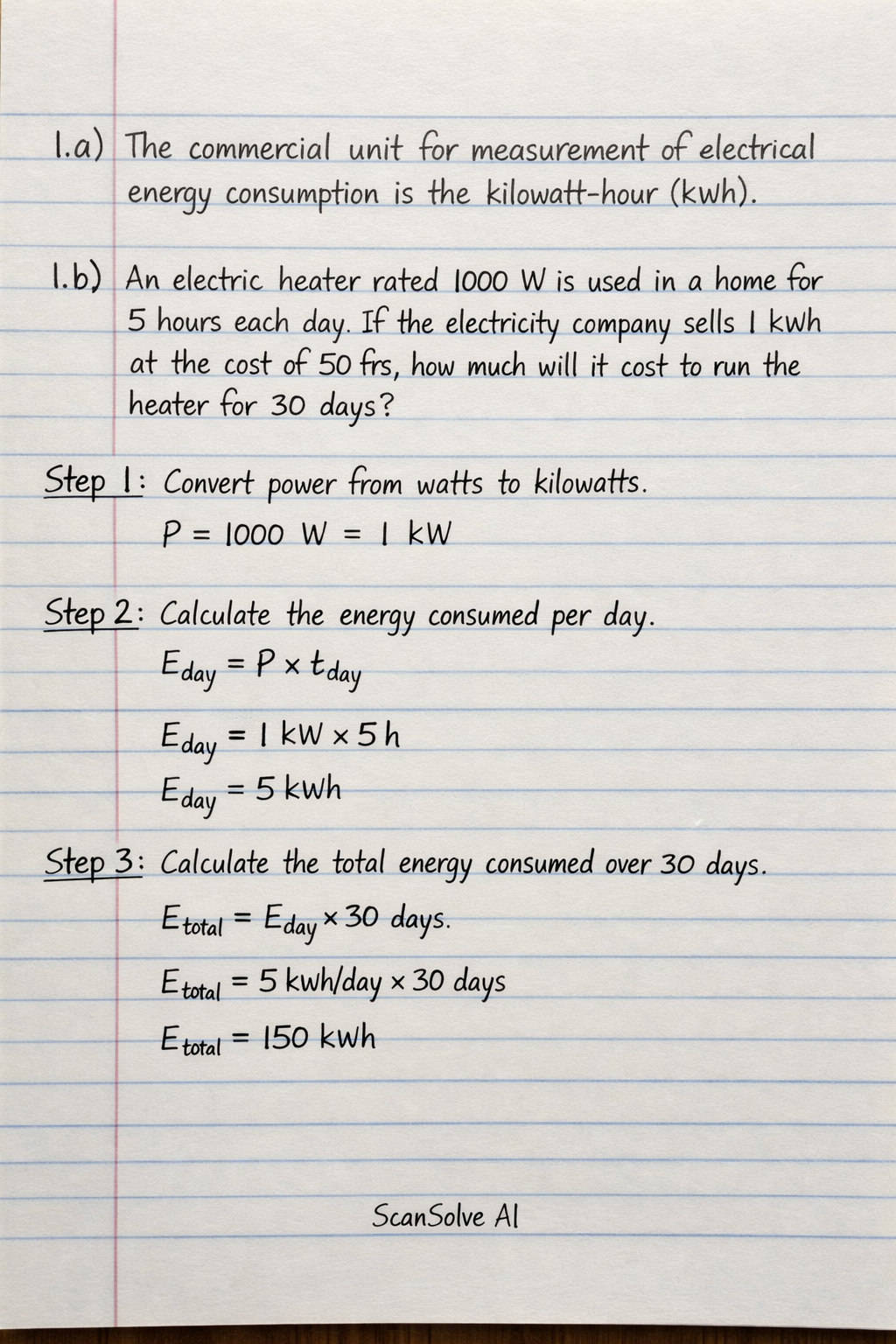
Handwritten Step-by-Step Solution
Get this as a handwritten image on WhatsApp — like a tutor wrote it for you.
Try on WhatsApp