
We read your photo as:
A) With the aid of production possibility curves, distinguish between increasing and decreasing opportunity costs.
ScanSolve AI Answer
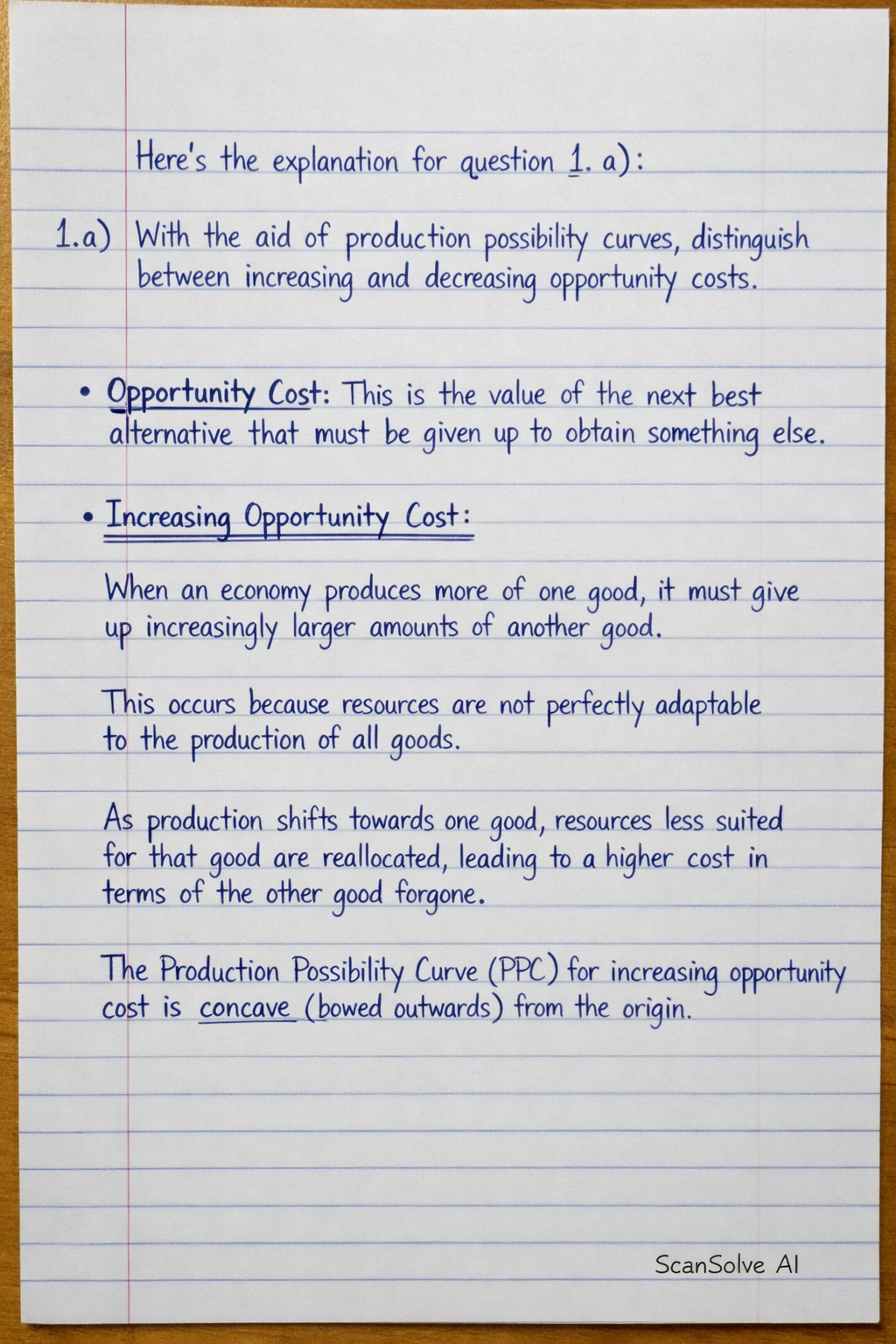
Here's the explanation for question 1. a):
1. a) With the aid of production possibility curves, distinguish between increasing and decreasing opportunity costs.
-
Opportunity Cost: This is the value of the next best alternative that must be given up to obtain something else.
-
Increasing Opportunity Cost: When an economy produces more of one good, it must give up increasingly larger amounts of another good. This occurs because resources are not perfectly adaptable to the production of all goods. As production shifts towards one good, resources less suited for that good are reallocated, leading to a higher cost in terms of the other good forgone. The Production Possibility Curve (PPC) for increasing opportunity cost is concave (bowed outwards) from the origin.
Diagram for Increasing Opportunity Cost:
Draw a graph with "Good X" on the x-axis and "Good Y" on the y-axis. The PPC should be a curve that bows outwards from the origin. As you move down the curve (producing more Good X), the slope becomes steeper, indicating that more and more Good Y must be sacrificed for each additional unit of Good X. -
Decreasing Opportunity Cost: When an economy produces more of one good, it gives up progressively smaller amounts of another good. This situation is less common but can occur if resources are highly specialized and become more efficient as production of a particular good increases, or if there are significant economies of scale. The PPC for decreasing opportunity cost is convex (bowed inwards) towards the origin.
Diagram for Decreasing Opportunity Cost:
Draw a graph with "Good X" on the x-axis and "Good Y" on the y-axis. The PPC should be a curve that bows inwards towards the origin. As you move down the curve (producing more Good X), the slope becomes flatter, indicating that less and less Good Y must be sacrificed for each additional unit of Good X.
Still stuck on this one?
Ask a follow-up, and the answer starts from this question.
More Economics Questions
Handwritten Step-by-Step Solution
Get this as a handwritten image on WhatsApp — like a tutor wrote it for you.
Try on WhatsApp