ScanSolve logoScanSolve
Toggle sidebar
  • Homework
  • Tutor
  • Humanizer
  • AI Detector
  • Questions
  • Blog
  • History
  • Mobile App

  • Homework
  • Tutor
  • Humanizer
  • AI Detector

  • Questions
  • Math homework helpMath
    Physics homework helpPhysics
    Chemistry homework helpChemistry
    Biology homework helpBiology
    Computer Science homework helpComputer Science
    History homework helpHistory
    More homework helpMore
  • Blog
  • History

  • Mobile App
ScanSolvePLUS
  • Unlimited answers
  • ScanSolve AI Pro
Start Free Trial →
Try on WhatsApp
Economics: 1. Differentiate between 'cross elasticity of demand' and 'income elasticity of... — Step-by-Step Solution | ScanSolve
Home > Economics Homework Help > Solution

1. Differentiate between 'cross elasticity of demand' and 'income elasticity of demand'.

Asked on March 28, 2026|Economics

This economics question tests your understanding of economic models and analysis. The step-by-step answer below applies the relevant framework and explains the reasoning.

ScanSolve AI AnswerAnswered on March 28, 2026
Here are the answers to your questions: 1. Differentiate between 'cross elasticity of demand' and 'income elasticity of demand'. Cross elasticity of demand (XED)* measures the responsiveness of the quantity demanded of one good to a change in the price of another good. It indicates whether goods are substitutes (positive XED) or complements (negative XED). Income elasticity of demand (YED)* measures the responsiveness of the quantity demanded of a good to a change in consumers' income. It indicates whether a good is normal (positive YED) or inferior (negative YED). 2. Discuss the FIVE types of elasticity of demand. Perfectly elastic demand*: Quantity demanded changes infinitely with a tiny change in price. The demand curve is horizontal. Relatively elastic demand*: The percentage change in quantity demanded is greater than the percentage change in price ($E_d > 1$). Consumers are very responsive to price changes. Unitary elastic demand*: The percentage change in quantity demanded is equal to the percentage change in price ($E_d = 1$). Total revenue remains constant with price changes. Relatively inelastic demand*: The percentage change in quantity demanded is less than the percentage change in price ($E_d < 1$). Consumers are not very responsive to price changes. Perfectly inelastic demand*: Quantity demanded does not change at all, regardless of the change in price ($E_d = 0$). The demand curve is vertical. 3. List any SIX factors which determine the elasticity of demand. Availability of close substitutes Whether the good is a necessity or a luxury The proportion of income spent on the good The time horizon considered The definition of the market The addictiveness or habit-forming nature of the good 4. In a tabular form, indicate any TWO differences between 'macro-economics' and 'micro-economics'. | Feature | Macroeconomics | Microeconomics | | :--------------- | :------------------------------------------------- | :------------------------------------------------ | | Scope | Studies the economy as a whole (aggregate level). | Studies individual economic units (firms, households). | | Key Concerns | Deals with national income, inflation, unemployment. | Deals with individual prices, output, consumer behavior. | 5. Explain the term 'opportunity cost'. Opportunity cost* is the value of the next best alternative that must be foregone when a choice is made. It represents what is given up in order to obtain something else.

Related Economics Questions

  • Principle of micro economics
  • Eco 101 course outline: ECONOMICS Meaning of economics Principles of micro economics Economic statement Macro economics...
  • 1. a) With the aid of production possibility curves, distinguish between increasing and decreasing opportunity costs.
  • Report on Periodic Trends and Production Process Recommendations
  • 1) Enumerate four different actions trade union's can take to enforce their demands 2) state four Economics factors whic...
  • 1) State the law of diminishing returns and justify why it holds 2) l list three assumption of this law 3) identify thre...
See all Economics questions

This step-by-step solution was generated by ScanSolve AI. Need help with more economics problems? Browse Economics solutions or ask your own question.

Home›Economics Homework Help›1. Differentiate between 'cross elasticity of demand' and 'i…
Q

1. Differentiate between 'cross elasticity of demand' and 'income elasticity of demand'.

March 28, 2026|Economics
1. Differentiate between 'cross elasticity of demand' and 'income elasticity of demand'.

1. Differentiate between 'cross elasticity of demand' and 'income elasticity of demand'.

ScanSolve AI

ScanSolve AI Answer

Answered on March 28, 2026

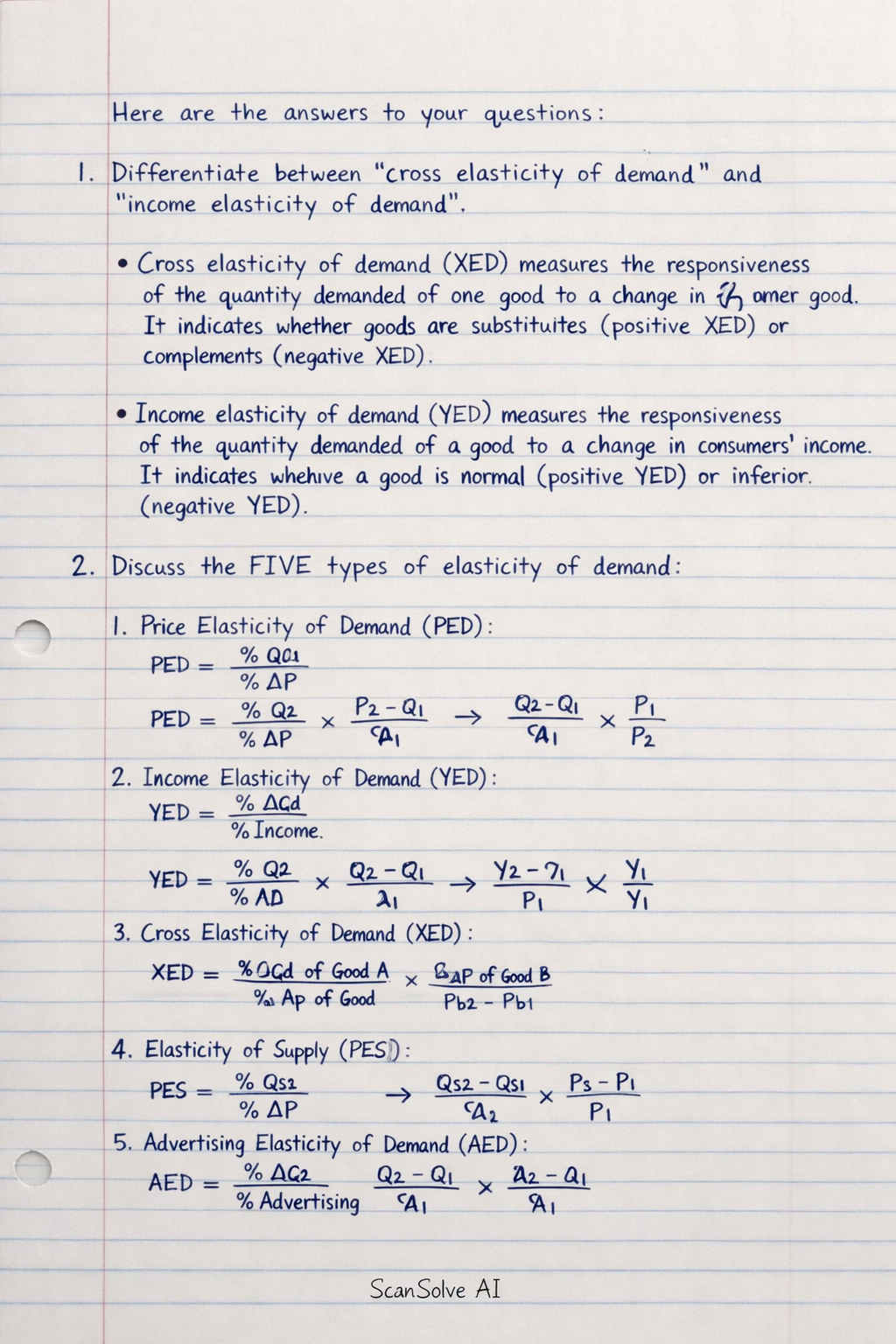
Here are the answers to your questions:

  1. Differentiate between 'cross elasticity of demand' and 'income elasticity of demand'.

    • Cross elasticity of demand (XED) measures the responsiveness of the quantity demanded of one good to a change in the price of another good. It indicates whether goods are substitutes (positive XED) or complements (negative XED).
    • Income elasticity of demand (YED) measures the responsiveness of the quantity demanded of a good to a change in consumers' income. It indicates whether a good is normal (positive YED) or inferior (negative YED).
  2. Discuss the FIVE types of elasticity of demand.

    • Perfectly elastic demand: Quantity demanded changes infinitely with a tiny change in price. The demand curve is horizontal.
    • Relatively elastic demand: The percentage change in quantity demanded is greater than the percentage change in price (Ed>1E_d > 1Ed​>1). Consumers are very responsive to price changes.
    • Unitary elastic demand: The percentage change in quantity demanded is equal to the percentage change in price (Ed=1E_d = 1Ed​=1). Total revenue remains constant with price changes.
    • Relatively inelastic demand: The percentage change in quantity demanded is less than the percentage change in price (Ed<1E_d < 1Ed​<1). Consumers are not very responsive to price changes.
    • Perfectly inelastic demand: Quantity demanded does not change at all, regardless of the change in price (Ed=0E_d = 0Ed​=0). The demand curve is vertical.
  3. List any SIX factors which determine the elasticity of demand.

    • Availability of close substitutes
    • Whether the good is a necessity or a luxury
    • The proportion of income spent on the good
    • The time horizon considered
    • The definition of the market
    • The addictiveness or habit-forming nature of the good
  4. In a tabular form, indicate any TWO differences between 'macro-economics' and 'micro-economics'.

    | Feature | Macroeconomics | Microeconomics | | :--------------- | :------------------------------------------------- | :------------------------------------------------ | | Scope | Studies the economy as a whole (aggregate level). | Studies individual economic units (firms, households). | | Key Concerns | Deals with national income, inflation, unemployment. | Deals with individual prices, output, consumer behavior. |

  5. Explain the term 'opportunity cost'.

    • Opportunity cost is the value of the next best alternative that must be foregone when a choice is made. It represents what is given up in order to obtain something else.

Need help with your own homework?

Get instant step-by-step solutions to any question. Free to start.

Ask Your Question
Handwritten step-by-step solution

Handwritten Step-by-Step Solution

Get this solution as a handwritten image on WhatsApp — just like a tutor wrote it for you.

Try on WhatsApp

More Economics Questions

Principle of micro economicsEco 101 course outline: ECONOMICS Meaning of economics Principles of micro economics Economic statem…1. a) With the aid of production possibility curves, distinguish between increasing and decreasing o…Report on Periodic Trends and Production Process Recommendations1) Enumerate four different actions trade union's can take to enforce their demands 2) state four Ec…1) State the law of diminishing returns and justify why it holds 2) l list three assumption of this…
See all Economicsquestions →