
We read your photo as:
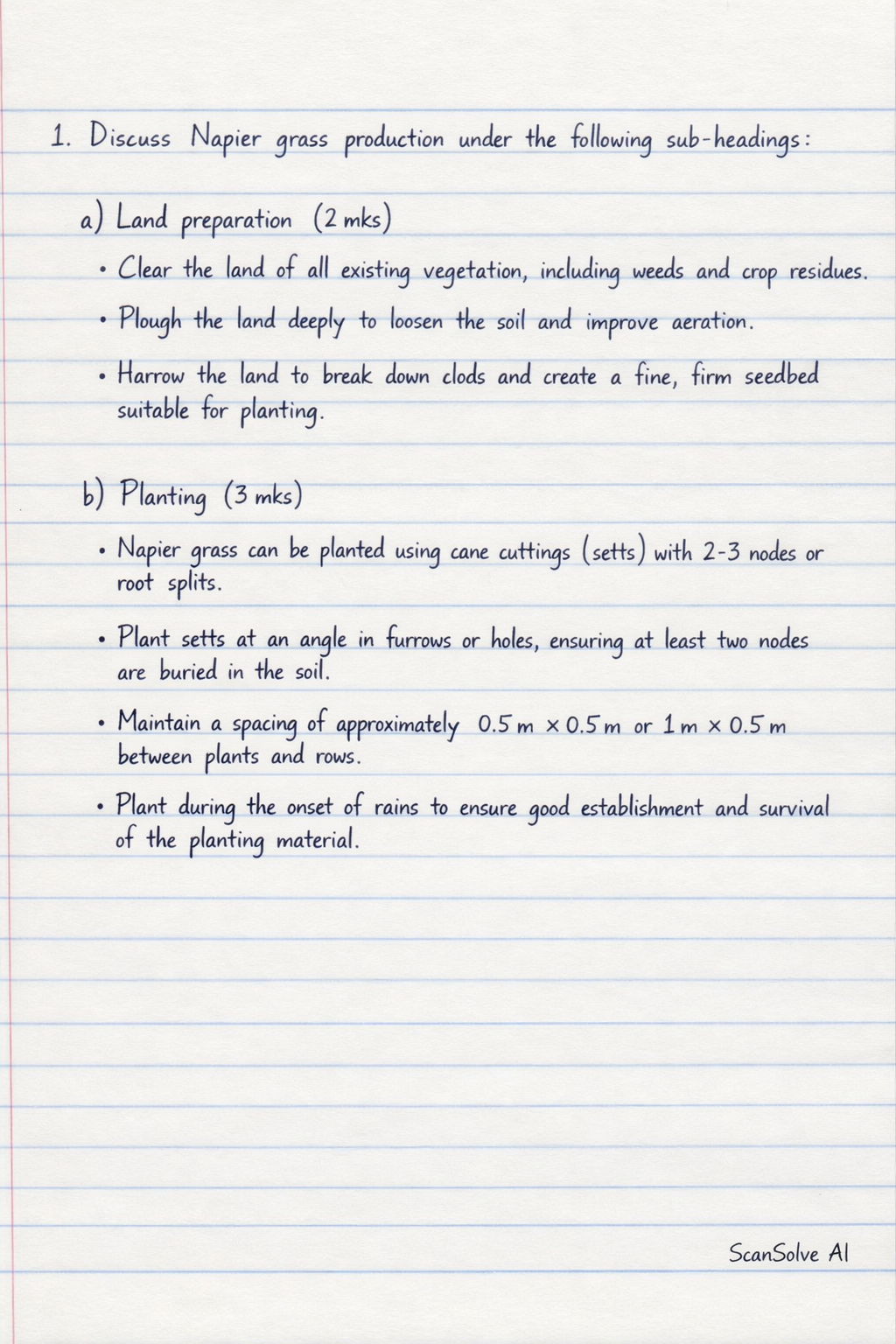
Discuss Napier grass production under the following sub-headings:
Economics
ScanSolve AI Answer
- Discuss Napier grass production under the following sub-headings:
-
a) Land preparation (2 mks)
- Clear the land of all existing vegetation, including weeds and crop residues.
- Plough the land deeply to loosen the soil and improve aeration.
- Harrow the land to break down clods and create a fine, firm seedbed suitable for planting.
-
b) Planting (3 mks)
- Napier grass can be planted using cane cuttings (setts) with 2-3 nodes or root splits.
- Plant setts at an angle in furrows or holes, ensuring at least two nodes are buried in the soil.
- Maintain a spacing of approximately or between plants and rows.
- Plant during the onset of rains to ensure good establishment and survival of the planting material.
-
c) Fertilizer application (3 mks)
- Apply well-rotted farmyard manure (FYM) at a rate of tonnes per acre during land preparation or in the planting holes.
- Alternatively, apply inorganic fertilizers such as Diammonium Phosphate (DAP) at planting, typically .
- Top-dress with nitrogenous fertilizers like Calcium Ammonium Nitrate (CAN) or Urea at a rate of after each cut to promote vigorous regrowth.
-
d) Weed control (2 mks)
- Weed the field manually or mechanically, especially during the early stages of growth, to minimize competition for nutrients and water.
- Ensure the field remains weed-free until the Napier grass is well-established and can suppress weeds on its own.
- Slashing or mowing between rows can also help control weeds in established stands.
- Describe the different physical methods used in crop pest control:
-
1. Use of lethal temperature:
- This involves exposing pests to temperatures outside their survival range. High temperatures can be used, such as sun-drying grains to kill storage pests or solarizing soil to eliminate soil-borne pests and pathogens. Low temperatures are also effective, for example, storing produce in cold rooms or freezing infested items to kill pests by inhibiting their metabolic activity.
-
2. Trapping:
- Various traps are used to physically capture or kill pests. Examples include light traps for nocturnal insects, sticky traps (e.g., yellow sticky traps) for flying insects, and pheromone traps which use chemical attractants to lure and capture specific insect pests. Water traps or pitfall traps can be used for ground-dwelling pests.
-
3. Flooding:
- This method involves submerging agricultural land in water for a period. Flooding can effectively drown soil-borne pests like nematodes, insect larvae, and pupae, or force them to the surface where they become vulnerable to predators or desiccation. It is commonly used in rice cultivation.
-
4. Hand picking:
- This is a direct method where pests, especially larger ones like caterpillars, slugs, or beetles, are manually removed from plants. It is practical for small-scale farming, high-value crops, or when pest infestations are localized.
-
5. Use of barriers/Exclusion:
- Physical barriers prevent pests from reaching crops. This includes using netting or row covers to protect plants from flying insects, fences to keep out larger animal pests (e.g., rodents, birds), and tree bands (sticky or chemical) to prevent crawling insects from ascending trees.
Was this helpful?
Still stuck on this one?
Ask a follow-up, and the answer starts from this question.
Got a different question?Ask your own question
More Economics Questions
QList benefits and reasons for pruning vegetables and perennial crops, importance of top dressing…Q1.1 Give THREE reasons in favour of your school. 1.1.2 Suggest THREE characteristic of crops that…QDiscuss the cultivation of ginger the following headings (1) soil requirement (2) land preparationQThree qualities of a good green manuring plant are:Q3.1. Explain the two (2) importance of nutrition in beef cattle production. (4) 3.2. Suggest three…
Handwritten Step-by-Step Solution
Get this as a handwritten image on WhatsApp — like a tutor wrote it for you.
Try on WhatsApp