
We read your photo as:
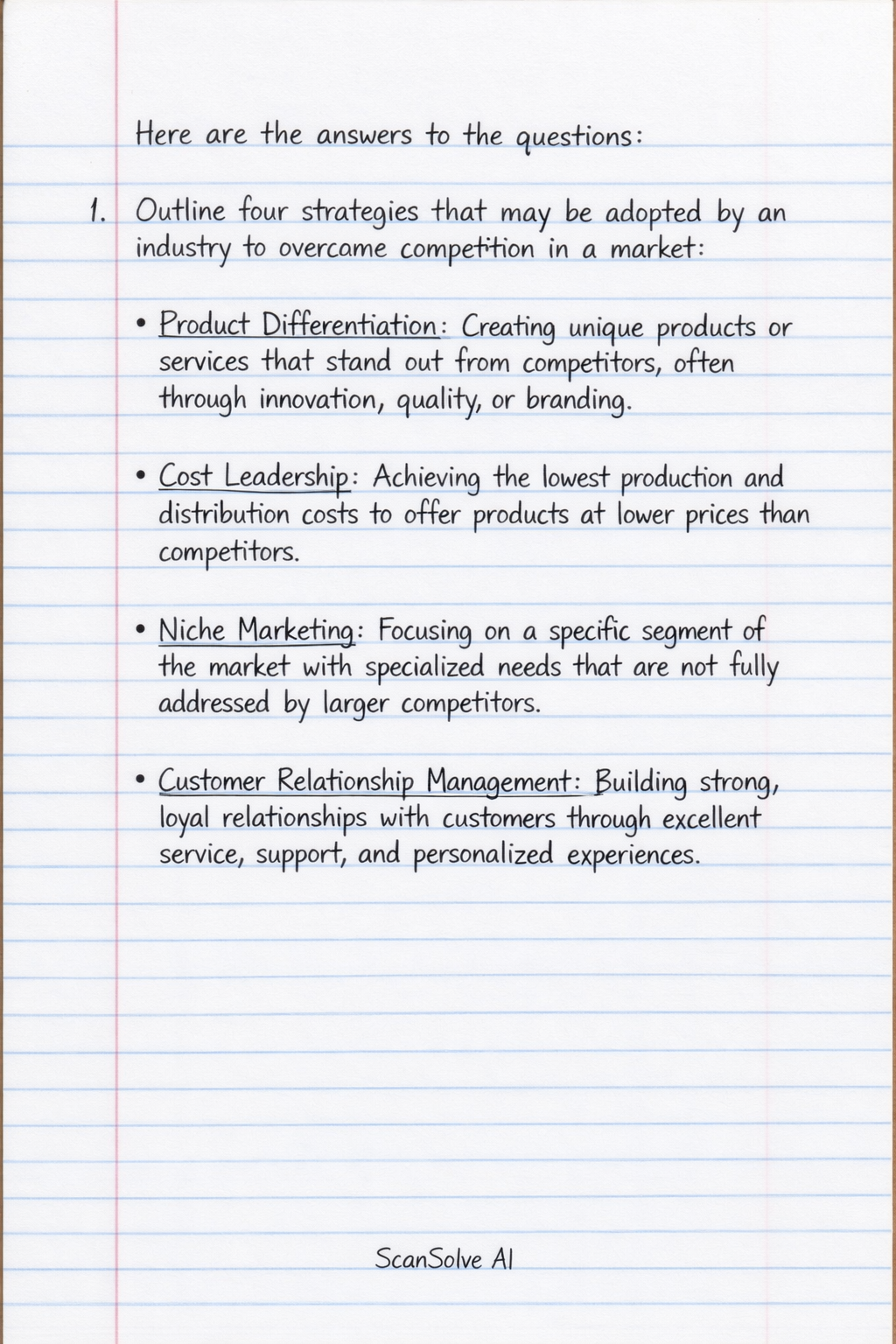
Outline four strategies that may be adopted by an industry to overcome competition in a market:
ScanSolve AI Answer
Here are the answers to the questions:
-
Outline four strategies that may be adopted by an industry to overcome competition in a market:
- Product Differentiation: Creating unique products or services that stand out from competitors, often through innovation, quality, or branding.
- Cost Leadership: Achieving the lowest production and distribution costs to offer products at lower prices than competitors.
- Niche Marketing: Focusing on a specific segment of the market with specialized needs that are not fully addressed by larger competitors.
- Customer Relationship Management: Building strong, loyal relationships with customers through excellent service, support, and personalized experiences.
-
Explain three reasons for adopting performance contracting in modern organizations:
- Improved Accountability: Performance contracts clearly define expectations, targets, and responsibilities, making individuals or departments more accountable for their results.
- Enhanced Efficiency and Productivity: By linking rewards to specific outcomes, performance contracting motivates employees to work more efficiently and productively to achieve set goals.
- Better Resource Allocation: It helps organizations allocate resources more effectively by focusing on areas that contribute directly to achieving strategic objectives and measurable results.
-
Describe three limitations of 'job production':
- High Unit Cost: Each product is unique and often custom-made, leading to higher labor and material costs per unit compared to mass production.
- Long Production Time: The bespoke nature of job production means that each item takes a significant amount of time to complete, from design to final delivery.
- Requires Highly Skilled Labor: It often necessitates a workforce with specialized skills and craftsmanship, which can be expensive to hire and difficult to manage.
SECTION B: ESTIMATING, TENDERING AND ENGINEERING SERVICES CONTRACTS
-
Describe three methods for resolving contractual disputes in the construction industry:
- Negotiation: This is the most common and least formal method, where parties directly discuss their differences to reach a mutually acceptable agreement without third-party intervention.
- Mediation: A neutral third party (mediator) facilitates communication and negotiation between the disputing parties, helping them explore options and reach a voluntary settlement. The mediator does not impose a decision.
- Arbitration: Disputing parties agree to submit their case to a neutral third party (arbitrator or panel of arbitrators) who hears evidence and arguments from both sides and then makes a binding decision.
-
Explain each of the following as used in the law of tort: (i) Trespass to property: This refers to the direct and unlawful interference with another person's possession of land or goods without their permission or legal justification. It is actionable per se, meaning no actual damage needs to be proven. (ii) Nuisance: This involves an unlawful interference with a person's use or enjoyment of land, or some right over or in connection with it. It can be private (affecting an individual's land) or public (affecting a community).
-
State four types of information contained in engineering drawings that are used for cost estimating:
- Dimensions and Quantities: Detailed measurements, sizes, and counts of components, materials, and spaces, allowing for accurate material take-offs.
- Material Specifications: Information on the type, grade, finish, and quality of materials required for each part of the construction.
- Construction Details and Methods: Specific instructions on how elements are to be assembled, joined, or constructed, which impacts labor and equipment costs.
- Location and Layout: The arrangement of structures, services, and components within the site, influencing logistics, access, and installation complexity.
-
Outline six types of office overheads incurred at a construction site:
- Salaries of Site Management and Administrative Staff: Wages for the site manager, foremen, quantity surveyors, and administrative personnel based at the site office.
- Rent or Depreciation of Site Office Facilities: Costs associated with the temporary site office, including rental fees or depreciation if owned.
- Utilities: Expenses for electricity, water, heating, and internet services consumed by the site office.
- Office Supplies and Consumables: Costs for stationery, printing, computer supplies, and other general office materials.
- Communication Costs: Telephone, mobile, and data charges for site-based communication.
- Cleaning and Maintenance: Expenses for keeping the site office clean and in good working order.
Still stuck on this one?
Ask a follow-up, and the answer starts from this question.
More Economics Questions
Handwritten Step-by-Step Solution
Get this as a handwritten image on WhatsApp — like a tutor wrote it for you.
Try on WhatsApp