
This economics question tests your understanding of economic models and analysis. The step-by-step answer below applies the relevant framework and explains the reasoning.
ScanSolve AI Answer
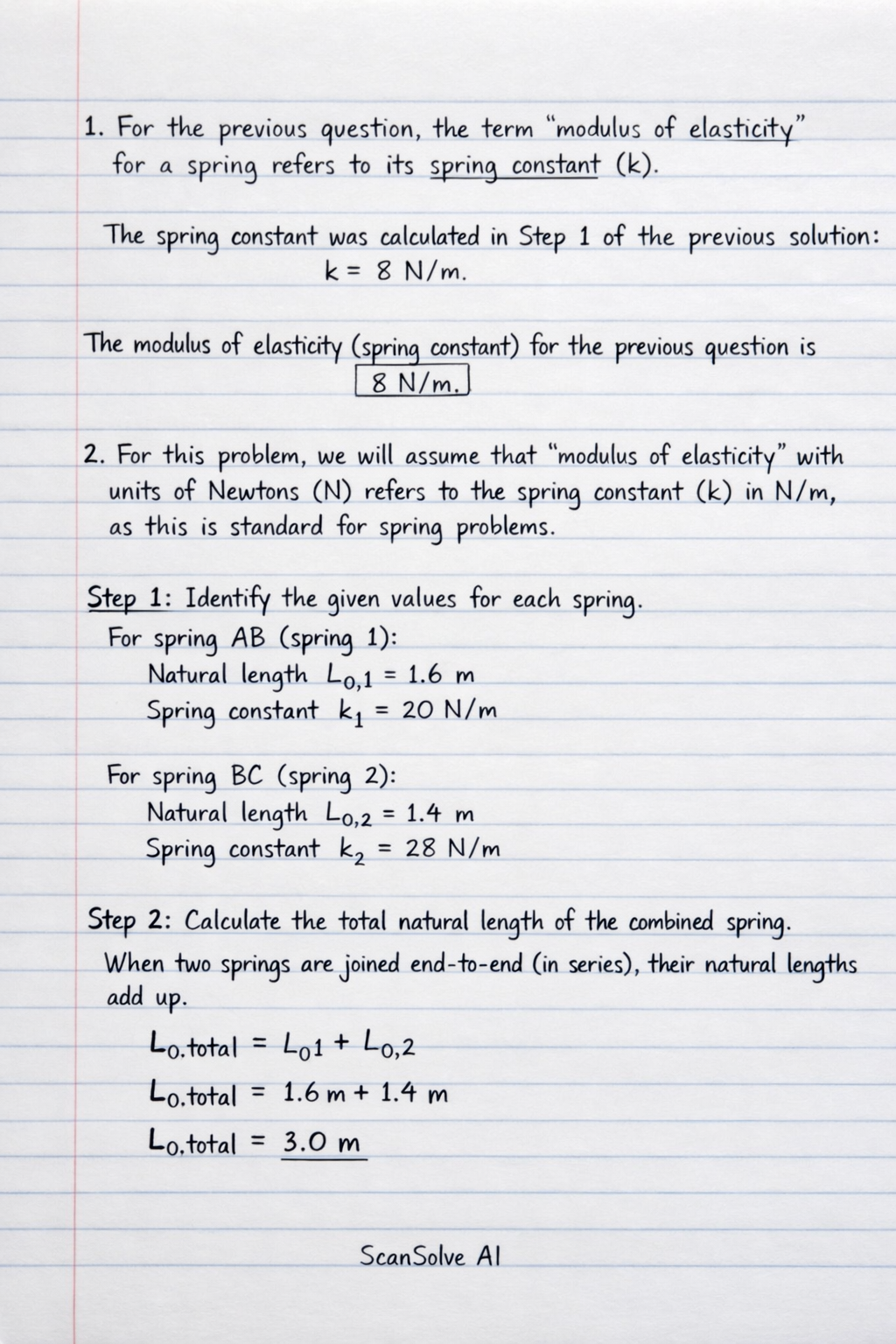
1. For the previous question, the term "modulus of elasticity" for a spring refers to its spring constant (k). The spring constant was calculated in Step 1 of the previous solution: k = 8 N/m The modulus of elasticity (spring constant) for the previous question is 8 N/m. 2. For this problem, we will assume that "modulus of elasticity" with units of Newtons (N) refers to the spring constant (k) in N/m, as this is standard for spring problems. Step 1: Identify the given values for each spring. For spring AB (spring 1): Natural length L_0,1 = 1.6 m Spring constant k_1 = 20 N/m For spring BC (spring 2): Natural length L_0,2 = 1.4 m Spring constant k_2 = 28 N/m Step 2: Calculate the total natural length of the combined spring. When two springs are joined end-to-end (in series), their natural lengths add up. L_0,total = L_0,1 + L_0,2 L_0,total = 1.6 m + 1.4 m L_0,total = 3.0 m Step 3: Calculate the total extension of the combined spring. The combined spring is stretched between two points 4 m apart. Total stretched length L_stretched = 4 m Total extension x_total = L_stretched - L_0,total x_total = 4 m - 3.0 m x_total = 1.0 m Step 4: Calculate the tension in the combined spring. When springs are in series, the tension (T) is the same in each spring, and the total extension is the sum of individual extensions. From Hooke's Law, x = T/k. So, x_1 = T/k_1 and x_2 = T/k_2. x_total = x_1 + x_2 x_total = (T)/(k_1) + (T)/(k_2) x_total = T ( (1)/(k_1) + (1)/(k_2) ) Substitute the known values: 1.0 m = T ( (1)/(20 N/m) + (1)/(28 N/m) ) 1.0 = T ( (28)/(20 × 28) + (20)/(20 × 28) ) 1.0 = T ( (28 + 20)/(560) ) 1.0 = T ( (48)/(560) ) Simplify the fraction: 1.0 = T ( (6)/(70) ) 1.0 = T ( (3)/(35) ) Solve for T: T = (35)/(3) N T ≈ 11.67 N The tension in the combined spring is 11.67 N.