
We read your photo as:
Highlight four adverse effects of production activities on the environment and community.
Economics
ScanSolve AI Answer
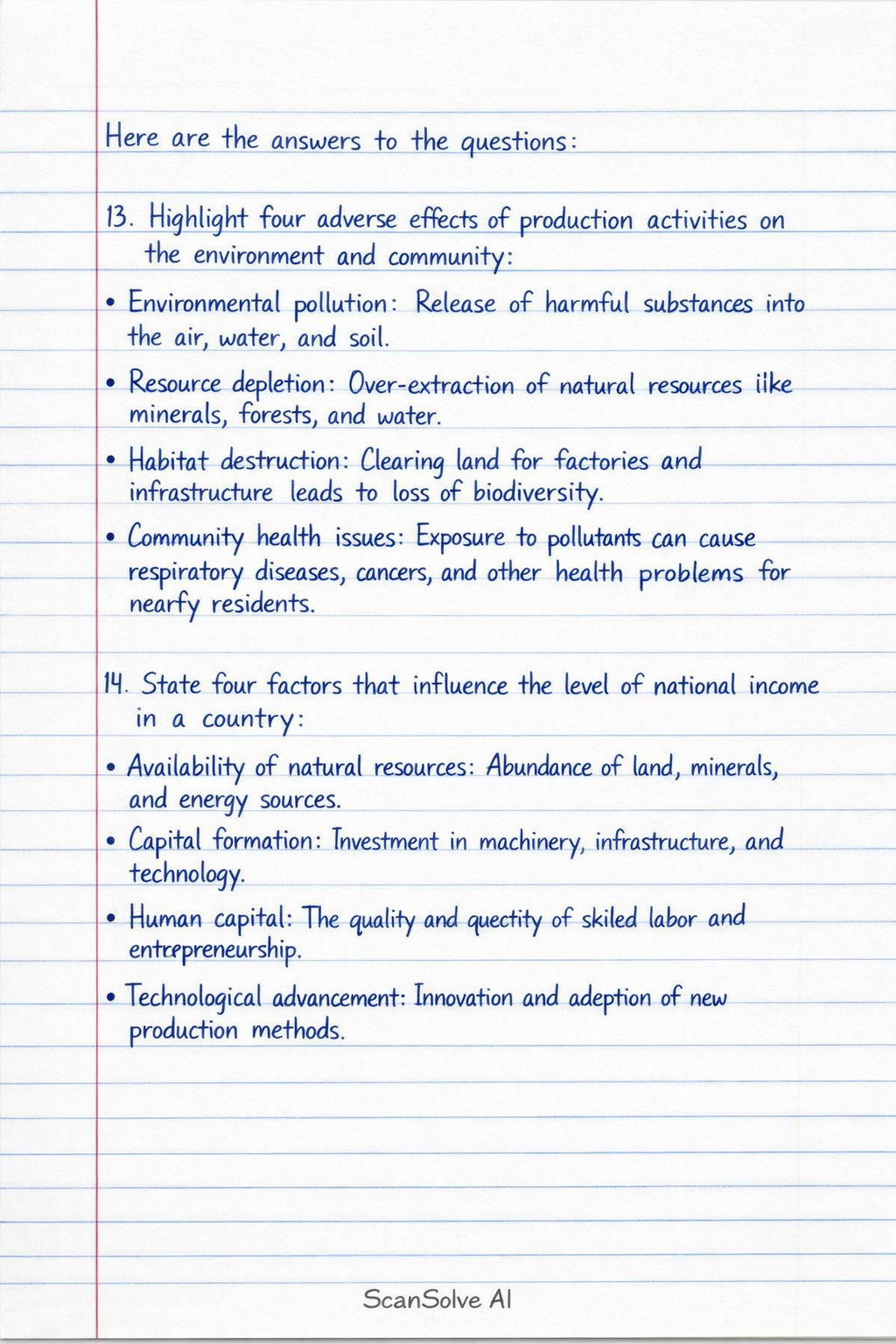
Here are the answers to the questions:
-
Highlight four adverse effects of production activities on the environment and community.
- Environmental pollution: Release of harmful substances into the air, water, and soil.
- Resource depletion: Over-extraction of natural resources like minerals, forests, and water.
- Habitat destruction: Clearing land for factories and infrastructure leads to loss of biodiversity.
- Community health issues: Exposure to pollutants can cause respiratory diseases, cancers, and other health problems for nearby residents.
-
State four factors that influence the level of national income in a country.
- Availability of natural resources: Abundance of land, minerals, and energy sources.
- Capital formation: Investment in machinery, infrastructure, and technology.
- Human capital: The quality and quantity of skilled labor and entrepreneurship.
- Technological advancement: Innovation and adoption of new production methods.
-
State four ways of determining prices for commodities.
- Market forces (supply and demand): Prices are set at the equilibrium point where quantity supplied equals quantity demanded.
- Cost-plus pricing: Adding a markup percentage to the total cost of production.
- Government regulation: Imposing price ceilings or floors on certain essential commodities.
- Competition-based pricing: Setting prices based on what competitors are charging for similar products.
-
List four types of source documents.
- Invoices: Documents requesting payment for goods or services provided.
- Receipts: Proof of payment for a transaction.
- Purchase orders: Documents issued by a buyer to a seller, indicating types, quantities, and agreed prices for products or services.
- Bank statements: Records of all transactions in a bank account over a period.
-
State four principles of a good tax system.
- Equity (Fairness): Taxes should be levied according to the ability to pay, ensuring a fair distribution of the tax burden.
- Certainty: Taxpayers should know exactly what, when, and how much tax they are required to pay.
- Convenience: The method and timing of tax payment should be easy and convenient for the taxpayer.
- Economy (Efficiency): The cost of collecting taxes should be minimal compared to the revenue generated.
-
Mention four problems faced when computing price indices (CPI).
- Quality changes: It is difficult to account for improvements or deteriorations in the quality of goods over time.
- New goods and services: The basket of goods needs frequent updating to include new products, which is a complex process.
- Substitution bias: Consumers tend to substitute away from goods whose prices have risen, but the fixed basket of goods in CPI doesn't immediately reflect this.
- Sampling errors: Data collection relies on samples of prices and outlets, which may not perfectly represent the entire market.
Was this helpful?
Still stuck on this one?
Ask a follow-up, and the answer starts from this question.
Got a different question?Ask your own question
More Economics Questions
QList four environmental and four social consequences of deforestation in your district.QIdentify four human activities that cause pollution in Ghana.QWhat are four environmental and four social consequences of deforestation in your district?QOutline any four challenges in extractive resource in Ghana. 2. Highlight five natural resources you…QIdentify the environmental issue, list two of its effects, and suggest one solution.
Handwritten Step-by-Step Solution
Get this as a handwritten image on WhatsApp — like a tutor wrote it for you.
Try on WhatsApp