
We read your photo as:
1STUDY THE CASE STUDY BELOW AND ANSWER THE QUESTION THAT FOLLOW GDP: QUANTIFYING SA’s ECONOMIC PERFORMANCE IN 2020
ScanSolve AI Answer
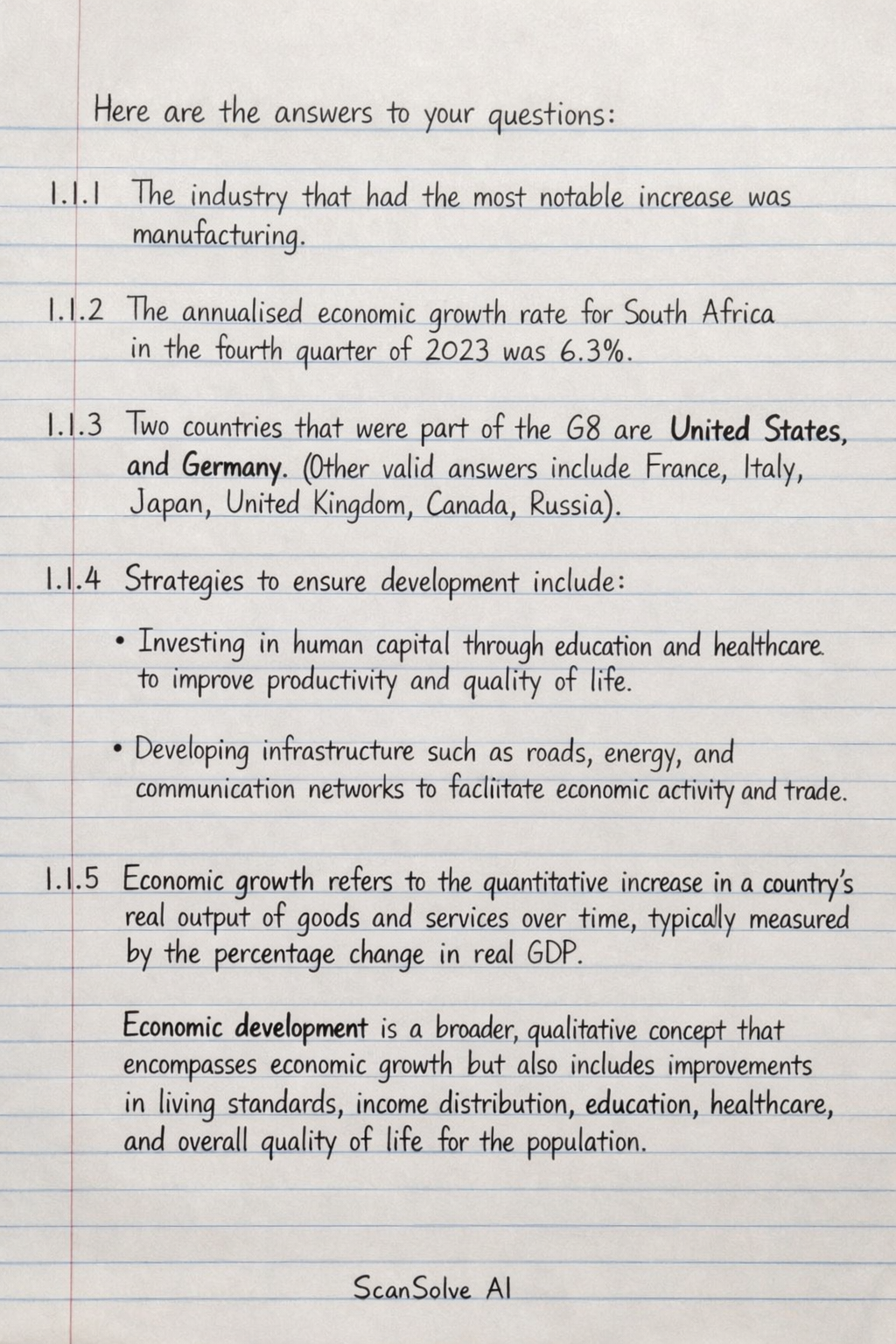
Here are the answers to your questions:
1.1.1 The industry that had the most notable increase was manufacturing.
1.1.2 The annualised economic growth rate for South Africa in the fourth quarter of 2023 was 6.3%.
1.1.3 Two countries that were part of the G8 are United States and Germany. (Other valid answers include France, Italy, Japan, United Kingdom, Canada, Russia).
1.1.4 Strategies to ensure development include:
- Investing in human capital through education and healthcare to improve productivity and quality of life.
- Developing infrastructure such as roads, energy, and communication networks to facilitate economic activity and trade.
1.1.5 Economic growth refers to the quantitative increase in a country's real output of goods and services over time, typically measured by the percentage change in real GDP. Economic development is a broader, qualitative concept that encompasses economic growth but also includes improvements in living standards, income distribution, education, healthcare, and overall quality of life for the population.
1.1.6 South Africa is regarded as a developing country due to several factors:
- It experiences high levels of income inequality and poverty, with a significant portion of the population living below the poverty line.
- The country faces high unemployment rates, particularly among youth, which hinders economic participation and social progress.
- Despite having a diversified economy, it still grapples with challenges in providing universal access to quality education and healthcare, which are crucial for human development.
- South Africa also exhibits characteristics of a dual economy, with a highly developed modern sector coexisting with a large informal sector and rural areas with limited economic opportunities.
1.1.7 Inflation affects the standard of living primarily by eroding purchasing power. As prices for goods and services rise, the same amount of money buys less, meaning households can afford fewer necessities and luxuries. This disproportionately impacts individuals on fixed incomes or those whose wages do not keep pace with inflation, leading to a decline in their real income. Additionally, inflation can reduce the real value of savings, making it harder for people to accumulate wealth and plan for the future, thereby lowering their overall quality of life.
1.1.8 The COVID-19 pandemic had a profound and largely negative impact on economic growth globally, and specifically in South Africa as highlighted in the case study.
- Severe economic contraction: The text states that South Africa's economy slumped by 7% in 2020, marking the biggest annual fall in economic activity since at least 1946. This was primarily due to stringent lockdown restrictions.
- Disruption of supply and demand: Lockdowns led to widespread business closures, supply chain disruptions, and a sharp decline in consumer spending and investment. Many industries, such as tourism and hospitality, faced unprecedented challenges.
- Increased unemployment: Businesses shedding jobs or closing down resulted in a significant rise in unemployment, further reducing household incomes and aggregate demand.
- Government intervention and debt: Governments worldwide implemented massive fiscal stimulus packages and increased healthcare spending to mitigate the crisis, leading to a surge in public debt.
- Uneven recovery: While some sectors adapted and even thrived (e.g., digital services), others struggled to recover, leading to an uneven economic rebound. The text notes that positive growth in later quarters was insufficient to offset the initial devastating impact.
Still stuck on this one?
Ask a follow-up, and the answer starts from this question.
More Economics Questions
Handwritten Step-by-Step Solution
Get this as a handwritten image on WhatsApp — like a tutor wrote it for you.
Try on WhatsApp