
We read your photo as:
4.5.1. A market structure describes the competitive environment in which buyers and sellers interact. It is defined by factors such as the number of firms, the nature of the product, and the ease of
ScanSolve AI Answer
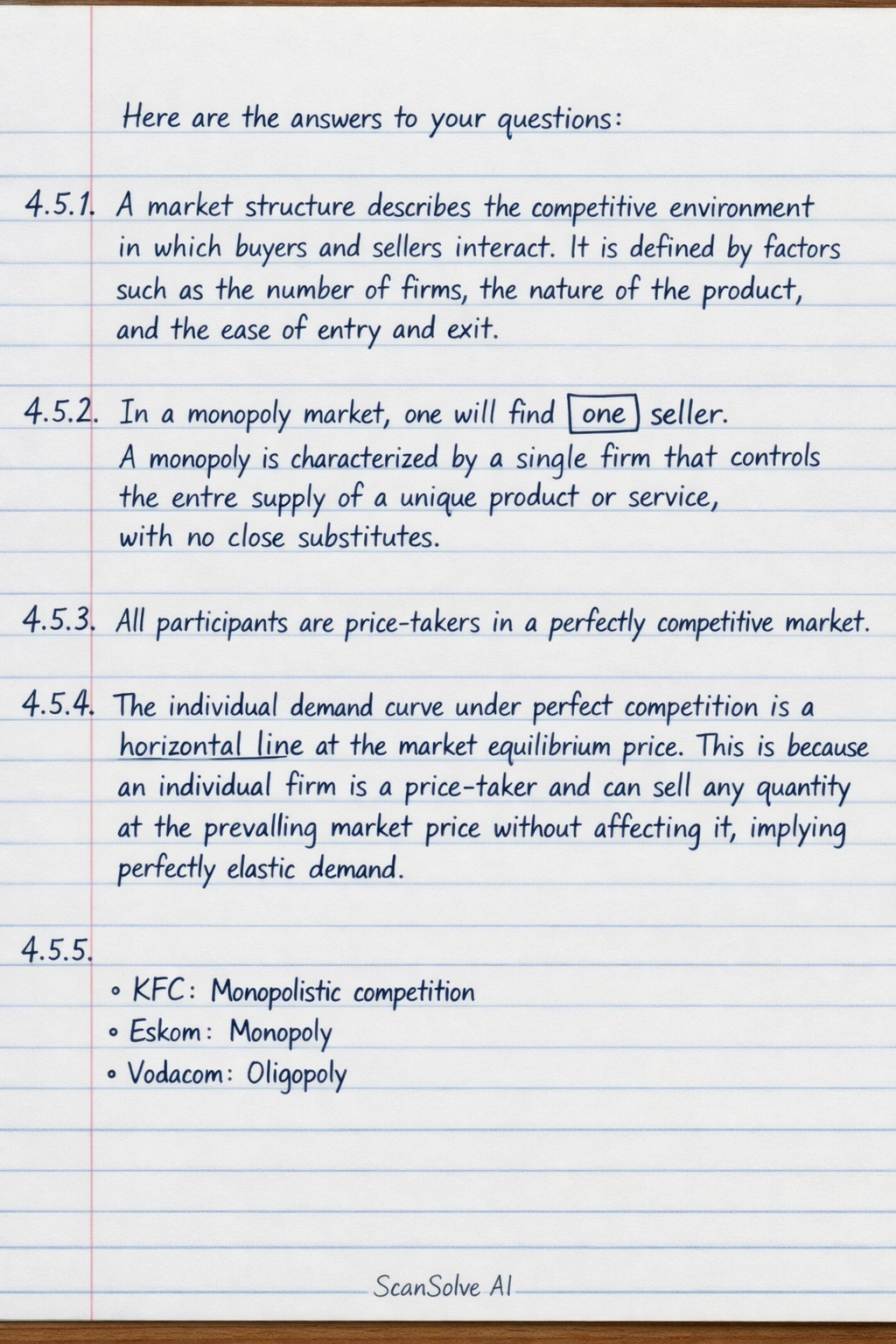
Here are the answers to your questions:
4.5.1. A market structure describes the competitive environment in which buyers and sellers interact. It is defined by factors such as the number of firms, the nature of the product, and the ease of entry and exit.
4.5.2. In a monopoly market, one will find seller. A monopoly is characterized by a single firm that controls the entire supply of a unique product or service, with no close substitutes.
4.5.3. All participants are price-takers in a perfectly competitive market.
4.5.4. The individual demand curve under perfect competition is a horizontal line at the market equilibrium price. This is because an individual firm is a price-taker and can sell any quantity at the prevailing market price without affecting it, implying perfectly elastic demand.
4.5.5.
- KFC: Monopolistic competition
- Eskom: Monopoly
- Vodacom: Oligopoly
4.5.6. The pie charts illustrate the number of sellers and buyers that define each market structure. They show that perfect and monopolistic competition have many sellers and buyers, an oligopoly has few sellers but many buyers, and a monopoly has only one seller but many buyers. This highlights how the concentration of market participants determines the level of competition.
4.6.1. The quantity where AC = MC is . (At Quantity 8, AC = 14 and MC = 14).
4.6.2. The MC curve intersects the AVC curve at its minimum point. From the table, the minimum AVC is 10, which occurs at Quantity = 6. At this quantity, MC is also 10. Therefore, the MC curve intersects the AVC curve at quantity .
4.6.3. Marginal cost is the additional cost incurred by a firm when it produces one more unit of output. It represents the change in total cost resulting from a one-unit increase in production.
4.6.4. A perfect competitor should consider shutting down their business if the market price falls below the minimum Average Variable Cost (AVC). At quantity 6, the AVC is 10, which is its minimum. If the market price is less than 10, the firm cannot even cover its variable costs, and it minimizes losses by ceasing production.
4.6.5. To draw the supply curve using the information above:
- Step 1: Draw a graph with Quantity on the x-axis and Price/Cost on the y-axis.
- Step 2: Identify the minimum Average Variable Cost (AVC) from the table, which is 10 at Quantity = 6. This is the shut-down point.
- Step 3: The firm's short-run supply curve is its Marginal Cost (MC) curve above the minimum AVC.
- Step 4: Plot the following points (Quantity, Price = MC) where MC is greater than or equal to the minimum AVC (10):
- (6, 10)
- (8, 14)
- (10, 16)
- (12, 20)
- Step 5: Connect these points to form an upward-sloping curve, starting from (6, 10). This curve represents the firm's supply curve.
Still stuck on this one?
Ask a follow-up, and the answer starts from this question.
More Economics Questions
Handwritten Step-by-Step Solution
Get this as a handwritten image on WhatsApp — like a tutor wrote it for you.
Try on WhatsApp