
We read your photo as:
A) Authorised share capital is the maximum number of shares that a company is legally permitted to issue to the public, as specified in its memorandum of association or articles of incorporation
ScanSolve AI Answer
Answers
2 partsStep-by-step solution
4 stepsHere are the explanations and calculations for the given questions:
a) Authorised share capital is the maximum number of shares that a company is legally permitted to issue to the public, as specified in its memorandum of association or articles of incorporation. It represents the upper limit of the company's share capital.
b) Issued share capital is the portion of the authorised share capital that has actually been issued and allotted to shareholders. It represents the total nominal value of shares that have been sold or distributed to investors.
Part c
- Similarity: Both preference shares and debentures typically offer a fixed rate of return to their holders (dividends for preference shares, interest for debentures).
- Difference: Preference shares represent equity (ownership) in the company, while debentures represent debt (a loan) to the company. Debenture holders are creditors, whereas preference shareholders are owners.
Part d(i)
Total dividend proposed on ordinary shares
Calculate the total nominal value of issued ordinary shares.
Calculate the ordinary dividend based on the proposed rate.
The total dividend proposed on ordinary shares is .
Part d(ii)
Total dividend payable on preference shares
Calculate the total nominal value of issued preference shares.
Calculate the preference dividend based on the fixed rate.
The total dividend payable on preference shares is .
Try one yourself
A new problem that tests the same skill.
Still stuck on this one?
Ask a follow-up, and the answer starts from this question.
More Economics Questions
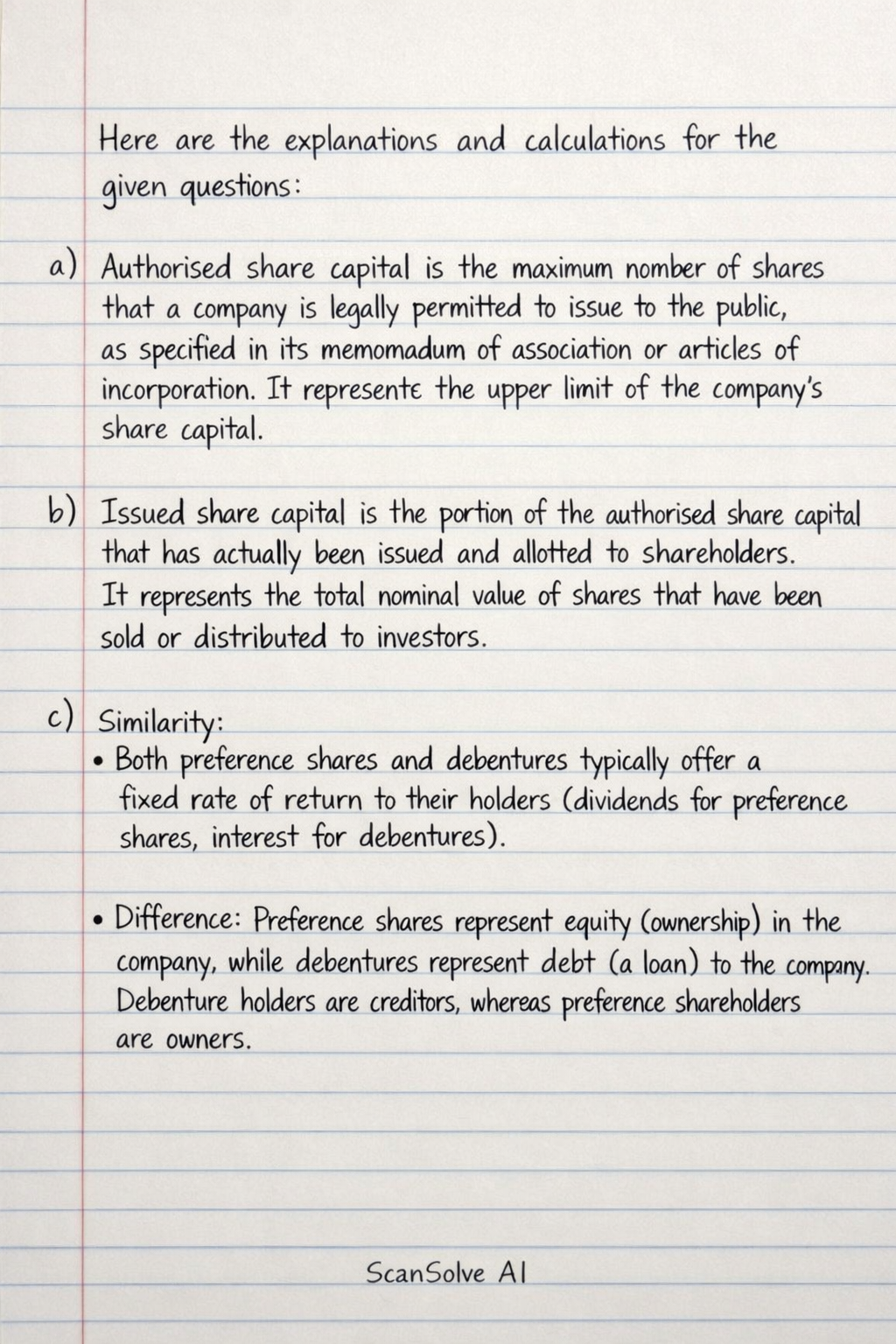
Handwritten Step-by-Step Solution
Get this as a handwritten image on WhatsApp — like a tutor wrote it for you.
Try on WhatsApp