
We read your photo as:
A bank receives a new deposit of $5,000. Assume the reserve ratio is 10%. Calculate the new deposit, new liquid asset, new loan, and total increase in money for five rounds.
ScanSolve AI Answer
Answers
2 partsStep-by-step solution
4 stepsASSIGNMENT 1: QUESTION 1
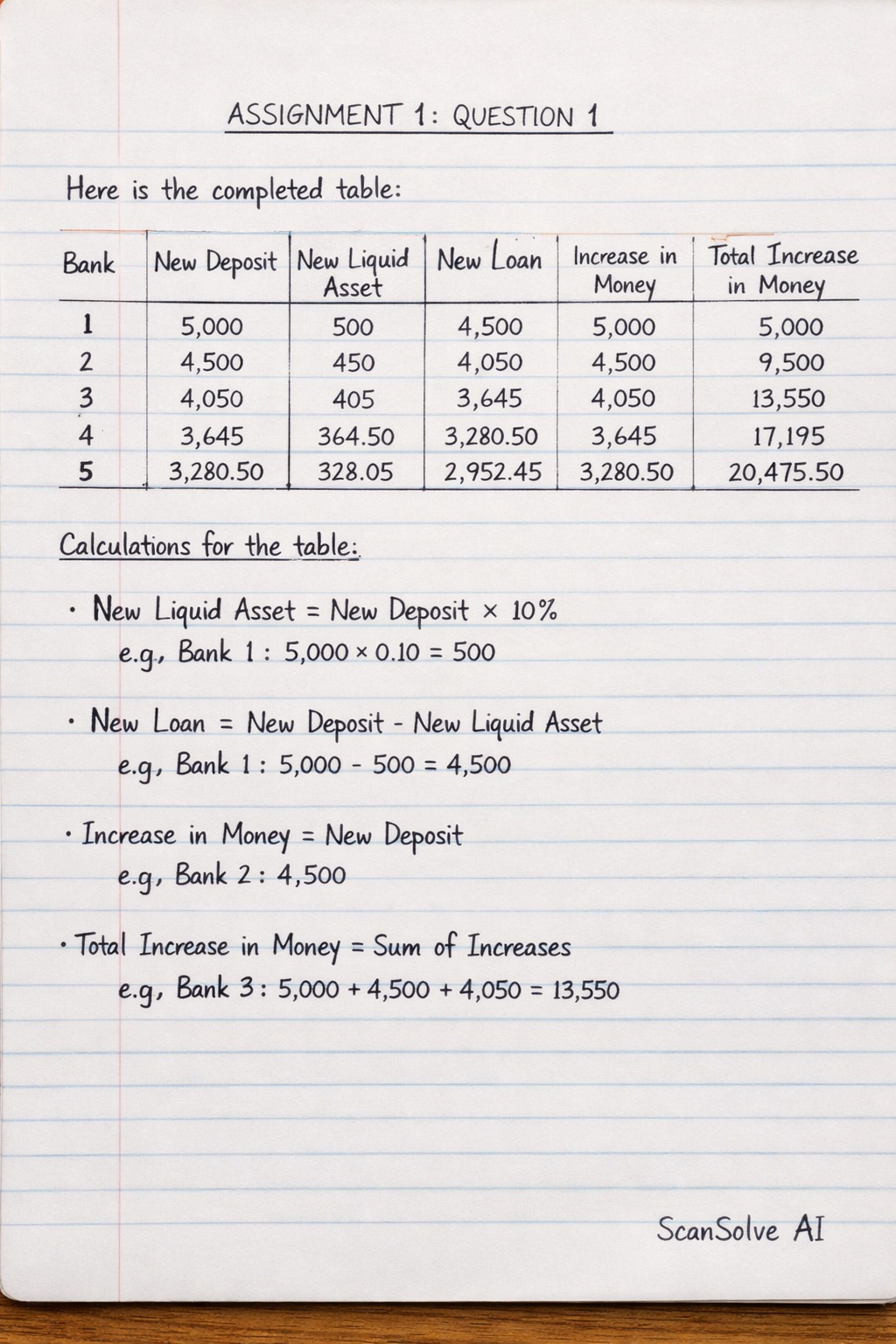
Here is the completed table:
| Bank | New Deposit | New Liquid Asset | New Loan | Increase in Money | Total Increase in Money |
|---|---|---|---|---|---|
| 1 | 5 000 | 500 | 4 500 | 5 000 | 5 000 |
| 2 | 4 500 | 450 | 4 050 | 4 500 | 9 500 |
| 3 | 4 050 | 405 | 3 645 | 4 050 | 13 550 |
| 4 | 3 645 | 364.50 | 3 280.50 | 3 645 | 17 195 |
| 5 | 3 280.50 | 328.05 | 2 952.45 | 3 280.50 | 20 475.50 |
Calculations for the table:
- New Liquid Asset = New Deposit 10% (Liquid Asset Ratio)
- New Loan = New Deposit - New Liquid Asset
- Increase in Money = New Deposit (for that bank)
- Total Increase in Money = Cumulative sum of "Increase in Money"
Bank 3:
- New Deposit: 4,050 (loan from Bank 2)
- New Liquid Asset:
- New Loan:
- Increase in Money: 4,050
- Total Increase in Money:
Bank 4:
- New Deposit: 3,645 (loan from Bank 3)
- New Liquid Asset:
- New Loan:
- Increase in Money: 3,645
- Total Increase in Money:
Bank 5:
- New Deposit: 3,280.50 (loan from Bank 4)
- New Liquid Asset:
- New Loan:
- Increase in Money: 3,280.50
- Total Increase in Money:
Part 4· 2 steps
Identify the liquid asset ratio (reserve ratio).
The liquid asset ratio is given as 10%, or 0.10.
Calculate the credit creation multiplier.
The credit creation multiplier (or money multiplier) is the reciprocal of the reserve ratio.
Part 550,000
Identify the initial deposit and the credit creation multiplier.
Initial Deposit = 5,000
Credit Creation Multiplier = 10Calculate the total increase in money.
ASSIGNMENT 2: MONETARY POLICY & FISCAL POLICY
Part 1
To reduce the level of economic activity, the central bank would use open market operations by selling government securities. When the central bank sells securities, commercial banks purchase them, which reduces their reserves. This decrease in reserves limits the amount of money banks can lend, leading to an increase in interest rates. Higher interest rates discourage borrowing and investment, thereby slowing down economic activity and reducing inflation.
Part 2
Here are three objectives of budget outcomes:
- Budget Surplus: The objective is to reduce national debt, save for future needs, or build up reserves for economic downturns. A surplus means government revenue exceeds spending.
- Budget Deficit: The objective is often to stimulate economic growth during a recession or to fund significant public investments. A deficit means government spending exceeds revenue, typically financed by borrowing.
- Balanced Budget: The objective is to maintain fiscal stability and avoid increasing national debt. A balanced budget occurs when government revenue equals government spending, aiming for neutrality in its impact on the economy.
Try one yourself
A new problem that tests the same skill.
Still stuck on this one?
Ask a follow-up, and the answer starts from this question.
More Economics Questions
Handwritten Step-by-Step Solution
Get this as a handwritten image on WhatsApp — like a tutor wrote it for you.
Try on WhatsApp