
We read your photo as:
A. Distinguish between creeping inflation and hyperinflation, and commercial bank and central bank. b. Classify transactions and precautionary motives for the demand for money.
Economics
ScanSolve AI Answer
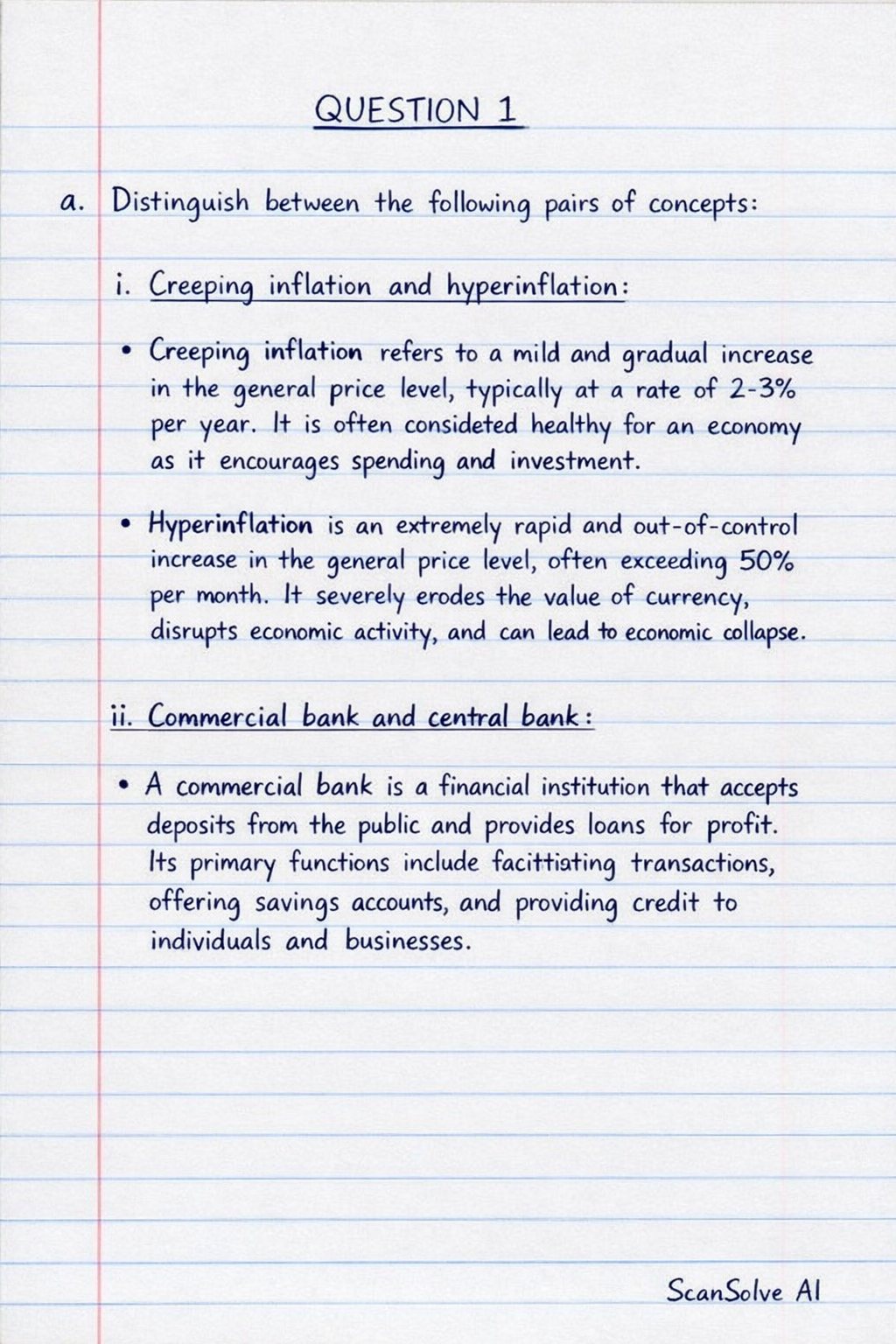
QUESTION 1
a. Distinguish between the following pairs of concepts:
- i. Creeping inflation and hyperinflation:
- Creeping inflation refers to a mild and gradual increase in the general price level, typically at a rate of 2-3% per year. It is often considered healthy for an economy as it encourages spending and investment.
- Hyperinflation is an extremely rapid and out-of-control increase in the general price level, often exceeding 50% per month. It severely erodes the value of currency, disrupts economic activity, and can lead to economic collapse.
- ii. Commercial bank and central bank:
- A commercial bank is a financial institution that accepts deposits from the public and provides loans for profit. Its primary functions include facilitating transactions, offering savings accounts, and providing credit to individuals and businesses.
- A central bank is the monetary authority of a country, responsible for maintaining financial stability, controlling the money supply, and regulating commercial banks. It acts as a banker to the government and commercial banks, and issues currency.
b. Classify the above motives for the demand for money:
- i. Transactions motives:
- Firms keeping money to buy raw material.
- Money held to pay transport fares.
- ii. Precautionary motives:
- Keeping cash to meet medical emergencies.
- iii. Speculative motives:
- Keeping money to buy bonds when interest rates rise.
c. State and explain three (3) measures, which the monetary authorities may use to increase the supply of money in the economy.
- Lowering the Cash Reserve Ratio (CRR): The central bank can reduce the percentage of deposits that commercial banks are required to hold as reserves. This frees up more funds for commercial banks to lend, increasing the money supply.
- Lowering the Bank Rate/Discount Rate: The central bank can reduce the interest rate at which it lends money to commercial banks. This makes borrowing cheaper for commercial banks, encouraging them to borrow more and, in turn, lend more to the public, thereby increasing the money supply.
- Open Market Operations (Buying Government Securities): The central bank can purchase government bonds and other securities from commercial banks or the public. This injects money directly into the banking system, increasing commercial banks' reserves and their capacity to lend, thus expanding the money supply.
d. Enumerate four (4) roles of the stock exchange.
- Facilitates Capital Formation: Provides a platform for companies to raise capital by issuing shares and bonds to investors.
- Mobilizes Savings: Encourages individuals and institutions to save by offering investment opportunities in listed companies.
- Provides Liquidity: Allows investors to easily buy and sell their securities, converting investments into cash when needed.
- Promotes Economic Growth: Channels funds from savers to productive investments, fostering industrial expansion and job creation.
- Price Discovery: Helps determine the fair market price of securities based on supply and demand.
- Facilitates Mergers and Acquisitions: Provides a mechanism for companies to merge or acquire other companies through share transactions.
Was this helpful?
Still stuck on this one?
Ask a follow-up, and the answer starts from this question.
Got a different question?Ask your own question
More Economics Questions
QDifferentiate between creeping inflation and hyperinflation, and between a commercial bank and a…QDistinguish between creeping inflation and hyperinflation, and between commercial and central banks…QWhat do you understand by the money supply?. Critically examine the effects of an increase in the…QDistinguish between total utility and marginal utility, and between creeping inflation and…QRead about demand for and supply of money. Read about money and the Economy Read about commercial…
Handwritten Step-by-Step Solution
Get this as a handwritten image on WhatsApp — like a tutor wrote it for you.
Try on WhatsApp