
We read your photo as:
A) Three advantages of using certified seeds in crop production are:
Economics
ScanSolve AI Answer
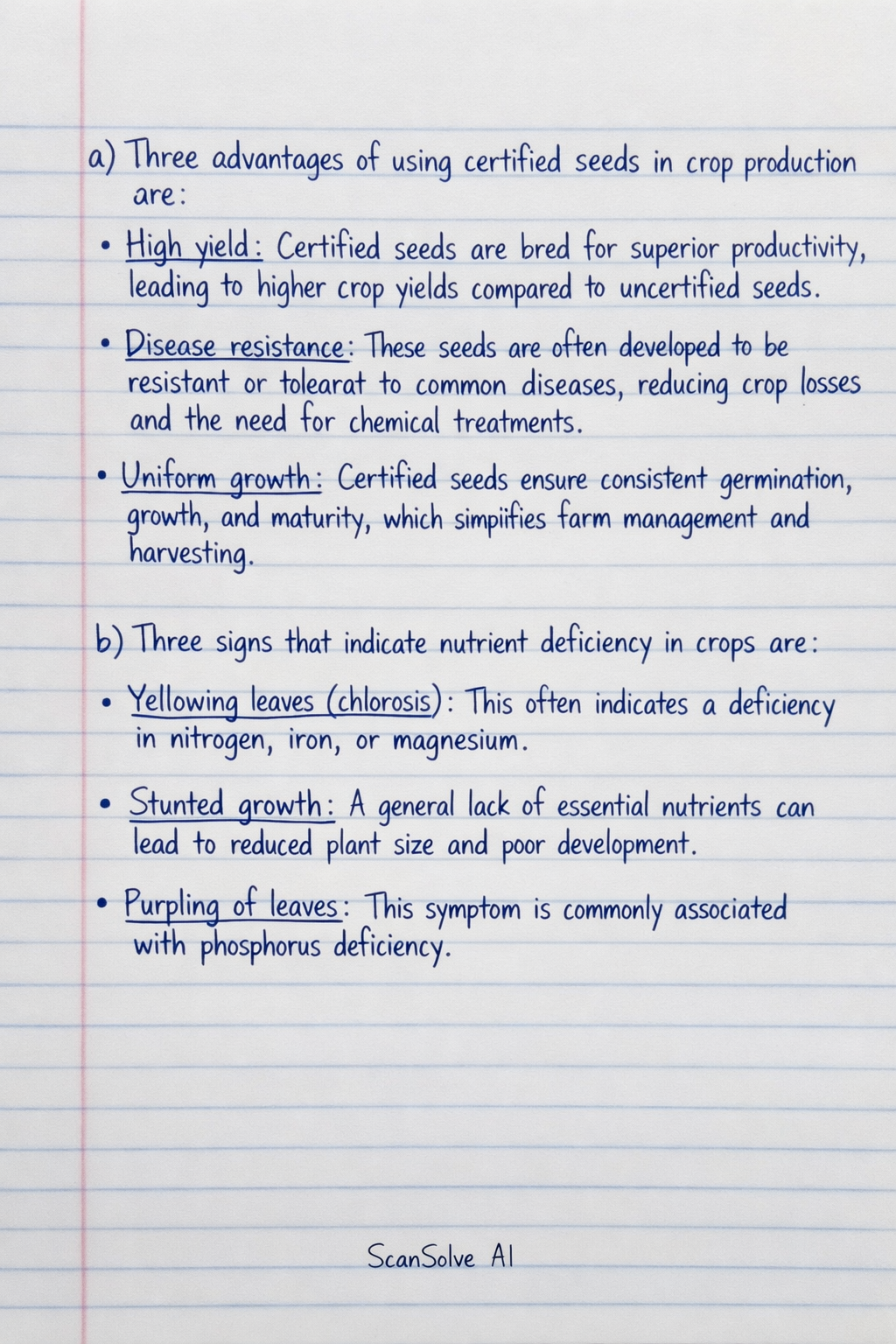
a) Three advantages of using certified seeds in crop production are:
- High yield: Certified seeds are bred for superior productivity, leading to higher crop yields compared to uncertified seeds.
- Disease resistance: These seeds are often developed to be resistant or tolerant to common diseases, reducing crop losses and the need for chemical treatments.
- Uniform growth: Certified seeds ensure consistent germination, growth, and maturity, which simplifies farm management and harvesting.
b) Three signs that indicate nutrient deficiency in crops are:
- Yellowing leaves (chlorosis): This often indicates a deficiency in nitrogen, iron, or magnesium.
- Stunted growth: A general lack of essential nutrients can lead to reduced plant size and poor development.
- Purpling of leaves: This symptom is commonly associated with phosphorus deficiency.
c) Three methods a youth group can use to acquire farmland legally in Kenya are:
- Leasing: The group can enter into a legal agreement with a landowner to use their land for a specified period in exchange for rent. This involves a lease agreement outlining terms and conditions.
- Buying: The group can purchase land outright from a willing seller. This process involves a sale agreement, payment, and subsequent transfer of the land title deed to the group's name.
- Receiving as a gift: A landowner can legally transfer ownership of land to the youth group as a gift. This requires a formal deed of gift and registration of the transfer with the relevant land authorities.
d) Two risks of farming on land with poor drainage are:
- Waterlogging: Poor drainage leads to excessive water accumulation in the soil, which deprives plant roots of oxygen. This can cause root rot, inhibit nutrient uptake, and ultimately lead to plant death.
- Increased incidence of diseases and pests: Constantly wet conditions create a favorable environment for the proliferation of fungal diseases (e.g., damping-off, root rot) and certain pests that thrive in moist environments, leading to crop damage and reduced yields.
e)
i) The three soil particles likely observed from bottom to top in a sedimentation test are:
- Sand
- Silt
- Clay
ii) Soil texture significantly influences water retention due to the size and arrangement of its particles.
- Clay soils, with their very fine particles and large surface area, have many small pores that hold water tightly against gravity, leading to high water retention. However, water movement can be slow.
- Sandy soils, composed of large particles, have large pore spaces that allow water to drain quickly, resulting in low water retention.
- Silt soils have medium-sized particles and moderate pore spaces, giving them intermediate water retention capabilities. Loam soils, a mixture of sand, silt, and clay, offer a good balance of water retention and drainage.
f) Three ways of improving sandy soil for vegetable farming are:
- Adding organic matter: Incorporating compost, manure, or other organic materials increases the soil's water-holding capacity and nutrient retention, as organic matter acts like a sponge.
- Applying clay: Mixing clay into sandy soil can improve its texture by increasing the proportion of fine particles, thereby enhancing water and nutrient retention.
- Using cover crops: Planting cover crops helps to add organic matter to the soil when they are tilled in, improves soil structure, and reduces nutrient leaching, making the soil more suitable for vegetables.
Was this helpful?
Still stuck on this one?
Ask a follow-up, and the answer starts from this question.
Got a different question?Ask your own question
More Economics Questions
QGive three advantages using certified seeds in crops productionQ3c) State TWO reasons why proper land preparation is important in crop production. (2 marks)QNo 3 c said enumerate 5 advantages of zero tillage in farm operationQb) Explain five importance of irrigation in crop production.QThree qualities of a good green manuring plant are:
Handwritten Step-by-Step Solution
Get this as a handwritten image on WhatsApp — like a tutor wrote it for you.
Try on WhatsApp