
We read your photo as:
Explain how an increase in demand and a subsequent decrease in supply affect the equilibrium price and quantity of lemons.
ScanSolve AI Answer
Step-by-step solution
10 stepsPart 1
Part 1.1· 3 steps
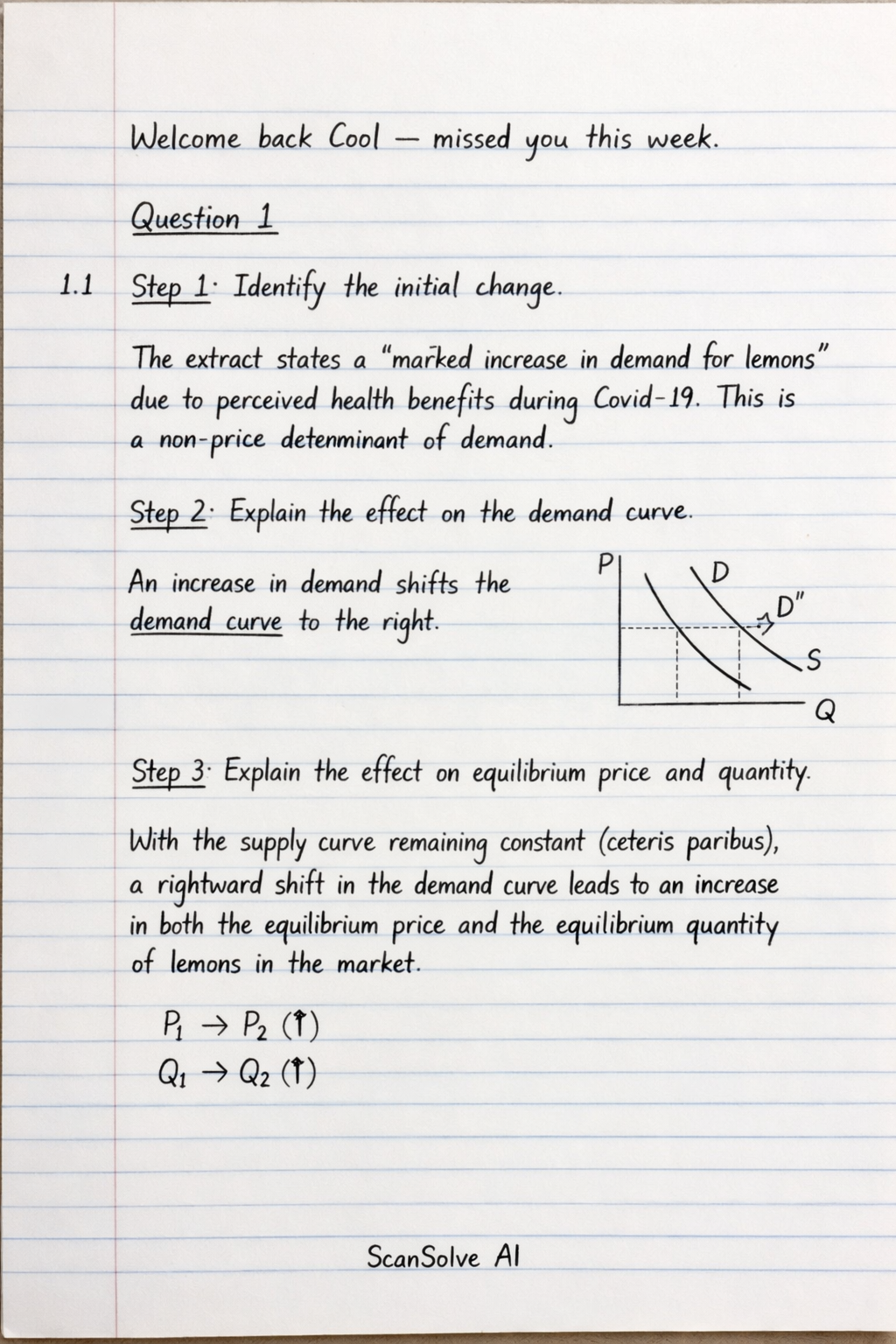
Identify the initial change.
The extract states a "marked increase in demand for lemons" due to perceived health benefits during Covid-19. This is a non-price determinant of demand.
Explain the effect on the demand curve.
An increase in demand shifts the demand curve to the right.
Explain the effect on equilibrium price and quantity.
With the supply curve remaining constant (ceteris paribus), a rightward shift in the demand curve leads to an increase in both the equilibrium price and the equilibrium quantity of lemons in the market.
Part 1.2· 4 steps
Identify the new change.
Following the increase in demand, cold weather causes frost, leading to a poor lemon harvest. This is a non-price determinant of supply.
Explain the effect on the supply curve.
A poor harvest means a decrease in the supply of lemons, which shifts the supply curve to the left.
Explain the combined effect on equilibrium price and quantity.
Starting from the new equilibrium after the demand increase (higher price and quantity), a leftward shift in the supply curve will further increase the equilibrium price. The effect on the equilibrium quantity is ambiguous; it could be higher or lower than the initial quantity before any shifts, depending on the relative magnitudes of the demand and supply shifts. However, it will be lower than the quantity achieved after only the demand shift.
Diagram explanation.
A properly labeled diagram would show an initial equilibrium (P1, Q1). The demand curve would shift right to D2, establishing a new equilibrium (P2, Q2) where P2 > P1 and Q2 > Q1. Then, the supply curve would shift left to S2, resulting in a final equilibrium (P3, Q3) where P3 > P2. Q3 would be less than Q2, but its relationship to Q1 would depend on the size of the shifts.
(Note: I am unable to provide a diagram directly, but the explanation describes how it would be constructed.)
Part 2
Part 2.1
The table shows the production possibilities schedule for a farmer, indicating the maximum combinations of apples and pears that can be produced with given resources.
Part 2.2
If the farmer uses all his resources for apple production, he will produce 100 apples.
Part 2.3
Two resources referred to in the extract are land (for farming) and labor (the farmer's effort).
Part 2.4
Efficient use of resources means producing the maximum possible output with the available inputs, without any waste. On a Production Possibility Curve (PPC), this is represented by any point that lies on the curve itself.
Part 2.5· 3 steps
Understand the PPC.
A Production Possibility Curve (PPC) is a graph that illustrates the variations in the amounts that can be produced of two products if both depend upon the same finite resources.
Plot the points.
To construct the PPC, you would plot the combinations from the table on a graph. Apples would typically be on the y-axis and Pears on the x-axis (or vice-versa).
- Point A: (0 Pears, 100 Apples)
- Point B: (15 Pears, 80 Apples)
- Point C: (25 Pears, 60 Apples)
- Point D: (30 Pears, 40 Apples)
- Point E: (35 Pears, 20 Apples)
- Point F: (40 Pears, 0 Apples)
Draw the curve.
Connect these points with a smooth curve. This curve represents the PPC.
(Note: I am unable to provide a diagram directly, but the explanation describes how it would be constructed.)
Still stuck on this one?
Ask a follow-up, and the answer starts from this question.
More Economics Questions
Handwritten Step-by-Step Solution
Get this as a handwritten image on WhatsApp — like a tutor wrote it for you.
Try on WhatsApp