
We read your photo as:
Analyze the economic incidence of a unit tax on cigarettes, considering elasticity of supply and demand, and the nature of ad valorem taxes.
Economics
ScanSolve AI Answer
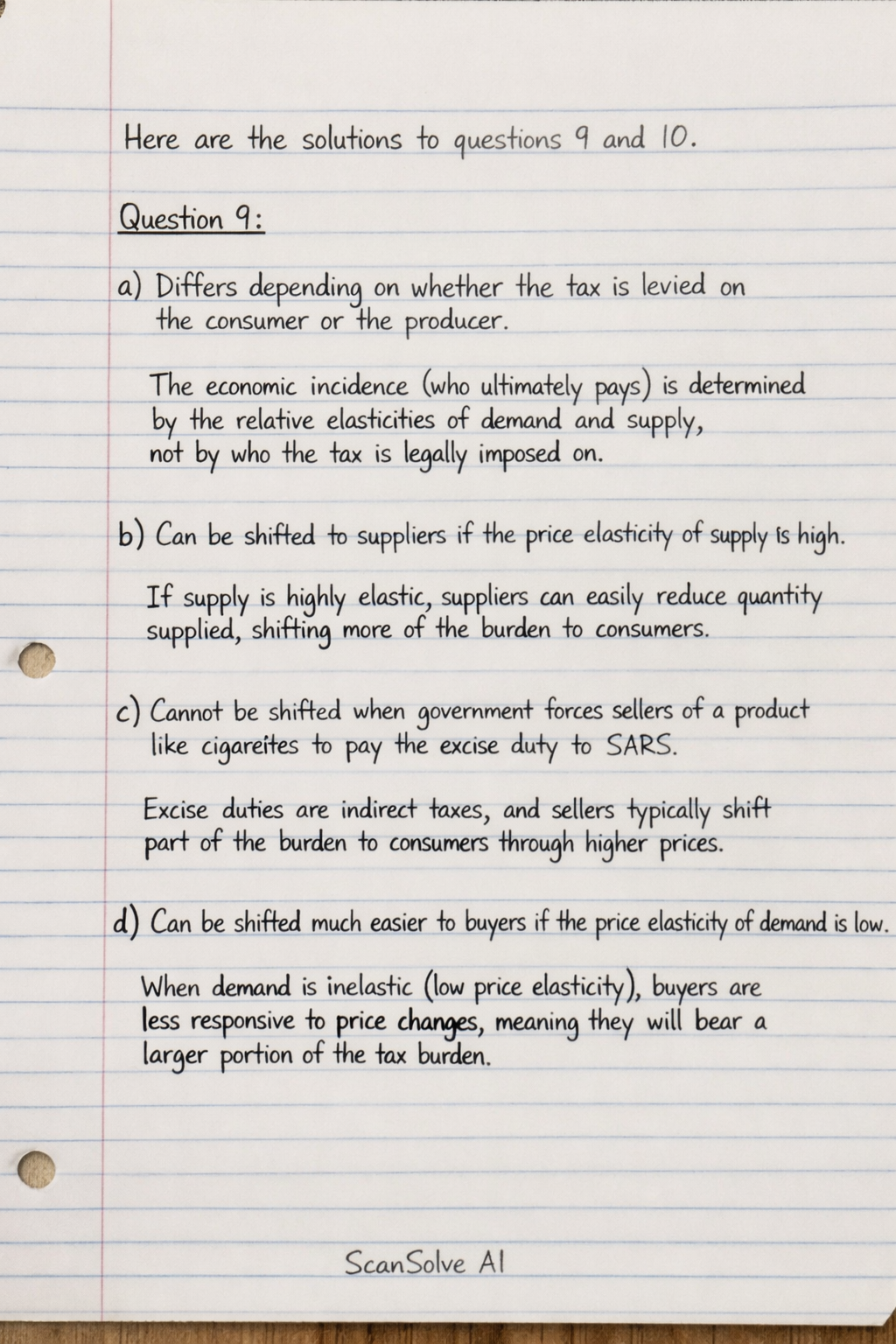
Here are the solutions to questions 9 and 10.
Question 9:
The incidence of a unit tax refers to who ultimately bears the burden of the tax.
- a) differs depending on whether the tax is levied on the consumer or the producer. The economic incidence (who ultimately pays) is determined by the relative elasticities of demand and supply, not by who the tax is legally imposed on.
- b) can be shifted to suppliers if the price elasticity of supply is high. If supply is highly elastic, suppliers can easily reduce quantity supplied, shifting more of the burden to consumers.
- c) cannot be shifted when government forces sellers of a product like cigarettes to pay the excise duty to SARS. Excise duties are indirect taxes, and sellers typically shift part of the burden to consumers through higher prices.
- d) can be shifted much easier to buyers if the price elasticity of demand is low. When demand is inelastic (low price elasticity), buyers are less responsive to price changes, meaning they will bear a larger portion of the tax burden.
The correct statement is d).
Question 10:
A 14% tax on the price of cigarettes is an ad valorem tax. Cigarettes typically have inelastic demand due to addiction.
- a) would cause the after-tax supply curve of cigarettes to shift parallel to the original curve. An ad valorem tax causes the supply curve to pivot upwards, not shift parallel. A unit tax causes a parallel shift.
- b) is a direct tax because it taxes the smoker directly. A tax on goods like cigarettes is an indirect tax, as it's levied on the sale of a good, not directly on income or wealth.
- c) is a unit tax. A 14% tax on the price is an ad valorem tax, not a unit tax (which is a fixed amount per unit).
- d) would result in the tax burden being borne mostly by the smokers themselves. Because the demand for cigarettes is generally inelastic (due to addiction), consumers (smokers) are less sensitive to price changes and will therefore bear a larger portion of the tax burden.
The correct statement is d).
Was this helpful?
Still stuck on this one?
Ask a follow-up, and the answer starts from this question.
Got a different question?Ask your own question
More Economics Questions
QAssume that the government imposes a per unit tax on cigarettes of K2. Plot the new supply curve on…QExplain the concepts of price elasticity of demand and supply. What are the implications of…QStudy the extract and answer the questions: Identify the item that refers to prices paid by…QGot you. This is Grade 10 Economics - questions on Public Sector, Indirect Taxes, and Subsidies…QAnalyze the effects of smoking on the health of the boys. Evaluate the strategies that can improve…
Browse by topic:Microeconomics
Handwritten Step-by-Step Solution
Get this as a handwritten image on WhatsApp — like a tutor wrote it for you.
Try on WhatsApp