
We read your photo as:
Assume the product is apples. Construct a supply schedule and illustrate the law of supply by drawing a supply curve. Show a shift in supply.
ScanSolve AI Answer
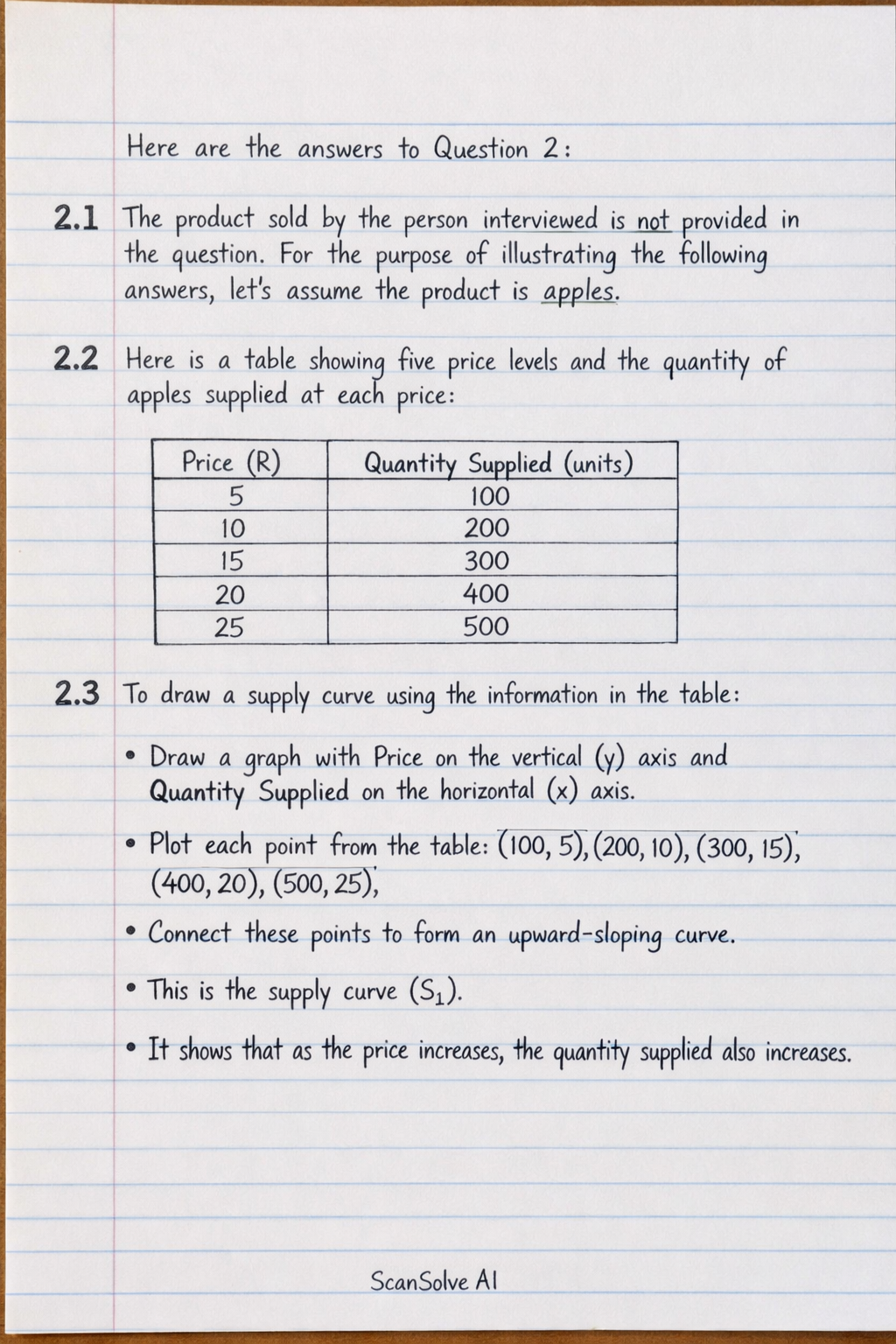
Here are the answers to Question 2:
2.1 The product sold by the person interviewed is not provided in the question. For the purpose of illustrating the following answers, let's assume the product is apples.
2.2 Here is a table showing five price levels and the quantity of apples supplied at each price:
| Price (R) | Quantity Supplied (units) |
|---|---|
| 5 | 100 |
| 10 | 200 |
| 15 | 300 |
| 20 | 400 |
| 25 | 500 |
2.3 To draw a supply curve using the information in the table:
- Draw a graph with the Price on the vertical (y) axis and Quantity Supplied on the horizontal (x) axis.
- Plot each point from the table (e.g., (100, 5), (200, 10), etc.).
- Connect these points to form an upward-sloping curve, which represents the supply curve (S1). This curve illustrates the law of supply, showing that as the price increases, the quantity supplied also increases.
2.4 To add a curve that shows an increase in supply in the graph from 2.3:
- Draw a new supply curve (S2) to the right of the original supply curve (S1).
- This shift to the right indicates that at every given price, a greater quantity of the product (apples) is now supplied to the market.
2.6 A supply curve can change (shift) due to several non-price factors:
- Changes in input costs: If the cost of resources used to produce the good (e.g., labor, raw materials, electricity) decreases, producers can supply more at each price, shifting the supply curve to the right. An increase in input costs would shift it to the left.
- Technology: Improvements in technology can make production more efficient, reducing costs and allowing producers to supply more at each price, shifting the supply curve to the right.
- Government policies: Subsidies (government payments to producers) can reduce production costs and increase supply (shift right), while taxes can increase costs and decrease supply (shift left).
- Number of sellers: An increase in the number of firms producing a good will increase the overall market supply, shifting the curve to the right.
2.7 Demand and supply are crucial for a market to exist because they are the fundamental forces that determine prices and quantities of goods and services exchanged. Demand represents the willingness and ability of consumers to buy, while supply represents the willingness and ability of producers to sell. Their interaction establishes the equilibrium price and equilibrium quantity, which are the points where the market clears, ensuring that resources are allocated efficiently and facilitating trade between buyers and sellers. Without both, there would be no mechanism for price discovery or exchange.
Still stuck on this one?
Ask a follow-up, and the answer starts from this question.
More Economics Questions
Handwritten Step-by-Step Solution
Get this as a handwritten image on WhatsApp — like a tutor wrote it for you.
Try on WhatsApp