
We read your photo as:
Define comparative cost advantage, tariffs, balance of trade, internal trade, and exchange rate. Calculate the terms of trade for 2019 and 2020.
ScanSolve AI Answer
Step-by-step solution
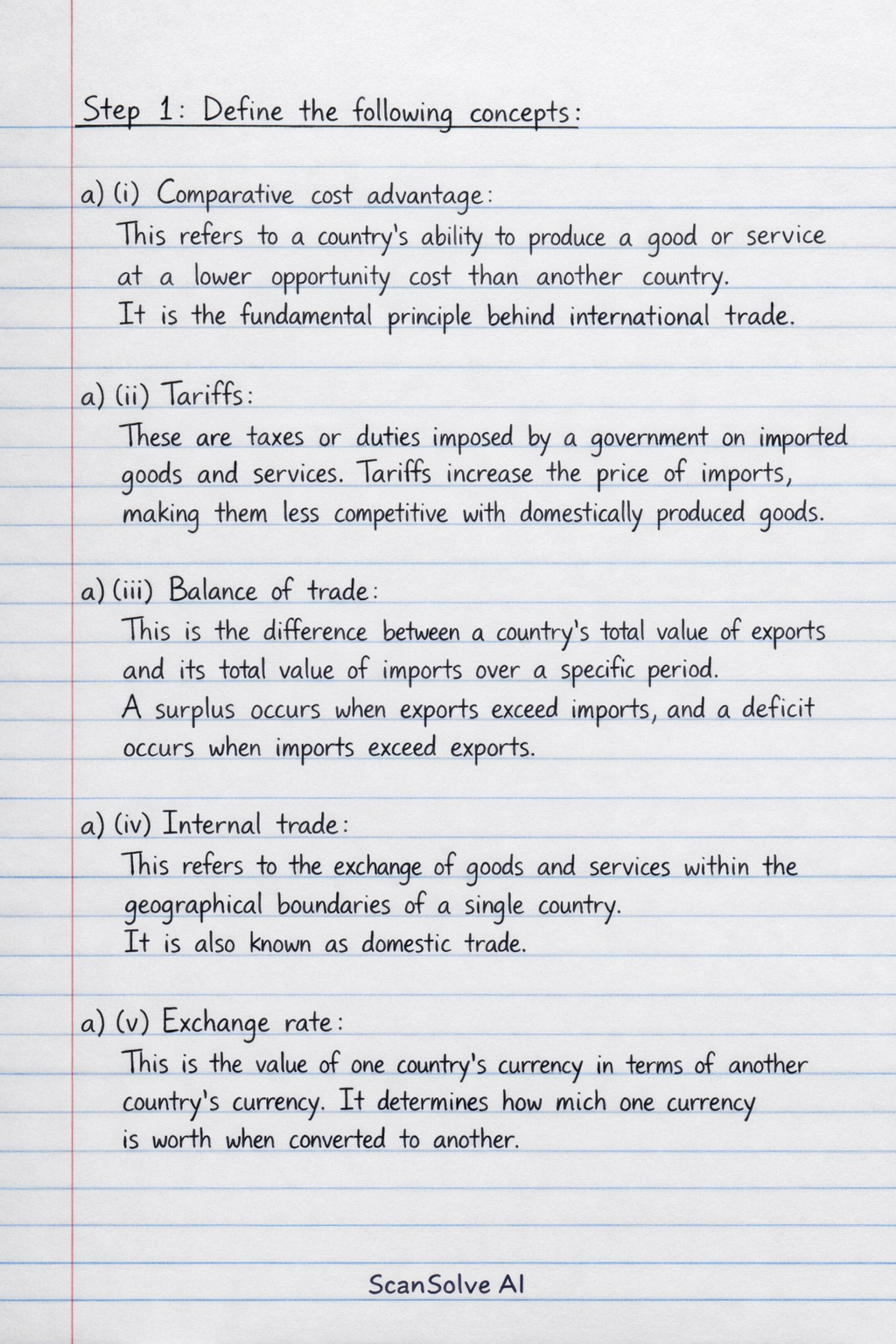
5 stepsDefine the following concepts.
-
a) (i) Comparative cost advantage: This refers to a country's ability to produce a good or service at a lower opportunity cost than another country. It is the fundamental principle behind international trade.
-
a) (ii) Tariffs: These are taxes or duties imposed by a government on imported goods and services. Tariffs increase the price of imports, making them less competitive with domestically produced goods.
-
a) (iii) Balance of trade: This is the difference between a country's total value of exports and its total value of imports over a specific period. A surplus occurs when exports exceed imports, and a deficit occurs when imports exceed exports.
-
a) (iv) Internal trade: This refers to the exchange of goods and services within the geographical boundaries of a single country. It is also known as domestic trade.
-
a) (v) Exchange rate: This is the value of one country's currency in terms of another country's currency. It determines how much one currency is worth when converted to another.
-
Calculate the terms of trade for 2019 and 2020.
The formula for terms of trade is:
-
b) (i) For 2019: Index of Export Prices = 98 Index of Import Prices = 98
-
b) (i) For 2020: Index of Export Prices = 100 Index of Import Prices = 125
-
State whether the terms of trade for 2019 and 2020 are favourable or unfavourable.
-
b) (ii) For 2019: The terms of trade are 100. This means that the country can obtain the same amount of imports for a given amount of exports as in the base period. Therefore, it is neither favourable nor unfavourable.
-
b) (ii) For 2020: The terms of trade are 80. This means that the country can obtain fewer imports for a given amount of exports compared to the base period (or 2019). Therefore, it is unfavourable.
-
Explain three reasons why countries are involved in international trade.
-
c) (i) Comparative Advantage: Countries engage in international trade because they can specialize in producing goods and services where they have a lower opportunity cost. This allows them to produce more efficiently and then trade for goods they produce less efficiently, leading to overall greater output and consumption for all trading partners.
-
c) (ii) Access to Diverse Goods and Services: No single country can produce all the goods and services its population desires or needs. International trade allows countries to access a wider variety of products, including those that cannot be produced domestically due to lack of resources, technology, or climate.
-
c) (iii) Economies of Scale: Specialization in production for a larger international market allows firms to achieve economies of scale. By producing larger quantities, firms can lower their average costs of production, which can lead to lower prices for consumers and increased competitiveness in global markets.
-
List any four measures a country can use to remedy a balance of payment deficit.
-
d) (i) Devaluation or Depreciation of Currency: Reducing the value of the domestic currency makes exports cheaper for foreign buyers and imports more expensive for domestic consumers, thereby encouraging exports and discouraging imports.
-
d) (ii) Deflationary Policies (Fiscal and Monetary): Implementing policies such as increasing interest rates (monetary policy) or reducing government spending and increasing taxes (fiscal policy) can reduce aggregate demand, which in turn lowers the demand for imports.
-
d) (iii) Import Controls: Governments can impose direct restrictions on imports through measures like tariffs (taxes on imports) or quotas (limits on the quantity of imports). This reduces the outflow of currency for foreign goods.
-
d) (iv) Export Promotion: Governments can implement policies to boost exports, such as providing subsidies to exporting industries, offering tax incentives, or engaging in trade agreements to open up foreign markets for domestic products.
-
Still stuck on this one?
Ask a follow-up, and the answer starts from this question.
More Economics Questions
Handwritten Step-by-Step Solution
Get this as a handwritten image on WhatsApp — like a tutor wrote it for you.
Try on WhatsApp