
We read your photo as:
Compare and contrast perfect competition and monopoly. Explain how a monopoly determines its profit-maximizing price and output.
ScanSolve AI Answer
Step-by-step solution
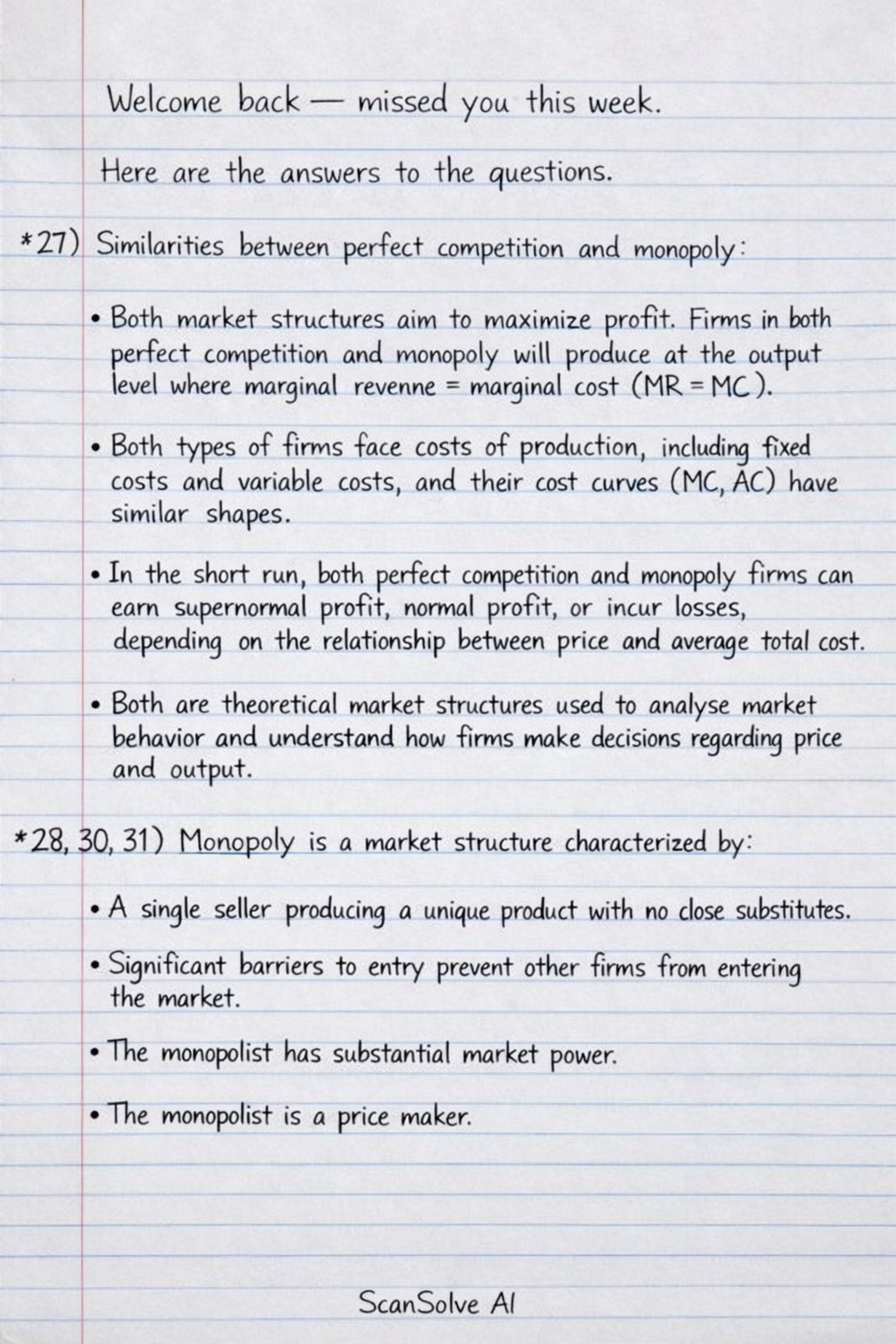
9 stepsHere are the answers to the questions.
27) Similarities between perfect competition and monopoly:
- Both market structures aim to maximize profit. Firms in both perfect competition and monopoly will produce at the output level where marginal revenue equals marginal cost ().
- Both types of firms face costs of production, including fixed costs and variable costs, and their cost curves (MC, AC) have similar shapes.
- In the short run, both perfect competition and monopoly firms can earn supernormal profit, normal profit, or incur losses, depending on the relationship between price and average total cost.
- Both are theoretical market structures used to analyze market behavior and understand how firms make decisions regarding price and output.
28, 30, 31) Monopoly is a market structure characterized by a single seller producing a unique product with no close substitutes, and significant barriers to entry prevent other firms from entering the market. The monopolist has substantial market power and is a price maker.
In a monopoly market, equilibrium price and output are determined in the short run using the Marginal Revenue (MR) and Marginal Cost (MC) approach.
The monopolist determines the profit-maximizing output level where marginal revenue () equals marginal cost ().
That is, .
Once the profit-maximizing output quantity () is identified, the monopolist sets the price () by finding the corresponding point on the demand curve (which is also the Average Revenue, , curve).
Since the monopolist is the sole producer, the market demand curve is its demand curve.
The monopolist's profit is determined by the difference between total revenue () and total cost (), where is the average total cost at output .
If , the firm earns supernormal profit. If , it earns normal profit. If , it incurs a loss.
(Note: A diagram would typically illustrate this by showing the downward-sloping demand (AR) curve, a steeper MR curve below it, and the U-shaped MC and ATC curves. Equilibrium output is where MC intersects MR, and the price is read from the demand curve above this output.)
29, 32) Perfect competition is a market structure characterized by a large number of buyers and sellers, homogeneous products, perfect information, free entry and exit, and no individual firm having the power to influence the market price. Firms in perfect competition are price takers.
In a perfect competition market, equilibrium price and output are determined in the short run using the Marginal Cost (MC) and Marginal Revenue (MR) approach.
Each firm in a perfectly competitive market faces a perfectly elastic demand curve, meaning the price () is constant and equal to marginal revenue () and average revenue ().
Thus, .
The firm determines its profit-maximizing output level where marginal cost () equals marginal revenue ().
Since , this condition becomes . The firm will produce at the output quantity () where intersects (and ).
The firm's profit is determined by the difference between total revenue () and total cost (), where is the average total cost at output .
If , the firm earns supernormal profit. If , it earns normal profit. If , it incurs a loss.
(Note: A diagram would typically illustrate this by showing a horizontal demand (P=MR=AR) curve, and the U-shaped MC and ATC curves. Equilibrium output is where MC intersects the P=MR=AR line.)
NUMERICAL QUESTIONS
1) Given:
Total Revenue ()
Total Cost ()The formula for total profit () is Total Revenue minus Total Cost.
Substitute the given expressions for and into the profit formula.
Distribute the negative sign to all terms in the total cost expression.
Combine like terms ( terms, terms, and constant terms).
The total profit is .
Still stuck on this one?
Ask a follow-up, and the answer starts from this question.
More Economics Questions
Handwritten Step-by-Step Solution
Get this as a handwritten image on WhatsApp — like a tutor wrote it for you.
Try on WhatsApp