
We read your photo as:
Explain creeping inflation and hyperinflation. Differentiate between a commercial bank and a central bank. Classify the motives for the demand for money given.
ScanSolve AI Answer
Question 1
a)
-
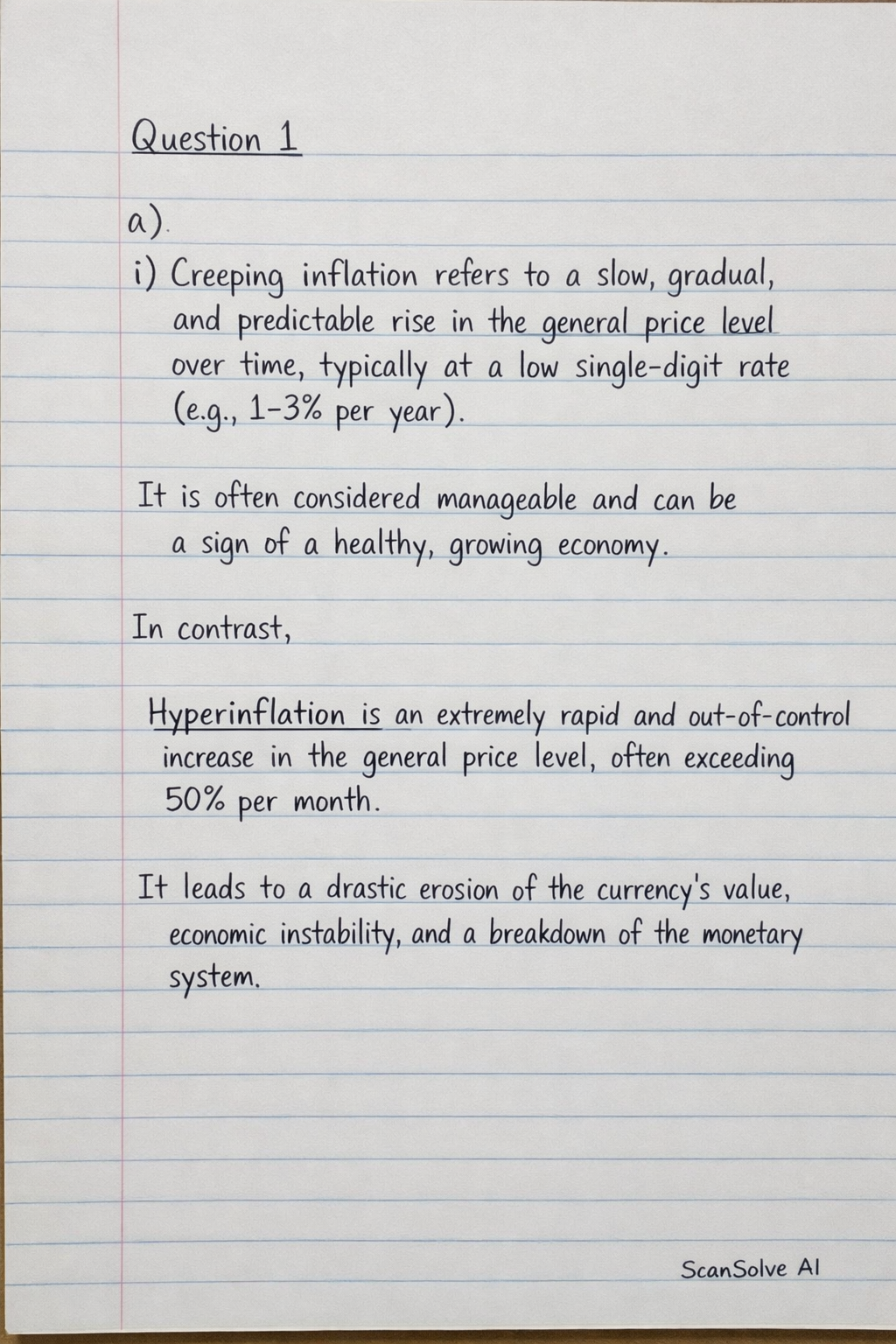
i) Creeping inflation refers to a slow, gradual, and predictable rise in the general price level over time, typically at a low single-digit rate (e.g., 1-3% per year). It is often considered manageable and can be a sign of a healthy, growing economy. In contrast, hyperinflation is an extremely rapid and out-of-control increase in the general price level, often exceeding 50% per month. It leads to a drastic erosion of the currency's value, economic instability, and a breakdown of the monetary system.
-
ii) A commercial bank is a financial institution that provides banking services to individuals and businesses, such as accepting deposits, making loans, and facilitating payments. Its primary objective is to generate profit for its shareholders. A central bank, on the other hand, is a national financial institution responsible for managing a country's currency, money supply, and interest rates. It acts as a banker to the government and commercial banks, supervises the banking system, and aims to maintain economic stability rather than profit.
b) Classification of motives for the demand for money:
- Keeping cash to meet medical emergencies: Precautionary motive
- Firms keeping money to buy raw material: Transactions motive
- Money held to pay transport fares: Transactions motive
- Keeping money to buy bonds when interest rates rise: Speculative motive
c) Three measures monetary authorities may use to increase the supply of money in the economy:
- Lowering the Discount Rate (or Policy Rate): The central bank can reduce the interest rate at which commercial banks borrow from it. This makes it cheaper for commercial banks to obtain funds, encouraging them to borrow more and, in turn, lend more to the public, thereby increasing the money supply.
- Reducing the Cash Reserve Ratio (CRR): The central bank can lower the percentage of deposits that commercial banks are legally required to hold as reserves. This frees up more funds for commercial banks to lend out, expanding their capacity to create credit and increasing the overall money supply in the economy.
- Buying Government Securities (Open Market Operations): The central bank can purchase government bonds and other securities from commercial banks or the public in the open market. When the central bank buys these assets, it pays with newly created money, which then enters the banking system, increasing bank reserves and the money supply.
d) Four roles of the stock exchange:
- Facilitates Capital Formation: It provides a platform for companies to raise long-term capital by issuing new shares and bonds to investors, which funds their expansion and investment projects.
- Provides Liquidity: The stock exchange allows investors to easily buy and sell existing securities, converting their investments into cash when needed, thus providing liquidity to financial assets.
- Mobilizes Savings: It encourages individuals and institutions to save by offering investment opportunities in various securities, channeling these savings into productive economic activities.
- Indicates Economic Health: The performance of the stock market often serves as a barometer of the overall economic health and investor confidence in a country.
Still stuck on this one?
Ask a follow-up, and the answer starts from this question.
More Economics Questions
Handwritten Step-by-Step Solution
Get this as a handwritten image on WhatsApp — like a tutor wrote it for you.
Try on WhatsApp