
This economics question tests your understanding of economic models and analysis. The step-by-step answer below applies the relevant framework and explains the reasoning.
ScanSolve AI Answer
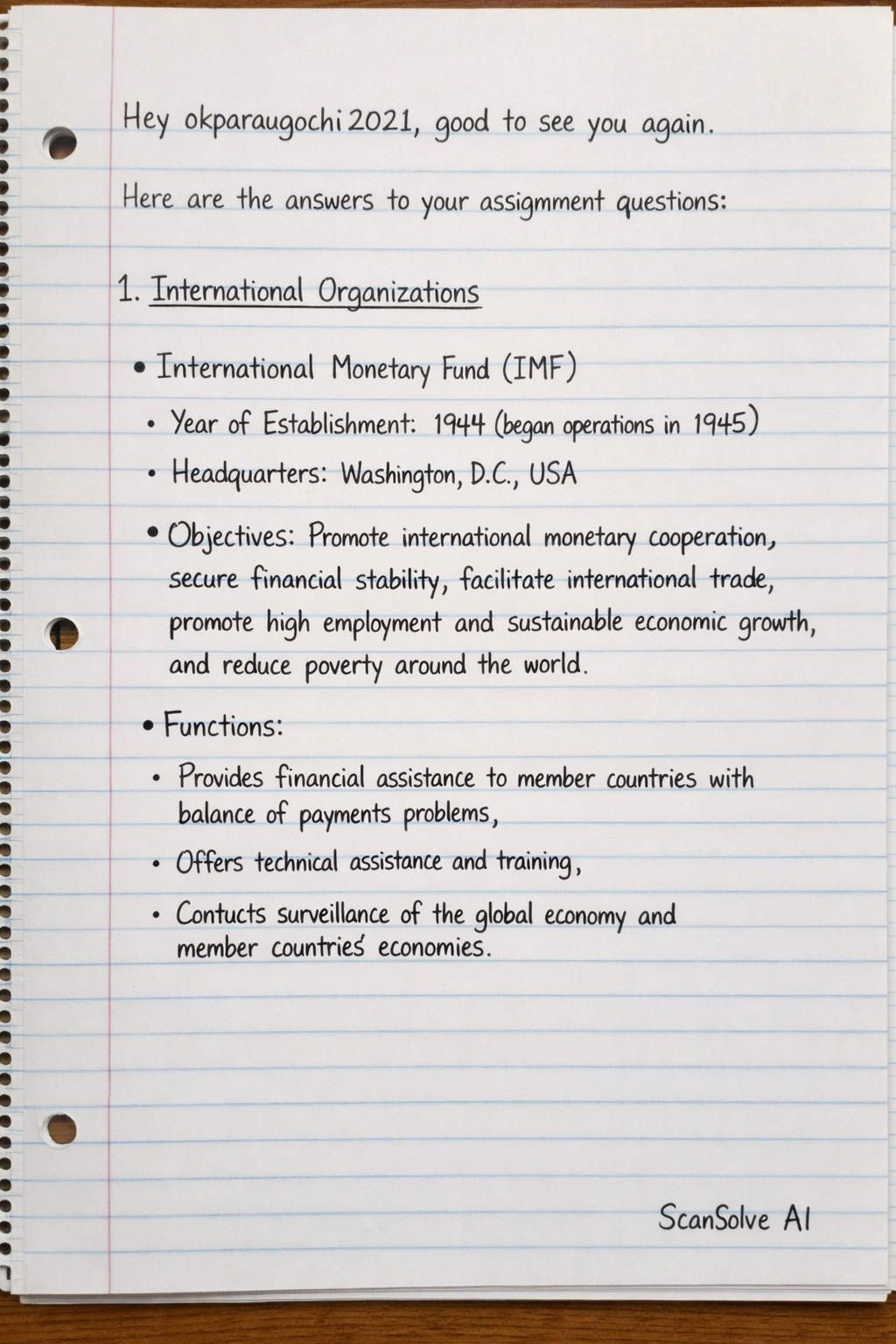
Here are the answers to your assignment questions: 1. International Organizations • International Monetary Fund (IMF) Year of Establishment: 1944 (began operations in 1945) Headquarters: Washington, D.C., USA Objectives: Promote international monetary cooperation, secure financial stability, facilitate international trade, promote high employment and sustainable economic growth, and reduce poverty around the world. Functions: Provides financial assistance to member countries with balance of payments problems, offers technical assistance and training, and conducts surveillance of the global economy and member countries' economies. • World Bank Group (specifically IBRD - International Bank for Reconstruction and Development) Year of Establishment: 1944 (began operations in 1946) Headquarters: Washington, D.C., USA Objectives: Reduce poverty and support development by providing financial and technical assistance to developing countries worldwide. Functions: Provides low-interest loans, interest-free credits, and grants to developing countries for projects in education, health, infrastructure, communications, and other areas. • World Trade Organization (WTO) Year of Establishment: 1995 (succeeded GATT, established in 1948) Headquarters: Geneva, Switzerland Objectives: Ensure that trade flows as smoothly, predictably, and freely as possible. Functions: Administers existing trade agreements, acts as a forum for multilateral trade negotiations, provides a mechanism for resolving trade disputes, and offers technical assistance to developing countries to help them trade more. • United Nations (UN) Year of Establishment: 1945 Headquarters: New York City, USA Objectives: Maintain international peace and security, develop friendly relations among nations, achieve international cooperation in solving international problems of an economic, social, cultural, or humanitarian character, and promote respect for human rights. Functions: Coordinates efforts for economic and social development through various agencies (e.g., UNDP, UNICEF, WHO), provides humanitarian aid, and promotes sustainable development goals. 2. Differentiate between economic growth and development Economic growth refers to the quantitative increase in a country's real output of goods and services over time, typically measured by the increase in real Gross Domestic Product (GDP) or Gross National Product (GNP) per capita. It focuses on the expansion of the economy's productive capacity. Economic development, on the other hand, is a broader, qualitative concept that encompasses improvements in the overall well-being and living standards of a country's population. It includes not only economic growth but also advancements in human capital (education, health), income distribution, poverty reduction, infrastructure, environmental sustainability, and institutional changes. While growth is a necessary condition, development implies a more holistic transformation of society. 3. Major causes or determinants of economic development • Human Capital Development: Investments in education, health, and skills training improve the productivity and innovation capacity of the workforce. • Physical Capital Formation: Accumulation of infrastructure (roads, power, communication) and productive assets (factories, machinery) increases the economy's capacity to produce goods and services. • Natural Resources: Availability and efficient utilization of natural resources (land, minerals, energy) can provide a foundation for economic activity, though resource curse is a potential challenge. • Technological Progress and Innovation: Adoption of new technologies and fostering innovation lead to increased efficiency, new products, and higher productivity. • Institutional Framework: Strong and stable institutions, including good governance, rule of law, property rights, and effective financial systems, create a predictable environment for investment and economic activity. • Sound Economic Policies: Macroeconomic stability (low inflation, stable exchange rates), open trade policies, and appropriate fiscal and monetary policies encourage investment and growth. • Entrepreneurship and Private Sector Development: A vibrant private sector driven by entrepreneurial activity is crucial for job creation, innovation, and economic dynamism. • Access to Markets and International Trade: Participation in global trade allows countries to specialize, gain access to larger markets, and benefit from technology transfer. Send me the next one 📸