
We read your photo as:
Explain why Economics differ from natural sciences (b) Discuss the relationship between economic systems and income inequality?
ScanSolve AI Answer
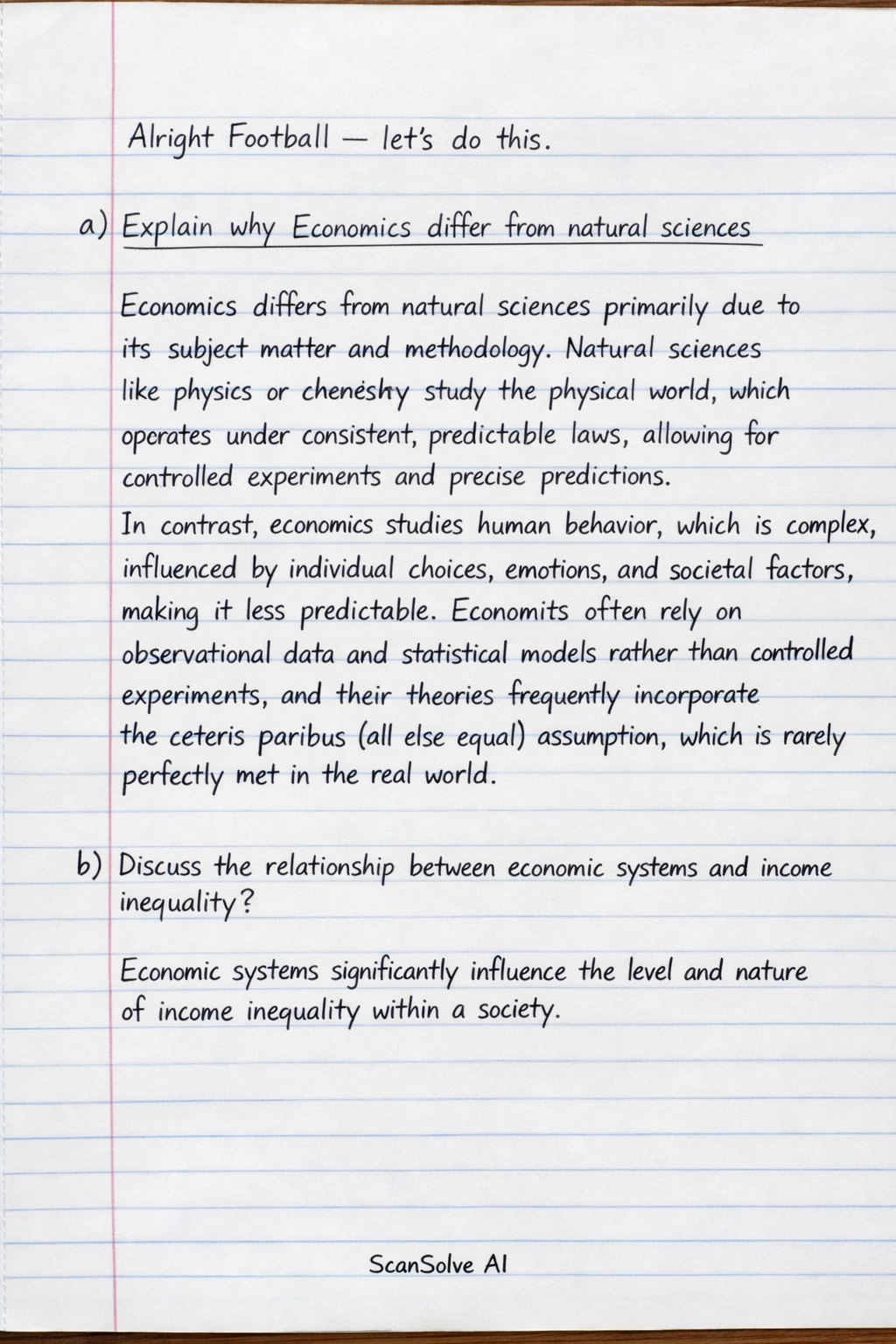
a) Explain why Economics differ from natural sciences
Economics differs from natural sciences primarily due to its subject matter and methodology. Natural sciences like physics or chemistry study the physical world, which operates under consistent, predictable laws, allowing for controlled experiments and precise predictions. In contrast, economics studies human behavior, which is complex, influenced by individual choices, emotions, and societal factors, making it less predictable. Economists often rely on observational data and statistical models rather than controlled experiments, and their theories frequently incorporate the ceteris paribus (all else equal) assumption, which is rarely perfectly met in the real world.
b) Discuss the relationship between economic systems and income inequality?
Economic systems significantly influence the level and nature of income inequality within a society.
- Market Economies (Capitalism): These systems, characterized by private ownership of resources and free markets, tend to exhibit higher levels of income inequality. Rewards are often based on individual productivity, capital ownership, and market demand, leading to significant disparities between high-skilled, capital-owning individuals and those with fewer skills or assets. While promoting efficiency and innovation, this system can exacerbate wealth gaps without government intervention.
- Command Economies (Socialism/Communism): In these systems, the government owns and controls most resources and means of production, aiming for a more equitable distribution of income and wealth. Central planning dictates wages and prices, often resulting in lower official income inequality compared to market economies. However, these systems can still have hidden inequalities related to access to goods, political power, and informal markets, and may sacrifice economic efficiency.
- Mixed Economies: Most modern economies are mixed, combining elements of both market and command systems. The degree of income inequality in a mixed economy depends heavily on government policies. Progressive taxation, social welfare programs, minimum wage laws, and public education can be used to mitigate the inequality generated by market forces, aiming for a balance between efficiency and equity.
Still stuck on this one?
Ask a follow-up, and the answer starts from this question.
More Economics Questions
Handwritten Step-by-Step Solution
Get this as a handwritten image on WhatsApp — like a tutor wrote it for you.
Try on WhatsApp